A new kind of Bucket List …

This guy makes a big deal of this ‘new approach’ to investing.

Recognizing that people are scared of the market right now [AJC: before they become irrationally exuberant, again, in the next upswing] instead of giving this guy 100% of your money to invest in crappy mutual funds …

… you only give him 80% πŸ˜‰

You put ‘the other 20%’ into The Bank, so that you have 2 years of cash to live off, and essentially ride the downswings.

I think that they’re hoping that by focusing on that yummy cash, you’ll forget to check what the market is doing, until you next go to top up your 2 year bucket.

OK, pre-retirement, 2 years living expenses is way too much to have aside. $0 is a better number.

Post retirement, I agree on the 2 year number (in fact, I recommend it); but, I don’t agree with his recommendations for the 80% bucket πŸ™‚

None of my friends know that I blog ;)

It’s true, I am the ultimate Secret Blogger …

… only two of my closest friends even know that I do blog – about personal finance – but, I won’t even tell them the name of my blog or my ‘pen name’!

[AJC: By now, you probably know that Adrian John Cartwood isn’t my real name – only the Adrian part is. For no reason that I can understand, my daughter started calling me ‘Adrian John Cartwood” when she was 7 … well, when the idea to write this blog sprang to mind in 2008, AJC was the natural choice!]

It’s not comfortable to talk about money: but, I resolved from Day 1 that this blog would need to be authentic and I would have to share the most gruesome details of my financial life.

So, when Bob asked:

From your β€œI’m a money hacker” post:

What is some financial advice you could give our readers?

Most people don’t really know how much house they can afford, so let me give your readers some very specific advice that will help them through every stage of their own financial journey: never have more than 20% of your Net Worth invested in your own house…

Do I understand from this post that $5M of your $7M net worth is in your own house?

… I can, from a position ‘protected’ by semi-anonymity, remind our readers that my $7 million journey represents a 7 year ‘slice’ of my financial life from when I started $30k in debt in 1998 and ended up with $7 million in the bank in 2004.

My recent ‘bad beat‘ post talks about what happened between 2008 and now πŸ™

But, the years in-between (i.e. 2004 to 2008) were very kind to me: dominated by a series of sales of my Australian, New Zealand, and US businesses to a UK public company … it was almost literally raining money for those years.

But, this is a personal finance blog, not a business blog, so I concentrate on the $7m7y because I believe that is repeatable by almost any of my readers.

Even so, my $5 million (cash) house certainly breaks the 20% Rule (my net worth would need to be $25m+) but, it doesn’t matter!

You see, the 20% Rule only applies when you are still chasing your Number!

When you have reached your Number (Making Money 301), THE RULES CHANGE:

Remember when you calculated your Number?

You:

1. Took your required annual living expenses (of course, adjusted for future inflation until your chose ‘retirement’ Date) and multiplied that by 20, and

2. ADDED in the value of your house (plus any additional cash required to pay off the mortgage), initial cars, and any other one-time purchases.

Once you reach your Number, you no longer require 75% of your Net Worth to be in investments: you ‘only’ require the amount that you came up with in Step 1.

So, you can buy as much ‘stuff’ (houses, vacation homes, cars, etc.) as you like with any extra cash that you happen to have!

For me, it doesn’t really matter how much house I bought, as long as I still have >$5m in investments, generating my annual living requirements.

So, Bob, you don’t have to worry about me … yet … I just like to complain πŸ™‚

How to save $1 million by 65? Who cares?!

The current state of American financial thinking is terrible, if this is the best advice that “a senior editor with Money Magazine” can come up with:

Question: I’m 28 and would like to have $1 million by the time I retire at 65. What are some of the investing options I should consider? –Joshua Sin, Fresno, Calif.

Answer: I’m all for savvy investing, and I’ll get to what I think you should do on that front in a minute. But let’s not forget that when it comes to building wealth, investing alone won’t do it. –Walter Updegrave, Senior Editor, Money Magazine.

Walter Updegrave, the author, then goes on to provide a very interesting analysis of how to come up with the $1 mill by 65 – basically saying that it can’t be done:

If you begin putting away $100 a month starting now and continue doing so until 2047, the year you’ll turn 65, you would need an annual return of roughly 13.5% a year to turn that monthly hundred dollars into a million bucks.

What investment options can deliver a 13.5% annual return for almost 40 years? None that I know of.

True. Correct. Perhaps, Insightful.

But, I’ve said it before and I’ll say it again: who in their right mind cares?

Hasn’t Walt forgotten to ask the key question … why???!!!

Joshua is to be commended for thinking so far ahead, at the age of 28, towards retirement. But, shouldn’t our financial expert’s first step be to examine if the objective is reasonable?

Let’s give it a shot:

Choosing a much more reasonable go-forward inflation rate of 3.5% …

[AJC: The author assumed “a modest 2.5% inflation rate”; that’s just UNDER the current outlook for the next 5 years, pulling out of a major global recession … but, I wouldn’t bet FOR a 40 year recession, if I were planning my own retirement!]

… by the time Joshua turns 65 that $1 million will only be worth $268k.

What does that mean?

It depends on what Joshua does with the money; however, given that his 37 year financial strategy has been simply to ‘save’ (presumably via CD’s, Bonds, Mutual Funds, and the like), I guess we need to assume that he will continue that strategy in retirement.

Therefore, Joshua will have little choice but to abide by the ‘advice’ of the financial planning community, which will be centered around finding a ‘safe withdrawal rate’; a great way to find out what that might be for Joshua, is to plug his $268,000 nest-egg into the T. Rowe Price Retirement Calculator:

Now, what annual income would be reasonable for somebody like Josh to aim for in retirement? $150k a year? $75k a year?

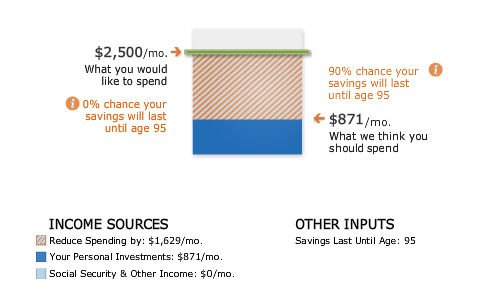
Let’s just say that he aims for $30,000 a year or $2,500 (before tax!) per month in today’s dollars; how well does he do with his $1,000,000?

Not very:

[AJC: PLUS whatever social security there may happen to be in 37 years time … how optimistic are you?!]

Do you think that Josh would have been more surprised to learn that:

a) he would need to average 13% p.a. on his savings to reach $1 mill, or

b) even if he made it all the way to his $1 mill. target, he would only have $871 per month to spend?!

Our readers represent a small but keen-to-learn cross-section of people interested in the subject of personal finance;Β  let’s tell the financial services, advice, and publishing industries:

What sort of financial advice are you looking for?

Go ahead, leave a comment – especially if you’ve never done so before – and, we’ll challenge them to respond!

Spend More To Invest More?

How do you redeem your credit card points?

View Results

Loading ... Loading ...

[You may select more than one option]

Our last foray into the world of credit cards pulled up an array of options around using the points generated; for example, MikeΒ  says that he:

Usually pockets the cash back but flying in the A380 Suites are always nice.

And, Investor Junkie uses the points to generate extra cash to invest:

Instead of Best Buy cards, it deposits directly into my Fidelity account.

A popular option, I’m sure, would be to ‘fly them off’ (as I do). On the other hand, Costco gives cash rebates (which we also enjoy). But, I would be interested to see how our readers currently redeem their credit card reward points?

Since you probably have multiple cards, I’ve allowed multiple options on this Reader poll, but just choose the one or two that you mostly figure on using?

Once you have made your selection/s, please read on ….

I wonder, though, where the best bag for buck (almost literally) comes from? I mean, each rewards program must have some sort of formula as to how they convert every dollar that you spend into points, then a more complicated formula (with different weightings, I’m guessing) to convert those points into the cash and/or airline miles and/or other stuff that they need to ‘buy’ to give to you.

But, I’m guessing that those weightings are NOT equal; so what is a more ‘efficient’ (or is that ‘effective’?) use for your points, for the credit cards that you have signed up for?

Using your points for:

1. Cash? Whether you direct it to your investing account, or just spend it.

2. More Stuff? Like Best Buy cards … I used to give the rewards to my employees (anything from bicycles to trips for 2, all paid for by redeemed rewards vouchers) in recognition for ‘above and beyond’ performance.

3. Airline Miles? I’m told that this is the best $$-for-point conversion that you can get … and, that redeeming your points for international flights outweighs domestic travel in terms of the ‘free value’ that you receive.

Since I fly a lot (esp. internationally), generally at my cost, this last option seems the best for me …

Logically, we should aim to get the most Usable Cash Value from our credit card points i.e. either cash, or something that we would convert into cash by using the points INSTEAD of using our own cash on something that we WOULD have spent cash on, anyway.

If it’s something that you would NOT have normally bought for yourself, then the Usable Cash Value is actually low [AJC: under my definition!].

Although, I am contradicting myself a little because I just ‘blew’ a whole heap of points on that First Class airline seat that I would never have bought for myself!

On the other hand, I am at the ‘other end’ of my financial journey, so what the hey πŸ˜‰

The Zero Dollar Emergency Fund …

If you own a boat that’s large, expensive, and is likely to take on water from time to time, you plan well ahead and put in a bilge pump.

But, if you have a dinghy and you’re paddling out on Lake Michigan, far away enough from shore to make swimming a poor second choice, then you carry a bucket … and, if the boat springs a leak (highly unlikely … it’s not a bad dinghy) or, water happens to come over the side from time to time …

… well, you start bailing water!

An Emergency Fund’s a little like that:

What you do depends on whether you expect the emergency [AJC: I know, it’s an oxymoron] or not. Of course, if you expect it – or, can reasonably foresee it (like problems with a beaten up old car), then it’s not an emergency at all … just something that you can’t budget an exact amount for.

But, you can provision for it; at least, as best you can.

But, true emergencies do arise – or, semi-expected events blow up bigger and/or sooner than you ‘expected’ – so what do you do?

Try and build up and emergency fund but not spend it even if a really great investing opportunity comes up [AJC: what’s the opportunity/cost of that?!]?

Or, why don’t you simply find a bucket of money that you can tap into IF an emergency arises … but, one that costs you zip (or, even makes you money) in the LIKELY event that an emergency does NOT arise.

Here are some examples of In-Case-Of-An-Emergency-Please-Break-The-Glass Funds:

1. A HELOC (home equity Line of Credit) that you put in place on your home ‘just in case’

Use an online mortgage calculator to make sure that you can borrow enough to cover your likely living costs + the repayments for as long as you think it will take you to get back on your feet and repay the loan. This is a pretty good, flexible option that only costs what you use.

The other advantage is that you should be able to raise a LOT more than you can save … and, it will be available as soon as you put the paperwork in place (a true emergency fund could take YEARS to save).

On the other hand – say, if you lose your job and the bank finds out – the HELOC may be revoked just when you need it the most … of course, if you’ve already drawn down the funds before the ‘pink slip’ is in your hands …. πŸ˜‰

2. Your 401k

There are usually provisions that allow you to borrow or withdraw funds against your Retirement Account; again, this may allow for ‘protection’ against fairly large emergencies (say, a few months off work), but it may come at a hefty opportunity cost … particularly, if the fund rules don’t allow for the funds to go back in on a tax-preferred basis, if you’ve managed to recover quickly enough.

Also, the tax and/or penalty interest costs may be quite high.

3. Your Car

Maybe you can do a sale and lease-back on your car .. or, maybe you can sell your car for cash and either use some of the proceeds to ‘trade down’ (therefore, freeing up some cash) or even make an exception to the “don’t finance a depreciating asset rule” by financing a (cheaper) one, instead (thereby, freeing up a lot more cash).

Remember, you’re really borrowing some money to tide you over in an emergency … you don’t expect to get out of it squeaky clean.

4. Credit Cards

Yep … this is the time that a bunch of credit cards sitting in a drawer can be really useful … but, it’s very expensive (19%+ p.a.) so make sure you only take this route for really short-term emergencies that you KNOW you can trade your way out of really quickly (i.e. less than a year).

5. The Three F’s

And … don’t forget that getting on your hands and knees and grovelling to your Friends, Family, or other associated Fools is also an option!

Anybody have any other true ‘Emergency Fund’ source ideas?

This will teach you all you need to know about marketing your product or service …

PAY CLOSE ATTENTION TO THE NARRATOR’S INSTRUCTIONS!

After you’ve seen the video, read on:

I said that if I found a video that was a real cracker, I would do one of my famous-in-my-own-lunchtime Videos on Sundays …

… well, I found this one on Youtube.

In fact, it’s the exact same video that I used to show students of our training division (before I gave it away to my ex-business-partner).

If you want to learn about WHY this works and HOW you can use these concepts in your own marketing, read Ramit Sethi’s spot-on post:

http://www.iwillteachyoutoberich.com/blog/why-personal-finance-experts-continue-writing-worthless-advice/

But, first be sure to let me know what you thought of this video!

Suffer any bad beats lately?

I have to admit that it’s very exciting seeing my two real-estate development projects coming to fruition [AJC: this is the architect’s rendition of just one of my two condo projects … click on the image to enlarge it … go ahead … do it … I’ll love you for it].

I’ll get back to that in a sec’ …

… first, let me tell you about a conversation that I just had with a friend, while we were playing poker today:

FRIEND: Do you find any parallels between business and poker?

AJC: It’s uncanny, but yes I do … and, it’s caused me to totally rethink the way that I think about money

Well, not so much ‘totally rethink’ as remind me about some important Making Money 301 lessons that I seem to have forgotten …

…. but, I keep getting side-tracked; back to the poker:

Case in point: I had quickly tripled my starting stack in a cash game but, just as quickly lost it on a series of bad beats; bad calls (by them, not me); and bad luck.

When you’re running hot, you feel invincible.

When you’re running cold, nothing that you do turns out right.

… and, your poker bankroll quickly slips away.

Well, it’s pretty much the same thing in business and personal finance:

Your investments and/or businesses are ‘on fire’ … the market’s running hot, and – if you’re smart – you cash out at the peak, building up quite a bankroll.

Maybe you even reach your Number.

What should you do then? STOP and smell the roses!

But, the trouble is, greed and the adrenalin kicks in … you believe that you’ve got the Midas Touch. And, you push for the next project.

… and, that’s the one that gets you.

You know, market downturn, bad luck, bad advisers, etc., etc. sob, sob, sob.

Which is, perhaps, why Ill Liquidity asked me:

I don’t get it. You make a tidy sum and retire from the rat race, paying yourself a salary… why go forth and try new money making ventures?

Given my own ‘stop and smell the roses’ advice in that regard, I agree, it’s hard to understand. Sometimes, it’s even hard for me to understand πŸ˜‰

So, let me take a stab at explaining it; the story so far:

I made my $7 million in 7 years (mainly through reinvesting the profits of my businesses into buy/hold real-estate), and then made a heap more (by selling those businesses just before the 2008 crash), but ….

… then the crash hit, and here’s where my money went:

1. $1.5 million cash into my house in the US (you know I can’t sell that, right?)

2. $5 million cash into my house in Australia

3. 25% of what I sold the businesses for in taxes [AJC: sheesh!]

4. Lost 100% of my $3 million bonus on company stock price crash + taxes paid on the full $3 million [AJC: double sheesh! … but, it’s nice to know that I have a heap of capital gains tax credits to use for the rest of my life]

5. Gave my accountant $1 million to invest in the Aussie stock market for me … he promptly lost 75% in about 6 weeks. My fault for trying to time the market, not his πŸ™

Don’t feel too sorry for me: when others try to get to sleep by counting sheep, I count millions!

My problem is this:

All of this bad luck and bad management has left me with assets – not including my $5 million primary residence – that I consider just enough to live my Life’s Purpose.

But, I am an ΓΌber-pessimist and I really want a large margin for error.

Now, in my rational moments, I realize that my house provides me that i.e. as soon as the kids move out, in approx. 10 to 15 years, we will sell down into a, say, $2 million apartment, which would free up another $3 million (all in today’s dollars, but the price differential should still hold true).

But, even that’s not good enough for me.

So the question that I am wresting with – and, have decided to put off answering until I have building permits for both projects in my hands:

Will I take my own advice and sell both development sites (with permits) for a tidy profit (if all goes well), or will I pull the trigger and dump most of my net worth into these developments to get the Really Big Bucks?

Only time will tell … but, you will be amongst the first to know πŸ™‚

In the meantime, have you suffered any ‘bad beats’ lately?

Riding the profitability curve …

Take a look at the chart on the left … yes, the one that I’m busy drawing for you πŸ˜‰

… because, if you’re in business – or aspire to be – whether online or offline, this is a lesson that you simply have to ‘get’ … and, early:

For those of you who have been to business school, there is a space between the sales [blue] and expense [red] lines called PROFIT.

Profit is for growing the business and returning value to the shareholders.

But, in a small business it’s mostly known as OWNERS’ SALARY, because the owners live off this instead of taking a wage … and, it’s usually (barely) enough to fund their ever-growing (assuming the business is becoming more and more successful) lifestyle.

Instead, it should be known as CAPITAL.

You see, large businesses (particularly publicly listed ones) find it easy to raise capital: they simply issue stock.

They trade bits of paper (stock) for more bits of paper (cash) to go ahead and do all the things they need to do in order to expand their businesses (e.g. buy new machinery, open new branches, fund acquisitions).

But, small business owners can’t do that … it’s very hard to raise money as a small business owner, for anything … including expansion.

So, my advice is to fund your own expansion, by retaining profits (instead of spending them on yourself) and using those retained profits to grow the business.

There’s your capital!

Fellow Aussie and business/success coach, Jon Giaan (knowledgesource.com.au) similarly advises aspiring business owners:

When starting a business, most people focus on generating income and lose sight of their long-term goal of having a successful and ‘sustainable’ business that will provide freedom, independence, wealth and support many years into the future. Keep focused on building a long-term asset.

No doubt this is true; Maslow’s Hierarchy puts food/shelter/clothing right at the top …

But, once your business has grown to supporting those needs, your mind starts to look at wants, and before you know it, you NEED your business just to survive mortgage payments, expensive car leases, private school/coach/country club fees, and the list goes on.

Right from the beginning, we had a different view, one that saw the owners of an [eventually] profitable business jointly deciding that the partner not working in the business – my wife – still needed to work her $60k – $90k per year ‘day job’ (as an IT Project Manager with a major telco).

The reason was exactly as Jon says: we wanted to keep “focused on building a long-term asset”.

We knew that it was only by reinvesting the cashflow produced by the business – both within (reinvesting in the business) and without (buying good quality buy/hold real-estate and other investments) that we would eventually reach our Number.

[AJC: Right there, in a nutshell is how we reached $7m7y: use the cashflow from the business to invest instead of spend. A side benefit being that we didn’t need to rely on the ongoing success and/or sale of the business to reach our Number. Too easy, huh?]

In fact, we eventually blew our first $7m7y out of the water … but, that’s a whole, other story πŸ™‚

Panning for gold …

[BEGIN Message from our Sponsor]

Some minor changes to the 7million7years format:

Previously, I had been trying to post to a Monday/Wed/Thur schedule PLUS a video on Sunday. Unless I really find a video that knocks my socks off, I’m going to drop my Sunday video (for now) and shift my posting schedule to Mon/Wed/Fri each week.

I should also point out some key differences between this free blog and my paid membership site (7m7y.com): my blog (i.e. the site you are on right now) is much more ‘chatty’ and random than my membership site; my blog simply reflects my thoughts, feelings, and experiences gleaned from my own journey from $30k in debt to $7 million the bank in 7 years.

My journey – hence, what I share on this blog – is absolutely authentic and I believe that there is real gold to be gleaned simply by reading this blog 3 times a week.

IMHO, it’s the best 6 minutes that you’ll spend each week, besides your love life πŸ˜‰

I liken reading this blog regularly to wading in a shallow stream and panning for gold: stand there long enough and you get what you need and, hopefully, enjoy yourself in the process. But, don’t expect instant results …

On the other hand, my NEW membership site (The $7 Million 7 Year Wealth System) is a complete course on wealth; if you’re a regular reader of this blog you’ll immediately recognize the main modules (Finding Your Number, Making Money 101, Making Money 201, and Making Money 301) but it’s covered to a depth that this blog simply doesn’t – and, can’t – go.

And, I’m building it to be a true step-by-step course to fulfiling YOUR financial destiny.

BUT, I don’t advertise on this blog, so the only way you’ll hear more about the course, is by subscribing to my free MONTHLY newsletter – using the form in the right-hand side-bar [see right ====>].

[END Message from our Sponsor] πŸ˜›

There IS an entrepreneurial bug!

This post has been featured in the Carnival of Wealth: http://personaldividends.com/news/admin/carnival-of-wealth-august-7-2010-edition

________________

People often say that they have been “bitten by the entrepreneurial bug” … and, I can say that is perfectly true!

I always wanted to be a ‘millionaire by 30’, but I missed my first million and jumped straight to making my 7th by the time I was 49 πŸ˜‰

But, that did not translate directly into wanting to be an entrepreneur; in fact, I was working for a Fortune 10 company and happily dreaming about becoming its CEO (“one day”) …

… apart from one or two disastrous years, I had a charmed time there, winning ‘bonuses’ left, right, and center – and, traveling around the world on the corporate budget, having the time of my life.

But, that all changed by Work Year 6.

Suddenly – and, I mean suddenly and inexplicably – I was struck with the desire to be in my own business. Almost literally, I was bitten by the entrepreneurial bug!

From that point on, I was miserable in my job … I schemed and planned my way to a myriad business ideas that I couldn’t quite translate into a real business.

In the end, I wimped out and joined IDB.

Yep, the Great Entrepreneur was In Dad’s Business!

Thankfully, that business promptly went broke leaving me with nothing but a $30k debt and a customer list, which I turned into a ‘cloned’ business (i.e. same customers, same concept, very similar name) that I still own, nearly 20 years later. And that business helped to fund the ‘other business’ that took me to the USA.

So, I guess I found the true Entrepreneur Within, after all …

But, what I wanted to share was my thought process, all those years ago when I was still at my ‘desk job’:

I wanted to be in business, and all I knew was IT (information/computer technology), so here were the choices that I came up with:

1. Consulting: as I mentioned in passing, in a recent post, I was something of a ‘world expert’ in my little niche so consulting was a natural first choice for going it alone. But, I realized that I would still be trading hours for dollars.

The formula is (from memory) 1440 possible working hours of the year – hours lost due to marketing, administration, and time off x billable rate = MAXIMUM total revenue. Plug any number in that you like, and it doesn’t add up to $7m7y.

2. Sell something: The only thing I knew how to sell was computers, and the only ones of those that I would likely be able to get a licence to sell would be PC’s. Unfortunately, I could see a price war and shakeout happening which would crush the small guys (this certainly happened).

3. Build something to sell: Again, the only thing that I knew was software: I could develop a piece of software and sell it. Unfortunately, every piece of software has a lifecycle … when the better one comes along, I’m toast.

There was my dilemma …

Fortunately for the world, Mr Price and Mr Coopers didn’t think about the consulting equation before starting PWC (one of the world’s biggest consulting companies before selling off to IBM).

Equally fortunately, Steve Jobs didn’t worry about costs and margins when creating the Apple 1 and 2 – then Lisa and Macintosh – computers and offering them to the world.

Perhaps unfortunately for the world (if you’re a M$-basher), Bill Gates didn’t think about obsolescence before licencing his piece of of software to IBM, then others.

Bottom line: if you’re passionate about an idea, give it a go … you’ll find a way to make money if the idea is good enough. If not, what you learn will be worth the ‘cost’ in lost time/money.