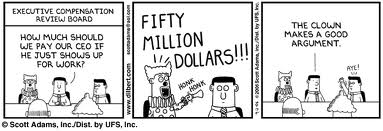
This is not just a provocation … I think it’s true.
It may not be true in some technical professions: think of a doctor or an accountant … you pay for advice and you expect it to be good (after all, she’s got a PHD right?).
Even then, how do you know it’s good advice?
After all, in most cases, you’re hardly expert enough to judge
Should you be worried?
Not unduly. After all, those articles about the accountant who diddled his clients books is something that you only ever read about. It never happens to you. Right?

What about the guy in the picture to the left? Would you go to him for advice on a healthy lifestyle?
The picture is of a statue, but it bears an uncanny resemblance to a doctor-friend of mine, whose picture I can’t show for obvious reasons; he’s actually a top vascular physician and surgeon.
So, best case, quality of advice is difficult to determine.
But, it’s downright impossible to pay for good, personalized financial (or business) advice!
A simple example: if you want to grow a successful business, can you pay a consultant to tell you how?
Of course not! If they knew the ‘secret’ to building a truly successful business, they would be busy doing it for themselves.
The best you’ll get is some clown offering cheap advice
Let’s try personal finance: people ask me how to select a good financial advisor:
The first thing that I ask them is how much money they want (and, by when)?
The answer is usually $7m7y (or, some other large Number / soon Date).
The next thing that I ask is how much of their own money their chosen advisor has made following the same recommendations that he is giving to them?!
I made $7million in 7 years, but it’s impossible for you to pay me for advice; I give it away … because I want to.
Still not sure?
OK, let’s say you want to invest in stocks.
Who do you want to pay for advice: (a) somebody who’s read about investing in stocks, or (b) somebody who’s made a lot of money investing in stocks?
If (b), why are they taking paltry fees from you?
Oh I see … they aren’t just taking fees from you, they have a managed fund. They’re not really taking money for advice, rather earning a fee for running the business of managing a huge bucket of money (including your tiny drop).
Even so, let me ask you another question:
Who do you want to pay to manage your money: (a) somebody who’s made a lot of money investing in stocks?, or (b) somebody who’s made the most money investing in stocks?
If (b), then who’s made the most money investing in stocks?
Obviously, it’s Warren Buffett (with George Soros a good second … but, if you said John Bogle you fail because he made money through his business of selling his low cost index funds to the masses, not from investing his own money in them).
So, if you want to invest in stocks, you can’t buy the right advice, because nobody’s selling … and, if you want to invest in some kind of fund you can’t pay for the best advice available …
… but, you can tap into that advice for ‘free’ just by buying Berkshire Hathaway stocks.
If I wasn’t going to manage my own money – listening to plenty of ‘advice’ but, ultimately taking my own counsel – that’s what I would do!

Unfortunately, life isn’t all about how much money you have.
When an earthquake hits, it matters not the size of your bank account.
Having nothing at all to do with personal finance, I thought I would tell you about a conversation that I had on Wednesday:
I met a couple who were travelling from – more like escaping from – Christchurch, New Zealand.
They had been living through the devastation there from last week’s earthquake, now horrifically overshadowed by the series of natural (and, man-contributed) disasters in Japan.
First, he told me that he lived the the horror of driving from work when the quake hit. His car was shaken badly, the suspension magnifying the effects of the quake, rather than my expectation that the shock-absorbers would diminish the effects.
He watched a 7-story building sway like a palm tree, then a rising cloud of ‘smoke’ which he soon realized was the total collapse of a much older building behind. He then was witness to a man being killed as a piece of concrete fell off a building and hit the car behind.
‘My man’ was lucky enough to escape unhurt.
But, he really brought home the magnitude of such a disaster, that extends far beyond the terrible news reports of deaths, with these two anecdotes:
1. He knew a young lady who was engaged to be married. She was caught in a building during the quake and escaped with her life but lost three limbs.
2. One family – lucky enough to escape any physical injury – is being torn apart by psychological injury as mother and son escape to Auckland, too scared to return to Christchurch which has suffered over 4,000 earthquakes in the past 6 months. Their husband/father remains in Christchurch where his business / livelihood has miraculously survived. Even the damage to their home is repairable, but their family life is not.
These two small stories bring home to me the devastating effects on lives and families far beyond those who have died in disasters such as that in Christchurch … or, in Japan, a disaster 10 to 100 times as far-reaching as that in New Zealand.
I have no advice, other than to live your life because, on a cosmic – or, even natural – scale, money just doesn’t seem that important, does it?
Thanks to all of those who entered my SECOND $700 In 7 Days” Social Giveaway” … if you didn’t enter, or win a prize, then you MAY get one more chance: I’m thinking about running one more similar contest before Christmas.
I’ll tell you the reasons why in due course, but if you’re familiar with marketing, I’m kind of running some very expensive (for me) A/B split marketing tests for my ‘Top Secret Project’ …
Which brings me to our lucky five winners:
1st Prize of $350 cash (as selected by Random.org) goes to Marilyn (user name = mnihill) … congratulations!!
2nd Prize of $150 cash (for referring Marilyn to the contest) goes to Barbara (user name = barbara4)
3rd Prize of $100 cash (for referring Barbara to the contest) goes to Trisha (user name = twag700)
So, here’s how it worked: Trisha entered the contest after reading my announcement post and invited some friends to enter – and some of those friends invited their own friends. One of those ‘friends of friends’ was lucky enough to win the first prize, so Trisha won a 3rd prize for indirectly referring her. Barbara won second prize because she actually did refer the lucky winner!
Since that accounted for only $600 of the $700 that I promised, I did a separate draw for the $100 left, so here’s who won that:
4thPrize of $50 cash (as selected by Random.org) goes to Michael (user name = mdralph)
… since nobody referred Michael to the contest, I did one more random draw for the 5th – and, final – winner:
5th Prize of $50 cash (as selected by Random.org) goes to Marie (user name = lwarren26).
Congratulations to the winners: please contact me [ajc AT 7million7years DOT com], using the e-mails that you provided when you entered and either send me a PayPal invoice for the prize that you won (apparently, this is very easy to do and makes sure that I don’t make any mistakes and pay the wrong person!). If I don’t receive the required confirmations by the end of the week, your prize goes to charity!
Now, that you see how easy it is, I hope that you will enter the next contest, which – I promise – will be even easier next time (I just spent $270 to try yet another software contest package!)…
AJC.
P.S. Looks like names beginning with ‘M’ scooped more than half the pool
Speaking of the ‘more bug’ I want MORE people to enter my latest contest … so far, I have given away $1,300 in cash and gift cards as I test a new project that I’m working on.
My financial pain is your cash gain
It’s a new kind of contest and I’m running this as an experiment. NEW because not only do you get a chance to win the $350 First Prize (that’s CASH, transfered straight to your PayPal account), but …
Once you have entered, simply let your friends know the User Name that you chose, and when they enter (using your user name) and win a prize, so do you!
Now, here comes the twist: when they enter they will be able to invite their own friends, not only will they win a prize if one of their friends wins a prize, but SO WILL YOU.
Your chances of winning a prize (of $50, $150, or even the $350 first prize … all in cash) can easily be 7, 15, 27, 56, … or MORE than in any other type of giveaway contest!
Instructions: Choose a short User Name (eg “Steve12″) for yourself and enter AJC42 as the user name for the person who referred you (unless you already have a user name from a friend who referred you) then send this link http://7million7years.com/contest/ (+ your User Name instead of mine) to all of your friends (via e-mail, Twitter, and FaceBook) and let the fun begin!
This is my SECOND EVER “$700 In 7 Days” Social Giveaway”, just in time for Xmas … why ‘social‘?
In exactly 7 days I am giving away $700 cash with a $350 first prize and the remaining $350 split between whoever referred the winner to this page and who referred them and so on … There are NO CATCHES (other than I will only pay by PayPal transfer).
Barbara was the Lucky First Prize Winner of our first ‘$700 In 7 Days Social Giveaway’ (Steve and Trisha split the remaining prizes):
I just want to say thank you! WOW I am still in shock that I won the contest…. it was a great Thanksgiving Day Surprise. Congrats to both Steve and Trisha who won prizes as well.
All you need to do is ENTER for your chance to win your share of $700 cash in just 7 days (first prize is a cool $350), when I announce the winners exactly one week from today … simply enter your details below for your chance to win …
Instructions: Choose a short User Name (eg “Steve12″) for yourself and enter AJC42 as the user name for the person that referred you (only one entry per person; refer friends – giving them YOUR username for even more chances to win a cash prize, see below for details):
If you refer your friends using the link below and they enter USING YOUR USER NAME as the person who referred them (eg “Steve12″), then if they win a prize so do you!
After you sign up to join the $700 In 7 Days Giveaway, send (e-mail, tweet, facebook, etc.) your friends this invitation link: http://7million7years.com/contest/ + your User Name
Example: “I joined the $700 in 7 Days Giveaway, you can join too by visiting http://balloon.mit.edu (my User Name is Betty16)”
If anyone you invite, or anyone they invite, or anyone they invite (…and so on) win money, then so will you!
We’re giving $350 to the first User Name that we pull out of the hat, but that’s not all — we’re also giving $150 to the person who invited them. Then we’re giving $100 to whoever invited the inviter, and $50 to whoever invited them, and so on… until we have given away the ENTIRE $700!
It might play out like this:
Angie joins the giveaway contest, selecting the User Name “Angie52″. http://7million7years.com/contest/.
Angie then e-mails the link http://7million7years.com/contest/ + her User Name to Bob, who uses it to also join the contest. Bob enters, choosing the User Name “Bob11″, who posts the link http://7million7years.com/contest/ + his User Name to Facebook. His friend Charlie sees it, signs up, then twitters about http://7million7years.com/contest/ + her User Name. Dave clicks the link and uses Charlie’s User Name to join…
… then his name is pulled out of the hat!
Dave is the person who wins the main prize. Once that happens, we send Dave $350 via payPal for winning. Charlie gets $150 for inviting Dave, Bob gets $100 for inviting Charlie, and Angie gets $50 for inviting Bob. The remaining $50 is donated to charity.
Easy and fun to win!
Remember: You only need to join to be in the running to win the $350 First Prize. Then, if you also want to multiply your chances of winning a cash prize of at least $50 simply send this link http://7million7years.com/contest/ + your User Name to all of your friends … the rest happens automatically!
Instructions: Choose a short User Name (eg “Steve12″) for yourself and enter AJC42 as the user name for the person who referred you (unless you already have a user name from a friend who referred you) then send this link http://7million7years.com/contest/ (+ your User Name instead of mine) to all of your friends (via e-mail, Twitter, and FaceBook) and let the fun begin!
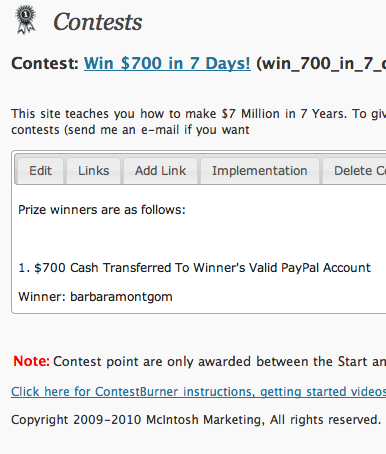
UPDATE: We have a winner in my $700 in 7 Days Giveaway … yep, ‘barbaramontgom’ (with 6 points) was chosen by random drawing (see below) and wins the entire $700 Cash!!!!!! Barbara just needs to send me an e-mail ajc [at] 7million7years [dot] com to claim her $700 cash prize (less any PayPal fees)!
Bet you wished that you had entered
Special thanks to Steve and Trisha who tied at the top of the leader board … if you send me an e-mail with your name/mailing address I will send each of you a $60 Apple Gift Card! Thanks to all of the others who entered and promoted the contest like crazy!
LAST CHANCE to enter my free contest: CONTEST OVER: in just ONE more today, I am giving away $700 cash to one lucky reader (drawn at random) as part of my $700 in 7 Days No Strings Attached promotion. It’s free to enter simply by clicking here.
________________
I am giving away $700 cash to one lucky reader. There are NO CATCHES other than I will only pay by transfer from my PayPal account to yours.
The contest is entirely free to enter … NO gotchas!
So, why am I simply throwing away $700 cash?
Well, I like the number ’7′ (this site is called $7 million 7 years) … but, it’s really to test an idea that I have for my new startup venture! I do a lot of “off the wall” stuff on this site, and I like to share what I’m up to with my readers.
This time, I want to see how many people join, what the referral sources are, and how active various readers are in promoting this contest, and so on.
My experiment is your gain … all you need to do is ENTER for your chance to win $700 cash in just 7 days, when I announce the winner exactly one week from today! Who knows, it might even be you!
Optional: For even more chances to win, get your links (below) and promote the contest to earn more points (each point = 1 entry). You can promote via Twitter, Facebook, Youtube, and you are even rewarded with more points (‘points’ = more chances to win) for leaving comments here.
Good Luck!
[contest_links contest="win_700_in_7_days_"]
Rules: there are none, except that I will only pay by transfer from my US PayPal account to yours (it’s up to YOU to make sure that you can accept payments via PayPal from the USA).
This is the world’s easiest contest. Simply enter for your chance to win.
Optional: Spread the word for even more chances to win. And, help a new experiment in social marketing while you’re at it!
In my last post I shared a lesson from Henry Hazlitt (from his book Economics in One Lesson called “The Broken Window”); in summary:
Some yahoo breaks the window of a bakery. Did he create employment by causing $250 in repairs, thus giving the window repair man more money to go and spend in a kind of economic ‘mini stimulus package’?
Well, no, as many of my readers were quick to point out …
Hazlitt identifies the missing pieces:
What is missing from the thought experiment of the gathered crowd is the fact that the baker was going to buy a suit with that $250 but he can no longer do that since he is $250 poorer. The suit he was going to buy can no longer come into being since the tailor is not going to get that $250 to make the suit. So in this community, the window repair man and all of the merchants he would spend the money with make out but the tailor and all of the people he would spend his money with lose out. So, was there really any net loss or gain? Other than for the baker, no. Instead of having a window and a suit, he just has a window and is now $250 poorer.
Well, d’uh!
But, “the main reason why no one typically considers the tailor and the merchants he would buy from is that, since the suit never came into being and was not readily visible, it never entered into anyone’s thoughts. The window, however, is quite visible and it does not take much to reason through who would benefit from the broken window.”
This issue of visibility is central to the way that most people manage their finances: the money goes where the need is most visible … now!
AJC.
PS Before you point it out, I know that the image, above, isn’t the Hazlitt Maneuver … it’s the Heineken Maneuver, of course
Here is a short piece by Henry Hazlitt from his book Economics in One Lesson called “The Broken Window” Maneuver :
A young hoodlum breaks the window of a bakery and the gathered crowd begins to philosophize about whether the hoodlum really harmed anyone at all since he, after all, created employment.
He created employment by having to force the baker to pay the $250 it costs to fix the window to the window repair man. The window repair man will then have an extra $250 to spend with other merchants and those merchants will have more money to spend elsewhere. This line of thinking can continue on forever.
If it weren’t for the broken window then the window repair man would have less money and employment and so would the merchants he would spend the money with and so on.
So, what do you think? Should we stimulate the US (indeed, world) economy, simply by arming our population with rocks and asking them to all go break windows?
Maybe it’s only because I recently compared personal finance to Vegemite, but I like this guy: he has the gumption [AJC: don't think this is the right word; any ideas?] to compare soccer to personal finance, then actually make it make sense!
Not to mention, it’s just plain good advice:
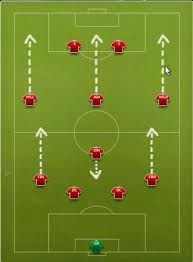
Spain is Soccer World Cup 2010 Champion. Analysts say that is because of their mental strength, their wily forwards, a strong defence and the hardworking midfield.
Apart from the mental strength, which is invisible, what’s visible on the field are three important components.
1. Forwards, to score the goals.
2. Midfielders, to control the game.
3. Defenders, to save, not leak goals.I know you have this idea that I would be comparing soccer with Personal Finance. Here it is.
Personal Finance has three important components too.
1. Investing, to get more bang on your money.
2. Maximizing your income, to control the game of money.
3. Frugality, to save and not leak money.And yes, you also need to have that mental strength not to be dragged down by “fear and greed”. And keep coming back even after failure.
Now, I haven’t given the whole game away [pun intended!], because Ranjan goes on to talk about the three types of investors … but, you’ll have to read his post to find out
I have become obsessed with lotteries!
Not in participating … I don’t: I recently refused to buy a $7 ticket to a $20 million+ lottery; the vendor thought that I was crazy, but he was crazy.
[AJC: Actually, I used to participate in my office lottery syndicate as a form of 'insurance': if my staff won, they might leave en masse, at least my lottery winning would help cushion the blow ... this is really how I think!]
There are government-sponsored anti-gambling ads running on Australian television right now that show that you have around twenty times the chance of a number one record as you do to win the biggest jackpot on a slot machine … lotteries are worse, much worse.
Yet, I can understand the temptation because the prizes are so large.
My interest actually has to do with my ‘easy come, easy go’ thesis: I believe that in order to keep a large sum of money, you have to make it slowly (so that you can learn the necessary financial lessons along the way) … by slowly, I mean years – say, 7 – not days.
When I heard that 80% of lottery winners lose their winnings within 5 years, I became very interested to find out more. Unfortunately, stats are hard to find:
Nora Moon, validations supervisor with the Virginia Lottery, has dealt with almost every lottery winner since the lottery began. Estimating how many Lotto winners have gotten into financial trouble is impossible, she said.
Documents submitted to the Supreme Court of Texas by the Attorney General state:
Steve Danish, a Virginia Commonwealth University psychology professor who has counseled Virginia Lottery winners, said one-third of about 40 winners he talked to in a seminar several years ago asked questions indicating they were in financial trouble.
But, I think the most interesting source comes from the lottery itself: Camelot Group Plc, who is the operator of The UK National Lottery. Camelot commissioned Ipsos MORI (a leading UK research house); in a good news / bad news survey, they found:
More than half the Lottery winners are happier now than they were before their win (55%). Most of the other winners claim that winning the Lottery has not affected their level of happiness, largely due to the fact that they were happy before their win. Only 2% of winners were less happy. The happiness of the winner is not affected by the size of his or her win.
Of the winners who are happier (55%) around two thirds claim one of the reasons is improved financial security and fewer worries (65%). A further 23% either stated that they can buy what they want now or that life is generally a lot easier.
The large majority of Lottery winners have not experienced any negative effects on family life or friendships.
That’s the good news … surprisingly (after all, the research was sponsored by the operators of the lottery!), there was some terribly bad news in a one-liner buried in the body of the report; money does buy happiness … but, that money (and, presumably, the happiness) is short-lived:
On average, the winners have so far spent 44% of their winnings …
Whoa!
I forgot to mention that this survey carried out in 1999 by MORI, marked the 5th birthday of The National Lottery and the findings “represent the most complete snapshot of the generation of Lottery winners who have emerged since the first draw on 19 November 1994″.
That’s a 44% depletion of winnings during a 5 year period or, on average, after just 2.5 years!
All of a sudden the ’80% of lottery winners are broke after 5 years’ myth is not so ‘mythical’ after all; here’s the lottery winner’s life cycle:
Happy => Rich => Happy => Spend => Broke => Happy or Devastated … you decide?
In either case, my ‘easy come, easy go’ thesis is looking better all the time