How to make 7 million in 7 years …

Life’s tough at $250k a year …

I was chatting to a friend last night and was amazed at his reaction to what I had to say.

The conversation went something like this:

Me: Did you see that article about the guy who can’t live on $350k a year?

Him: What guy?

Me: Oh, some guy written up in the Wall Street Journal the other day.

Him: I didn’t see the article. What about him?

Me: He’s a lawyer or law professor or something who earns $350k a year and can’t make ends meet.

Him: Yeah, I know people like that. Remember Elton John nearly went broke?

Me: Yeah [laughs]. But, that’s not what I’m talking about. He says he can’t even afford to own a house because he lives in New York … in Queens or Brooklyn or somewhere like that … and between his taxes … I think he pays nearly half in taxes … and his rent, he is really struggling.

Him: Poor him [laughs]

Me: [laughs]. Yeah I guess it seems funny. But, I actually know where he’s coming from. I own my house and my cars outright. OK, I have two kids in private school, so that’s expensive. But, we struggle to stick to our $250k a year spending budget.

Now, here’s the weird part: my friend didn’t seem surprised at all …

… like NOT being able to live on $250k a year (before taxes) when you have NO mortgage, NO car payments – in fact, NO debt at all – is nothing unusual.

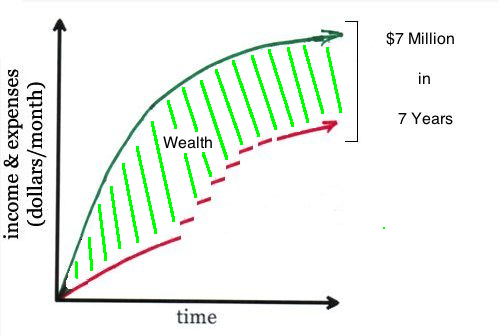
I made $7 million in 7 years so, for me, spending ‘only’ $250k a year is probably being frugal.

What’s his excuse?

And, how much annual expenditure are you banking on your Number being able to produce?

The ‘No Lease’ car lease …

The wrong way to buy a car is to lease it:

You’re financing a depreciating asset: so, as the car goes DOWN in value over time, your investment in it is going UP, payment by payment.

Dumb, huh?

The frugal way is to buy a used vehicle and run it into the ground.

But, what if you like and can afford to buy a ‘certain quality of car’?

Well, I would never buy a new one, and I would usually buy one of a lesser standard than I can afford, because cars do depreciate and are simply NOT an investment (even when you think they are).

Now, this is a blog for aspiring MULTI-millionaires, so I am going to spare you the usual reasons for buying used rather than new [hint: something to do with depreciation vs future resale value curves], because you can actually afford to buy new!

No, what I have to share works on the assumption that you can afford to buy a new car, but you do have budgetary contraints: i.e. a Number that has to fund your required standard of living for life. You can’t afford (literally) to have your money run out before you do!

If you’re either too rich or too poor for that to apply then this post [AJC: actually, my whole blog] does not apply to you …

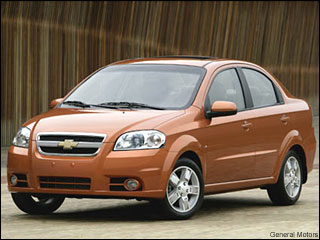
But, this post DOES apply if you have a new car budget, be it a new $250,000 Ferrari 458 Italia [yum] or a new $11,000 Chevrolet Aveo [yuk]:

No, the problem is that IF your mindset is to buy a new vehicle, then how do you feed your desires in 3 to 5 years when your ‘new’ car becomes just another ‘used’ car?

However you justified the ‘new car’ purchase – new car smell, new car warranty, new car reliability, new car status – in just 3 to 5 years, the ‘gloss’ will have well and truly worn off, and you will be in exactly the same position as you are in today:

You will want ANOTHER new car!

And, you will want another one – similar to the first one (or better!) every 3 to 5 years thereafter, until you are too old to care about cars anymore … and, take it from me, you will be pretty old when THAT happens :)

That’s why, when I ask people to calculate their Number, I ask them to come up with their required annual spending plan (and, multiply by 20), then add in any one-off costs: usually just houses plus your first post-retirement vehicle purchases (what’s your chances of your spouse settling for less than you?).

But, for non-annual repeat purchases (the annual ones should already be in the budget … get it?), I simply ask them to calculate a lease / finance rate for the occasional purchases they are interested in (e.g. cars, around the world trips) as though they were going to finance those purchases, and build that cost into their required annual spending plan (basically, their expected retirement living budget).

This will include your replacement vehicles … the ones that you will need to buy after the first 3 to 5 years in retirement.

How to calculate the correct amount?

It’s actually quite simple:

1. Choose the car from today’s model lists that seems to be likely to suit your purposes from a new car pricing web-site.

Right now, I drive a BMW M3, my next car is likely to be no less expensive. But, I actually want more, so I will build in the cost of a Ferrari 458 Italia (that should pretty much cover me for any other car I decide to ‘graduate’ to as I get older, e.g. top-of-the-line Mercedes). If I didn’t aspire to more in the future then I would use the current list price of a 2011 BMW M3 as my ‘base’.

2. Find the current price of a 5 year old Ferrari F430 (because the 458 Italia wasn’t around 5 years ago) from a used car pricing web-site.

3. Subtract 2. from 1.

4. Find an online auto leasing calculator and use 3. (i.e. the amount over the trade-in of your current auto that you will need to come up with every 3 to 5 years) plus the age of the vehicle that you selected in 2. (i.e. how often you expect to want to changeover cars) plus select an interest rate that is likely to reflect long-term averages for investment returns on your remaining money (6% – 8% is plenty)

5. The calculator should then spit out the monthly amount that you need to add to your required annual spending plan

Now, why should you choose “an interest rate that is likely to reflect long-term averages for investment returns on your remaining money” rather than the expected cost of FINANCING such vehicles?

Didn’t you read the opening paragraph of this post?!

You’re not financing anything, you are SAVING to replace you current auto (or, the one that you first bought when you reached your Number and stopped working), and you are building in the LOST OPPORTUNITY COST of having your cash tied up in your cars rather than sitting in your investment account working for you, and you are accounting for inflation pushing up the price of your future, future, future replacement vehicles.

What if you make a mistake with you future financial position or the price of your next car?

Well, you simply hang on to the cars that you already own for a while longer … or, ‘down-size’, if you have to …. who says that you HAVE to replace your cars every 3 to 5 years?

Now, you can apply this same strategy before you retire: it’s called saving up for your next car (and, the one after that, and the one after …) rather than financing it ;)

AJC.

PS If you run these numbers again, here’s an even better strategy:

Instead of buying a new car, buy a slightly used – but much better – make and/or model of vehicle. Because I’ve found that cars – just like radiation – have a half-life (but, different for each brand of vehicles) and some depreciate 20% as soon as you drive them off the lot, you may find that you can buy a much better car for the same money albeit 1 to 2 years old. If you choose well, you may find that you are (a) driving a better vehicle and (b) can keep this vehicle for another 4 to 6 years before replacing it (because ‘classic cars’ tend to remain classic long after your shiny new American/Japanese/Korean production-line ‘beauty’ has well and truly gone off the boil). Plug a 6 to 8 year replacement cycle into you calculator v the 4 year one that you chose for new and see what that does for your retirement plans!

Why climb Mt Everest?

Thanks to all of those who entered my SECOND $700 in 7 Days Giveaway; you still have a couple of hours to sneak in and submit your entry for what looks like a better than 1 in 30 chance to win the first prize of $350 in cash … that’s like $10 just for filling in a 2 second form!

If you refer friends, you will be in the running to win the second ($150), third ($50), and fourth prizes of ($50) CASH as well … right now, I’ll be struggling to give all of those prizes away, so that’s a pretty good hint. But, since you’re late to the party, you’ll have to find the entry form yourself. HINT: xxxx ;)
_______________________
I wasn’t spanked by my readers nearly as much as I expected for sharing my happiness with my mansion purchase (actually, two mansions: one in US and one in Aus), then again the purpose wasn’t to brag but to counter the idea that spending is bad.

In fact, spending is only bad out of context … $7 million in 7 years kind of context … when not spending would be even more absurd.

Anyhow, Josh did pull me up:

What’s the point? Maybe I’m missing something. Maybe it’s because my assets are in the 7-figure range and not the 8-figure range. But why spend $X Million on a home?

I live debt-free in a home that cost $300K. I could have bought a $2M+ home, but it seems so impersonal, pretentious, and secluded. I want people to come over and feel comfortable drinking beer with their feet up on the coffee table, or to let their kiddos run around carefree after coming inside on a rainy day. Even now, some people feel uncomfortable in my house because it is “so nice” for the area in which we live.

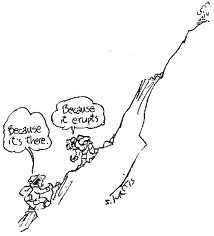
Well, why do people climb Mt Everest? What’s the point?

Because (a) it’s there, and (b) they can!

So, I have a very simple rule on spending that has kept me in good stead – through poorer and richer:

I spend money when it doesn’t make sense NOT to!

I became rich because I wanted to travel spiritually (that’s free); mentally (that costs me in time and ‘venture’ capital); and physically (that much traveling costs me a LOT of time/money: hey, I retired at 49 so I WANT to travel Business Class and stay in at least 3/4/5-star hotels).

So I set out to make my $7 million in 7 years to allow me to begin the life that I wanted to live (without needing to work) and was fortunate enough to succeed …

… and, one of the side benefits of that financial success is that I have plenty of cash for cars and houses, and vacations and bling. And, for charitable gifts and deeds :)

I write this blog because I wish the same for all of you …

AJC.

PS a big house doesn’t need to be pretentious; ours is homely and welcoming and people love it because they get to hang with us, play tennis, watch movies, and swim :)

Beating the ‘more’ bug!

Do you have the ‘more’ bug?

I certainly do, and I think that most of us do … in fact, I’m so sure of it, because I see hundreds of blogs and books solely aimed at eradicating the disease with drastic remedies such as self-flagellating frugality and anorexic debt diets.

Kind of reminds me of how we used to treat ourselves with blood-letting, hole-in-head-drilling, and leeching – actually, all still legitimate remedies in a tiny minority of real-world cases – because we didn’t know any better.

In those days, a ‘real’ doctor, prescribing a drug that they had discovered would have been seen as a heretic or master of the ‘black arts’ (Louis Pasteur, anybody?).

But, I’m getting ahead of myself … first, here’s how Scott (a doctor, plenty of disposable income, so he’s a prime candidate) describes the symptoms:

I think a big dragon that we all face is that human nature of wanting more. We all seem to do it to some degree or another. We’ll live in a 150k-200k house(which was probably an amazing home to our grandparents standards) and while there, we imagine that million dollar pad. Once we get that, we need a 5 million dollar one, etc..etc..and our number continues to climb with the chronic discontent and needing more.

As Scott says, it’s not such much a ‘bug’ as a human condition: to always want more.

To get a little metaphysical: if you were the Ultimate Higher Power and you wanted to design an environment with endless conflict (all the way up from a personal level to a global level), you would fill it with little creatures that you ‘program’ to always want ‘more’. And, you would give them the tools (opposable thumbs, a modicum of intelligence, and inventiveness) to ensure that they create an endless stream of upscaled ‘stuff’ to constantly fuel that desire.

What Eternal fun! ;)

Assuming that the ‘more’ bug is curable … or at least manageable … how do you deal with this seemingly insatiable desire for ‘more’?

Well, if it really is a disease or condition, then I’m not sure how easy it is to switch off the ‘more’ switch; maybe a 12 Step Program for Wants (might be a great online/offline business here for any psychologists who have a side interest in personal finance)?

But, if it is real – and, manageable – then another strategy might be to build in gradual spending/lifestyle increases into your budget. Allow the ‘disease’, but control it …

For example, I drive a BMW M3 Convertible (in Australia, this is a USD$200k car, due to low volumes, importation costs, and exorbitant luxury vehicle taxes) but I really WANT a Ferrari ($500k++).

So, I have given myself a target:

Develop and/or cash out (for a certain amount over purchase price) on my development sites and I ‘reward’ myself with the Ferrari (not as simple as that: I will also need a day-to-day car, so figure a $150k Audi S6 or Maserati Quattroporte, in addition to the Ferrari … repeat every 5 to 8 years). I think that some of the Sudden Money strategies that I posted about recently are ideal for managing this.

Another way to deal with this was suggested by Robert Kiyosaki: he said that he, too, wanted a Ferrari. His wife said that he could only buy one if he generated the income to cover it. So, he bought a self-storage business and used the income to fund the payments on the car … I’m OK with this: even though he’s funding the car, rather than paying cash, the capital is in an income-producing asset – one that really should increase in value over time.

And, it’s not a ‘real’ business, in that it won’t need a lot of ‘hands on’ management … of course, it’s not a real passive investment either. Other candidates could be automated / no staff car-washes; ‘coin’ laundries (the new kind that use cards instead of cash); and, some of the absentee-owner franchises.

[AJC: Just be warned, you probably can't tax-deduct much - if any - of the vehicle payments. Contrary to what the financial spruikers and shysters will tell you, the IRS is not stupid: why do you need a Ferrari to help the self-storage business / car-wash / coin-laundry produce an income?!]

But, now that Scott mentions it, I do have a hankering for an island ;)

Fitting another square peg into a round hole …

I need your help on a small project that I am working on! I have a new FaceBook Page for Top Secret Startup Project # 4 and need 25 people to “like” the page in order to get a proper URL. Would you PLEASE take exactly 10 seconds to visit that page by CLICKING HERE and click the “like” button.

I might even send one of you (by random selection) a surprise gift (HINT: think ‘apple’ and think ‘card’) AND you will be amongst the first to know what I’m up to over the next few weeks! Now, back to today’s post …
________________________
Philip Brewer is the first to break ranks … that makes him a pioneer!

He’s the first personal finance writer to question the validity of the 4% Rule; I’ll let him do what he does best … explain:

There’s a rule of thumb that’s pretty well known to retirement planners: the 4% rule. It states that if you spend 4% of your capital in your first year of retirement, you can go on spending that much — and even adjust it for inflation — and you won’t run out of money before you die. That rule is starting to look kind of iffy.

The rule is just an observation: Over the past hundred years you could have followed the 4% rule starting in any year and you wouldn’t have run out of money. That’s been true because the return to capital has been pretty high, and because downturns have been pretty short.

So, that’s the genesis of the 4% Rule … basically an assumption that if inflation runs at 3%, you can get at least 7% return on your investment (the difference being the amount you can spend: 4%). But, most investments haven’t ‘returned’ 7% – or anywhere near that – for quite some time, as Philip explains:

Stock investors saw some price appreciation in the 1990s, but there’s been no appreciation since then. In fact, your stock portfolio is probably down over the past decade, even with reinvested dividends.

… and bonds and cash haven’t fared much better, certainly not enough to keep up with inflation and provide spending money for a retiree!

The problem is we’re trying to fit a square peg into a round hole:

Square Peg

Bonds, cash, and stocks are all capital investments (my term); they are designed to hold (preferably, appreciate) the capital that you put in.

You create ‘income’ from these investments: (a) from their (relatively speaking) meager dividends, and/or (b) by selling down your portfolio as needed. The 4% Rule says that the amount that you need to selll down SHOULD be offset by the increase in value of what you have left even after accounting for inflation.

The problem is in the ‘SHOULD’ word: this should all work, but as Philip points out, there are times when it doesn’t …

Round Hole

When you are retired you shouldn’t spend capital unless you print the stuff … or, at least, have an unlimited supply.

You don’t want capital, when you are retired, you really want income.

Specifically, you want a certain amount of income – and, you want regular pay increases (at least enough to keep up with inflation) – just like when you were working.

But, you want it:

a. without needing to work, and

b. without running the risk of being ‘fired’ (i.e. having your retirement income run out).

Other than some nebulous (perhaps, for you, well-defined) need to leave some of your hard-earned, precious, irreplaceable, capital behind for charity, your cat, and/or the next generation, you really don’t – shouldn’t – care very much about it, except for its ability to provide that much needed income.

So, why try and cajole capital-appreciating assets to do the work of your former employer, when there are perfectly good investments out there specifically manufactured for the sole purpose of:

1. At least maintaining their own value (ideally, after inflation), and

2. Providing you with an income, indexed for inflation, for your life or the life of the asset (whichever comes first).

A few such assets immediately spring to mind … each with their own pros/cons (which we can explore in the comments and/or future posts):

1. Real-estate: it tends to increase in value according to inflation; it tends to provide semi-reliable income that increases (again) with inflation,

2. Inflation-indexed annuities: you give up claim on the capital in return for a guaranteed (well, as long as AIG or its like stays in business) income that increases with inflation,

3. Treasury Inflation-Protected Bonds (some Municipal MUNI’s also do much the same): These guarantee that your capital will increase with inflation, and you can ladder them cleverly to provide some semblance of a (albeit low) income stream that increases with inflation.

Of all of these – and, in retirement – I like 100%-owned (i.e. paid for by cash) real-estate the best; what do you recommend?

There’s something about Todd …

Poor Todd, where I don’t fear to tread, Todd (now) refuses to go:

Everybody hates Todd Henderson.

In case you haven’t heard, he’s the University of Chicago law professor who unwisely blogged about his financial woes in a post headlined “We Are the Super Rich.”

Mr. Henderson and his wife, an oncologist, make more than $250,000 a year, and apparently they’re struggling to get by. If President Barack Obama gets his wicked way, and tax rates rise for those earning more than $250,000 a year, Mr. Henderson says it will mean real sacrifice in his family.

It’s too easy to pelt Mr. Henderson with rotten eggs, as so many have now done. (He yanked the post, but way too late–and on the Internet, one’s blunders never die.)

Never, ever, ever again blog about how hard it is to live on $300,000 or $350,000 a year at a time when one middle-aged man in four can’t find a full-time job, and one in five can’t find any job at all.

Yeah, I understand that Mr Todd was whinging to people much worse off than him.

But, I’m not afraid to speak my mind – when it comes to money – after all, ever heard of “teach a man to fish …”?

Early retirement in the extreme …

Jacob and I are really the bookends for early retirement: he says that he has retired on $6k per year (a budget of $500 p.m.), and I am retired on $250k per year (around $20k p.m.).

I know I’m happy, and I’m pretty sure that Jacob is happy, too.

Now, there are some non apples-for-apples comparisons, here:

- Jacob has a spouse who works; my spouse does not work but has thought about working

[AJC: one of the problems with being 'rich' is that it's embarrassing to take a part-time admin. job that pays $13k per year, driving there in 10 years salary worth of car and driving home to 461 years worth of house! I told her that it might be better if she just donated her time to the charity that wanted to hire her]

- Jacob has no children; I have two

- Jacob’s net worth is higher than the typical American’s … so is mine!

Wealth is defined as being able to live comfortably on the passive proceeds of your investments; clearly, both Jacob and I can do that according to our individual assessments of ‘comfort’, so we are both wealthy.

Moreover, our wealth and retirement strategies are not for the masses … but, the lessons learned can be!

However – and, this is a big ‘however’ – I simply don’t believe that ‘extreme’ early retirement strategies really work for any, but a small minority of families. There will simply be too much financial pressure – some generated directly, and some indirectly (yes, peer pressure is real) from the children:

- Food: you may be happy eating home-cooked meals. Your kids will want sushi and sodas with their friends.

- Clothing: you may be happy with last-season Gap and TJ Maxx. Your kids will want this season Abercrombie and Ed Hardy.

- Education: you may be happy on $500 p.m., but how much college will that buy? Your kids will resent having to buy their own, so that you can do nothing.

- Health: your kids will be at the doctor every day … for everything from a runny nose to broken bones to removal of superfluous bits (foreskins, adenoids, tonsils, and appendix … and, that’s just in healthy children!). They won’t ask to go … every time they so much as sneeze, you’ll be dragging them there in a panic!

- Cars/phones/bling/going out/travel: see ‘college’, above!

Of course, you could bring your children up like BF:

He too, is a minimalist, but his parents (well, his father) trained him to be like that from young.

When they were kids, they weren’t poor in the sense that they were living paycheque to paycheque. They had money, they had savings, but they never spent it.

BF joked that to his parents, Money = No Object(s)!

No Television: “It’s all crap on there. Sorry kids. No TV. It’s not reality, and if you want to watch TV, you go over to your cousin’s place. But it’s crap. The radio is better. And free.”

Then from not having a TV they avoided buying:

  • TV accessories
  • A couch to sit in to watch TV
  • A VCR or DVR to record things on TV or to watch videos on the TV
  • …anything the commercials were selling

No Telephone: “Why do we need a telephone for? If you want to talk to somebody, just go over and see them.”

Then from not having a telephone:

  • No phone bills
  • No actual phone to purchase
  • No long distance calls

So what did they spend their money on? Food. And utilities to cook food. That’s it.

No extra clothes, toys, or anything I ever took for granted as a kid. Not even soccer club fees or lessons, because that would mean that you’d have to buy a soccer ball and a uniform.

… you could – and, it might even be character building for both you and your children – but, I wouldn’t count on your future familial happiness ;)

She’s an heiress …

Madam X (provocative name) over at My Open Wallet says that she is an heiress:

Remember Great Aunt Minnie? She died peacefully a few weeks ago. I had a chance to see her one last time in May, and spoke to her on the phone a few days before her death … it was even more weird to find a thick envelope in my mail the other night, which turned out to be from Minnie’s lawyer, because I’ll inherit a share of her estate. So now I just have to see what happens once the estate is settled and divided up. I have no idea how much money it will be. I certainly don’t expect much, given I’ll only get one twelfth of her estate.

Receiving money ‘suddenly’, be it from a sad occasion such as this, or from some fortuitous circumstance such as winning a substantial prize in the lottery, can be difficult, because you probably have no plan.

And, because you have no plan, the money can go as quickly as it comes (remember poor-then-rich-then-poor Lou Eisenberg?).

I call this Found Money, and here’s how to deal with it:

If you’re lucky enough to receive such a windfall, you should spend enough to fully celebrate your good fortune (even more so if it was a result of hard work – e.g. selling your business – rather than luck).

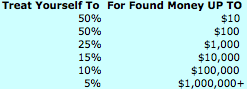
Here’s a table that will help you decide how much to save and how much to spend, depending on how much Found Money you happen to come across:


The idea is that money is for SPENDING and ONLY FOR SPENDING … but, you need to PLAN to spend some now and PLAN to spend some later (a.k.a. saving). That’s exactly what this table is designed to do.

So, if you find $10 in the street, buy yourself a fun magazine, then stick the rest in a jar.

If you happen to inherit $100,000 go ahead and upgrade your car (and/or take a vacation) – totally guilt free – then plan to invest the other $90k very wisely ;)

Spend More To Invest More?

How do you redeem your credit card points?

View Results

Loading ... Loading ...

[You may select more than one option]

Our last foray into the world of credit cards pulled up an array of options around using the points generated; for example, Mike  says that he:

Usually pockets the cash back but flying in the A380 Suites are always nice.

And, Investor Junkie uses the points to generate extra cash to invest:

Instead of Best Buy cards, it deposits directly into my Fidelity account.

A popular option, I’m sure, would be to ‘fly them off’ (as I do). On the other hand, Costco gives cash rebates (which we also enjoy). But, I would be interested to see how our readers currently redeem their credit card reward points?

Since you probably have multiple cards, I’ve allowed multiple options on this Reader poll, but just choose the one or two that you mostly figure on using?

Once you have made your selection/s, please read on ….

I wonder, though, where the best bag for buck (almost literally) comes from? I mean, each rewards program must have some sort of formula as to how they convert every dollar that you spend into points, then a more complicated formula (with different weightings, I’m guessing) to convert those points into the cash and/or airline miles and/or other stuff that they need to ‘buy’ to give to you.

But, I’m guessing that those weightings are NOT equal; so what is a more ‘efficient’ (or is that ‘effective’?) use for your points, for the credit cards that you have signed up for?

Using your points for:

1. Cash? Whether you direct it to your investing account, or just spend it.

2. More Stuff? Like Best Buy cards … I used to give the rewards to my employees (anything from bicycles to trips for 2, all paid for by redeemed rewards vouchers) in recognition for ‘above and beyond’ performance.

3. Airline Miles? I’m told that this is the best $$-for-point conversion that you can get … and, that redeeming your points for international flights outweighs domestic travel in terms of the ‘free value’ that you receive.

Since I fly a lot (esp. internationally), generally at my cost, this last option seems the best for me …

Logically, we should aim to get the most Usable Cash Value from our credit card points i.e. either cash, or something that we would convert into cash by using the points INSTEAD of using our own cash on something that we WOULD have spent cash on, anyway.

If it’s something that you would NOT have normally bought for yourself, then the Usable Cash Value is actually low [AJC: under my definition!].

Although, I am contradicting myself a little because I just ‘blew’ a whole heap of points on that First Class airline seat that I would never have bought for myself!

On the other hand, I am at the ‘other end’ of my financial journey, so what the hey ;)

To mini-retire or not to mini-retire?

DrDollaz takes issue with whole ‘eat hamburger now so that you can eat steak later’ philosophy:

Problem with that philosophy is that years later – after being used to eating nothing but hamburger – most people have a hard time splurging on steak!

The whole fallacy of ‘saving so that you can enjoy retirement’ is BS – your life should be filled with mini-retirements.

But, Think Simple Now tried a mini-retirement and found that it wasn’t all it was cracked up to be:

When I first learned of the mini-retirement concept, I was immediately attracted to the idea. To me it represented freedom. I had all these romantic notions associated with it, and when I found a way to take three months off from work, I jumped at the first chance and ran with it.

While traveling is an eye-opening experience and a chance to see how others live in vastly different cultures. It is exhausting, on many levels. It quickly became clear to me that the romantic concept of traveling is flawed.

It turns out that TSN is more disillusioned with travel rather than mini-retirements, per se.

Fortunately, I agree with DrDollaz …

The $7million7years Way  is all about leading you to some future date where you have amassed the required amount of money to start living (your Life’s Purpose).

But, of course, if that’s all you take away then you’ve missed half the story:

Because I also say that money has only one purpose: to spend.

And, I have written many posts telling you to save now, but also to spend now!

Life is a journey …

… and, that includes the bits both before and after your reach your Number ;)

Page 1 of 41234
Powered by Wordpress | Designed by Elegant Themes