Happiness = $75,000 a year!

It’s not too late to enter my free contest: in just 3 more days, I am giving away $700 cash to one lucky reader (drawn at random) as part of my $700 in 7 Days No Strings Attached promotion. It’s free to enter simply by clicking here.

Remember, the more entries you earn the more chance you have to win! You can check out the current leaders here!

________________
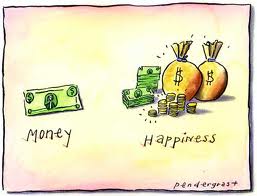
Finally, there is a study that equates money to happiness!

The Wall Street Journal reports a study by “the Princeton economist Angus Deaton and famed psychologist Daniel Kahneman”, which states:

As people earn more money, their day-to-day happiness rises. Until you hit $75,000. After that, it is just more stuff, with no gain in happiness.

Let’s assume you want to retire in 20 years on the equivalent of $75k p.a. – after adjusting for inflation (roughly double your required income every 20 years) and applying the Rule of 20 (equates to a 5% p.a. drawdown on your money), this means:

Your Optimal Happiness Number = $3,000,000

None of my readers are chasing less – otherwise, why would you be reading a blog called How To Make $7 Million In 7 Years (?) – but, the point of the study has been taken by the press and the pf blogging community to mean that it’s pointless to chase more than $3 million … seemingly making my uniquely positioned blog redundant by half 🙁

Well, it’s quite interesting because there’s a second part to the study that the media and most other bloggers are conveniently ignoring:

That doesn’t mean wealthy and ultrawealthy are equally happy. More money does boost people’s life assessment, all the way up the income ladder. People who earned $160,000 a year, for instance, reported more overall satisfaction than people earning $120,000, and so on.

“Giving people more income beyond 75K is not going to do much for their daily mood … but it is going to make them feel they have a better life,” Mr. Deaton told the Associated Press.

I don’t know about you, but I like to be happy ($75k p.a. happy) and have a better life ($250k p.a. better life)!

How about you?

The difference between a business and a job …

In just 6 more days, I am giving away $700 cash to one lucky reader (drawn at random) as part of my $700 in 7 Days No Strings Attached promotion. It’s free to enter simply by clicking here.

Optional: Once you enter, you will be shown fun ways to spread the word and win more free entries. Remember, the more entries you earn the more chance you have to win!

________________

You already know that I won the business lottery!

[Let’s face it, some guys have all the luck: It took me just 7 years to build a $7 million real-estate, business, and investment portfolio from worse than scratch (I was $30k in debt when I started). Then, I managed to sell my businesses (in the USA, Australia and New Zealand) just before the market crashed. On the other hand, I’m only 5 ft 4 inches tall and balding … so, things have a way of balancing themselves out.]

So, now I get lots of people who are clearly excited when they tell me that they are “also in business” … except that they aren’t!

Mostly, they’re just working 60 to 80 hours a week – on little to no pay – for the toughest boss of all: themselves.

Worse … their spouses!

Let me give you a couple of real-life examples that should help to explain:

Peter Hastings, who already owns the antiques store right next door, opens a sandwich shop at 2264 North Lincoln Avenue. A quaint sandwich shop that he decorates with many of the items from his antique store. The shop thrives and provides Peter with a nice income for the next 20 years, when he sells it. Peter, with his two little businesses, has carved out a nice niche for himself. He was careful with his money, both before and after ‘retirement’, so – after 20+ years of hard but fulfilling work – he can finally afford to take it a little easier.

Bryant Keil buys a sandwich shop; it’s uniquely (and, quaintly) decorated, it’s in a nice location, had one owner who is selling in order to wind down a little after ‘working’ the business for 20 years. Bryant buys the little shop and develops a franchise model around it. Within 10 years, Bryant has “over 200 stores, in Illinois, Indiana, Michigan, Minnesota, Ohio, Texas, Maryland, Virginia, Pennsylvania, New Jersey, Washington, D.C., Kentucky, and Wisconsin.” Bryant is now a billionaire.

So, if you own a little sandwich shop – or, the online equivalent (here’s how you spell it: B-L-O-G) – don’t bother me with the details … it’s nice that you’re keeping yourself busy, but I’ll get bored listening to your story.

But, if you’re working on the next Potbelly Sandwich Works – or, the online equivalent (F-A-C-E-B-O-O-K) – drop me a line and don’t spare the gory details … I’m listening to every single word you say!

A fund manager’s view …

This is a little different to all of those “this is what a millionaire thinks” posts, because Evan is in a support role (“my role is more brain storming and putting together documents and calculations….then I prepare materials for the planners’ second meeting and beyond”) at a financial planning office that specializes in sucking the blood out of – I mean assisting – high net-worth clients:

My role is more brain storming and putting together documents and calculations. So basically I see almost every balance sheet that may have significant net worth which goes through my office

Since I’m a sample of one, when it comes to high net-worth clients, it might be interesting to see what Evan sees:

The House is almost always Paid off

Prepaying your mortgage is always a hot topic on Personal Finance Blogs.  Everyone once in a while one of the big players in the field will put a post and it will garner tons of comments.  The comments are usually heated and go both ways about how the move is stupid and then invariably someone will say, its a great move.  Regardless of how you feel, most of the high net worth clients’ balance sheet that I see will have either a paid off house, or one with a very low debt to equity ratio.

They Almost Always Own a Business

Almost every high net worth client’s balance sheet has a business on it.  The types of businesses range from the mundane, lawyer who owns their practice, to beyond what I could have imagined as a viable business.

They Almost Always have Investment/Financial Advisors

Almost every single high net worth client/prospect is not hands on when it comes to their own investments.  Some are more active than others when it comes to asset allocation, but for the most part unless they are in the money business (fund managers, hedge fund execs, etc.) they just don’t deal with it.

Since Evan is coming from a position of observation of his sample size of many, I will observe from my position of a sample size of one:

– I found it valuable to have a business; indeed, it’s the ultimate driver of my financial success; even before selling the business I could use the spare cashflows (after attending to the business’ own growth needs) to fund a substantial real-estate and investment portfolio.

– I own a house, and almost always have … now that I am wealthy, I carry no debt on these houses, but started reducing my debt almost in proportion to the increase in my wealth. It’s not a strategy, just a happenstance. But, I will not hesitate to use some (perhaps, up to 50%) of that equity, if required to fund an investment.

– I certainly use an investment advisor – in fact, multiple; but (here is where my experience diverges from Evan’s observations) Evan says: “Almost every single high net worth client/prospect is not hands on when it comes to their own investments.”, yet the opposite is true for me. Could this be observation bias for either Evan (he does work for a financial planning/advisory firm, right?) and/or for me?

I would never hand the keys over to my Future Fortune [AJC: How do you make $1,000,000? Give an ‘investment advisor’ $10 million … and, wait!] to somebody who has not already made their’s … if so, why do they need me?

Thanks for sharing, Evan!

Announcing the 5 x $100 Apple Gift Card winners!

Speaking of contests: I have launched (in ‘stealth mode’) a new site that marries contests and social marketing. I am now looking for a team to help with the build/launch. If you love contests and if you have experience with social/viral marketing or development, then contact me immediately at ajc [at] 7million7years [dot] com. This is your opportunity to hit the big-time with a small salary (full or part-time) + a chunk of equity + your name in lights!

_________________________________________

Thanks to everybody who entered the contest inspired by Trent Hamm, from a Simple Dollar, who is giving away a book called Everything You Ever Really Needed to Know About Personal Finance On Just One Page.

If you want to find out more about the contest, click here: http://7million7years.com/2010/10/28/just-one-page/

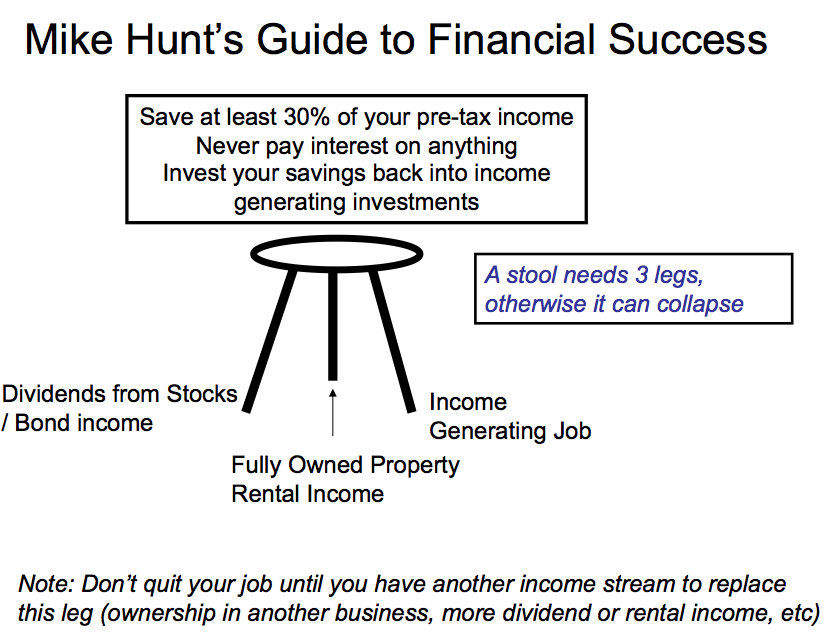
It’s too hard to pick a “best” entry, but, I did like Mike Hunt’s stool analogy (“needs all three legs to stand up”):

Our other winners (in no particular order) are:

– Roger, the Amateur Financier certainly deserves a card for his entry: http://www.theamateurfinancier.com/blog/the-amateur-financier-one-page-financial-guide/

– Jaime @ Eventual Millionaire just got $100 closer with her gift card: http://www.eventualmillionaire.com/blog/2010/11/the-one-page-financial-system/

– Daniel is Sweating the Big stuff, but (thankfully) still had time for this: http://sweatingthebigstuff.com/put-your-system-onto-just-one-page/

… and, I’m saving the final prize for a cartoon character. Seriously!

You can see Eugene Krabs’ entry as the first comment to this Free Money Finance blog post: http://www.freemoneyfinance.com/2010/10/how-to-get-rich-quick.html

He described a formula for wealth (it’s not THE formula for wealth; this is: the key to untold wealth):

I’ve boiled what I’ve read myself down to the following equation:

Wealth = Capital + Risk + Time

(To be clear, capital is the money you have right now to make more money with.)

Technically, any one of those factors can do it for you. For example, if you have a massive amount of capital, or if you take massive amounts of risk and beat the odds, or if you have a lot of time to build your wealth, then you can still become wealthy at the expense of the other two factors.

However, there are downsides to all of these individual factors.

The best thing to do is to push on all three of these fronts at the same time, I believe you will then maximize your chances of becoming wealthy.

That’s it. As we have all have probably known for quite some time that there is no real secret to being wealthy. It’s just not easy. Bottom line, we need start now, stay fanatically focused, and be mindful of the risks involved.

The winners need to contact me via e-mail [ajc AT 7million7years DOT com] for details on how to claim their prizes; if any prize isn’t claimed I’ll donate the $100 to charity and post back here.

Thanks to everybody who entered, commented, and/or spread the word!

__________________________

Come and visit us at this week’s Carnival of Personal Finance: http://www.simplyforties.com/2010/11/carnival-of-personal-finance-283.html

The key to untold wealth!

If you’ve been following this blog for a while, you may have the sneaking suspicion that I’m also a bit of a ‘mad scientist’.

For example, I told you that, like Albert Einstein, I’ve been working on a ‘unified theory’ [AJC: I’m rather proud of this post, so go ahead and pull it out of the 7m7y archives by clicking on this link: The Big Papa lives in the 11th Dimension!].

Unlike Albert Einstein, though, I am (a little more) kempt; (very slightly) less absent-minded;  (a lot) less than genius (even a little more ‘less’ each year); and, have no Germanic accent, although my parents spoke the language fluently (but, never allowed me to learn it … it was their ‘secret language’).

On the positive side, unlike Albert Einstein who reportedly went to his grave with his secret, I have found the Unified Theory of Finance!

After literally years of searching – and, this blog has been a way for me to publicly articulate my thoughts, and get the feedback that I needed along the way [AJC: so, I will need to remember to thank all of my readers – that’s you! – at my Nobel Prize for Finance acceptance speech] – I finally made this Great Discovery (?!) on the weekend.

In fact, the breakthrough came in two parts:

The Search

Because I am (still) enamored with Sponge Bob, I was attracted to “Eugene Krabs“, who left his version of the secret formula for wealth in a seemingly innocuous comment on Free Money Finance’s blog:

I’ve boiled what I’ve read myself down to the following equation:

Wealth = Capital + Risk + Time

(To be clear, capital is the money you have right now to make more money with.)

Technically, any one of those factors can do it for you. For example, if you have a massive amount of capital, or if you take massive amounts of risk and beat the odds, or if you have a lot of time to build your wealth, then you can still become wealthy at the expense of the other two factors.

However, there are downsides to all of these individual factors.

Sensational stuff!

Unfortunately, I can’t thank “Mr Krabs” because he didn’t include any links with his moniker. On the other hand, you may quickly spot a few issues:

1. Clearly Wealth isn’t an additive of capital, risk, and time, it’s really a complex function. But, that can be solved by rewriting the equation as W = C * R * T or, even better yet, as:

W = Fn {C,R,T} i.e. Wealth is a (perhaps, complex) function of Capital, Risk, and Time.

But, understanding the math is not the point – I’m sure that Mr Krabs’ formula is meant as conceptual, not mathematically rigorous – it’s understanding that you need to balance Capital, Risk, and Time, if you want to become wealthy, that’s important … at least, according to a fictional cartoon character who saves every penny that he can get his claws on 😉

2. The more important point is that this version of the formula forgets Return; and, if we substitute Return (e.g. the 9% or 0.09 return that you supposedly get if you stick your money in the stock market for long enough), you actually have something very similar to the basic formula for compounding (which, at least according to Einstein, is the ‘most powerful force in the universe’:

3. Even if I somehow modified Mr Krabs’ simple version (and/or the more complex – but, correct – mathematical representation of compounding) to include both Risk and Return (a.k.a. Reward), the formula IMHO still wouldn’t explain why Warren Buffett is sensationally rich investing in exactly the same stocks that we invest in, yet we manage to lose money (in the short term, in absolute value, and even in the long term, certainly after inflation is taken into account)!?!

Until I can explain that, there is no formula 🙁

The Breakthrough

Still my gut told me that Mr Krabs [AJC: I love using his pen name … I’ll see how many more times I can fit it into this really very serious post!] was on the right track, because his representation did provide the missing simplification that I needed.

But, I kept hitting brick wall after brick wall …

… until last Sunday.

Last Sunday, I took my son and a few friends to play in their weekly teenage tennis competition [AJC: we all got free ‘slurpies’ from a 7-11 Convenience store on the way back home from tennis because it was 7-11 Day: November 7, 2010. Go figure!].

Instead of watching the game, I sat in the car with all my notes – pages and pages of complex math, simple math, all trying to fit Risk, Return, Capital, Time, and so on into a simple, conceptual ‘formula’ … all the while, trying to use it to explain the difference between you, me, and Warren Buffett.

As I said, until I could do that, I had nothing!

It was driving me crazy! So, I did the only sensible thing: I laid back the car seat and dozed off … but, when I woke up half an hour later, I had it:
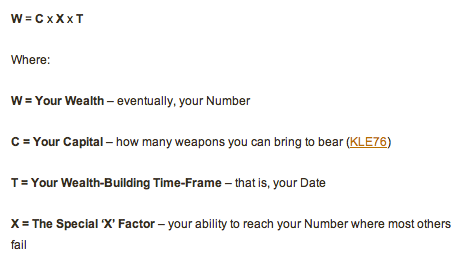

“Is that all?”, you say [yawn]

Hell, yes!

Really understand this, and you have the key to untold wealth … in any field of endeavor.

I’ll explain the X-Factor (it can be explained!) in an upcoming post …

AJC.

PS Remember: this ‘formula’ is conceptual and is more correctly (but, still grossly) simplified as:

W = Fn {C,X,T} i.e. Wealth is a (definitely, very) complex function of Capital, The ‘X-Factor’, and Time.

The False War On Debt …

There’s a war raging out there: it’s being fought by authors and bloggers everywhere.

But, is it the right war? Is it a just war? Or, are we just throwing ourselves, by the millions, into a hail of fire: exploding spending, rampant inflation, the death of social security?

Sure, as we sit in the relative safety of our trenches (at least, that’s what we tell ourselves, until a random mortar shell of job loss or unexpected expenses chooses to lob our way) this is not OUR future … it’s somebody else’s, or it’s too far away, or it just can’t happen …

The sad truth is that legions have jumped the wall before us and have been brutally cut down for lack of an adequate nest-egg; it’s sad to see them go over the dreaded wall of retirement (be it their time, or forced on them early) without an adequate safety net … when they do, it’s as though their grim fate had already been sealed.

Broke – or ‘just’ financially crippled – and unable (for financial reasons) to live life as they had hoped, they are a sad, sad lot.

You see, the war that they fought wasn’t – isn’t – a just war. It’s not even a war … well, it shouldn’t even be more than a skirmish.

It’s the War Against Debt!

When it comes to that war, I’m strictly a pacifist; isn’t it better to simply avoid BAD debt?

Of course, that doesn’t mean that we can’t … shouldn’t … defend ourselves.

Far from it: if we find that BAD debt has snuck through our defences, let’s keep an eye on it. And, if we find that it’s also EXPENSIVE debt, then let’s whip out the Big Guns and wipe it out. Quickly, surgically …

… but, let’s not commit Debt Genocide.

You see, unlike the well-intentioned, but largely Debt-McArthyist “ALL Debt Is Bad, So Let’s Wipe It Out” rabble out there, let’s first ask The Missing Question:

What will you do after your debt is paid off?

“Well, start investing of course!”

But, does that REALLY happen? Who better to ask than Money Reasons:

This past February 2010, I became totally debt free, but now what!

I thought that there would be a period where I would break even for a while, and then start to plow about $1,000 extra each month into investments!  So now that it’s seven months later and how much extra did I save or invest?  Not a single cent!

Hang on, the whole purpose of suiting up for battle – for going to war against debt – was so that you could start investing, right? What’s up with that, Money Reasons:

Well it’s been a matter of bad luck with equipment breaking down and needing replaced and spending too much for our past vacation to Hilton Head Island!

But it’s also been a subtle form of LifeStyle Inflation!  Thinking back now, I realize that when wants would arise, I would just go ahead and buy it.  Yeah, I thought about it a bit, but I knew that I had the cash.  Then when your car and lawn mower broke down, I had the cash too…

Money Reasons should have started investing well before all of his debt was paid off … he should have started investing as soon as his expensive debt was paid off and left his cheap debt on a regimen of minimum payments.

The problem with this war is that it’s an unjust war; as TraineeInvestor said: “Debt is a tool. Paying it off is simply choosing not to use the tool.”

Yes, becoming debt free is simply a tactic

If you have to go and fight a war, don’t fight a war against debt …

… go and fight a war for investment 😉

In case of emergency break glass …

A couple of weeks ago, I shared my thoughts on how – and why – to set up an emergency fund with just $0. For a start, it doesn’t take much cash 😉

I suggested using a HELOC, or tapping your 401k in case of a true emergency. Some of our readers had other suggestions:

– Trainee Investor suggested selling stocks (they can be liquidated pretty quickly), or taking an unsecured overdraft.

– Evan suggested adding the “Cash value portion of a whole life insurance policy to the list. You can have the cash in your account within a day or two”

– Investor junkie says that you can avoid selling your stocks by taking a margin loan [AJC: just beware of the dreaded ‘margin call’ which can force you to sell your stocks – possibly at a loss – if there’s a drop in market price]

And, Yahoo Finance provides their view of the The Best (and Worst) Ways to Raise Fast Cash; check it out. Then let me know if you’ve changed tack with your own emergency fund, or if you still prefer to fund it with cash?

All you need to know from a guy who does know …

After three years, you may be sick of listening to me – besides, by now, you should be $2 million or $3 million into your own $7 million 7 year journey, so what can I teach you? – so, here is some really important advice from Darwin Deason, a self-made billionaire entrepreneur:

Forbes Magazine: You have $100,000–where do you put it?

Darwin Deason: It depends on age and goals–but if I was young, I’d put all of it in a company that a) I could directly influence or control, and b) that I loved.

——————–

If you have your own financial advice, or feel that summarizing somebody else’s ‘personal finance system’ into “just one page” would be fun – and useful – then I have 5 x $100 Apple Gift cards to give away!

Just check out this post to join the action: http://7million7years.com/2010/10/28/just-one-page/

But, hurry … the giveaway finishes on Thursday November 11th (the last day for submissions) and the entries are already starting to come in!

Winners announced Monday, November 15.

The Hazlitt Maneuver Fallacy

In my last post I shared a lesson from Henry Hazlitt (from his book Economics in One Lesson called “The Broken Window”); in summary:

Some yahoo breaks the window of a bakery. Did he create employment by causing $250 in repairs, thus giving the window repair man more money to go and spend in a kind of economic ‘mini stimulus package’?

Well, no, as many of my readers were quick to point out …

Hazlitt identifies the missing pieces:

What is missing from the thought experiment of the gathered crowd is the fact that the baker was going to buy a suit with that $250 but he can no longer do that since he is $250 poorer. The suit he was going to buy can no longer come into being since the tailor is not going to get that $250 to make the suit. So in this community, the window repair man and all of the merchants he would spend the money with make out but the tailor and all of the people he would spend his money with lose out. So, was there really any net loss or gain? Other than for the baker, no. Instead of having a window and a suit, he just has a window and is now $250 poorer.

Well, d’uh!

But, “the main reason why no one typically considers the tailor and the merchants he would buy from is that, since the suit never came into being and was not readily visible, it never entered into anyone’s thoughts. The window, however, is quite visible and it does not take much to reason through who would benefit from the broken window.”

This issue of visibility is central to the way that most people manage their finances: the money goes where the need is most visible … now!

AJC.

PS Before you point it out, I know that the image, above, isn’t the Hazlitt Maneuver … it’s the Heineken Maneuver, of course 😛

The Hazlitt Maneuver

Here is a short piece by Henry Hazlitt from his book Economics in One Lesson called “The Broken Window” Maneuver  :

A young hoodlum breaks the window of a bakery and the gathered crowd begins to philosophize about whether the hoodlum really harmed anyone at all since he, after all, created employment.

He created employment by having to force the baker to pay the $250 it costs to fix the window to the window repair man. The window repair man will then have an extra $250 to spend with other merchants and those merchants will have more money to spend elsewhere. This line of thinking can continue on forever.

If it weren’t for the broken window then the window repair man would have less money and employment and so would the merchants he would spend the money with and so on.

So, what do you think? Should we stimulate the US (indeed, world) economy, simply by arming our population with rocks and asking them to all go break windows?