
The one question that you should ask, before you ask your question!

Now, that’s a circular headline: The one question that you should ask, before you ask your question!

It’s because Consumerism Commentary has shared his experiences in customer service:

The prevailing wisdom when dealing with customer service representatives is to just keep repeating “let me speak to your supervisor” until you eventually get what you want. Every time I read this, though, I get defensive and annoyed. I can’t forget that year I spent answering the phones for Bank of America … I learned a couple of very important lessons as a CSR that are in direct conflict with the “let me speak to your supervisor” rule.

His rules are good … and, basically involve trying to make the customer service representative on the other end of the phone line your “friend” which (he says) usually results in not only getting his issue/s resolved but also getting “fees reversed, special deals made, you name it.”

Now, I can’t argue with that!

Well, I could, since I employed well over a hundred staff in call-centers across three countries … but, I won’t 🙂

But, I will say that there is one question that you should ask as early on as you can politely work it into the conversation with ANYBODY that you hope to ‘get something out of’ e.g

– The customer service representative at the store or on the phone where you hope to have a problem resolved

– The person at the bank who you are sitting in front of to negotiate a new loan

– The customer sitting across the desk from you (or on the other side of the telephone line) when you are trying to make a sale

– The sales rep at the dealership where you are trying to negotiate a “super, great deal” on that new fridge, car, house, etc.

– and, so on …

… particularly, when you know (or, as soon as you are told) that you are ‘pushing the envelope’ with your request.

This one question that I am about to share with you will save you hours and hours of going around in circles trying to ‘close’ whatever deal you are working on (in your favor, of course!), before you have to finally resort to asking to “speak to your supervisor” … and, have to start all over again!

What’s the question?

Simple: “Do you have the authority to [insert: request of choice]?”

A word of warning: you don’t ever want to question somebody’s status, so be subtle and choose the right moment and way to ask this?

For example, in a sales situation, a really neat way to ask this same question without the running the risk of being thrown out of Mr-Lower-Middle-Manager-Who’s-Job-It-Is-To-Keep-People-Like-You-Away-From-The-Real-Decision-Maker’s office, is to politely and innocently enquire:

“Who do you usually like to talk to before you make decisions like this one?”

That’s who you want to speak to right off the bat … not Mr Peabody 😉

People came to him for financial advice!

This video commercial from the New York Lottery shows Louis Eisenberg, the then biggest ever lottery winner with $5 million.

The trouble is he is now broke and living on social security in a trailer park …

… until then, people actually asked him for financial advice:

All of a sudden, people were asking, ‘Lou, what about this?’ ‘What about that?’

All because he – temporarily – won $5 million!

You gotta have a hobby …

I don’t collect bees!

My hobby is personal finance: talking about it, writing about it, reading about it, thinking about it …

… strangely enough, making money is actually not my hobby [AJC: although, I far prefer it to the alternative ;)] although making money gives me the credibility to do the talking/writing.

Anyhow, one of my latest readings is a series of e-mails that is a section-by-section delivery of what Malcolm Hughes also sells as an eBook.

Presumably, when reading these e-mails, you will get SO EXCITED that you won’t be able to wait for the next FREE e-mail, so you will fork out your money for the eBook – ‘Millionaire Stealth Secrets’ Handbook.

Surprisingly, I found that I can wait 😉

For a ‘Millionaire Handbook’, there’s actually NO advice on making/keeping money that I can see, unless you count e-mail upon boring e-mail of goal setting / visualization / dreaming mumbo-jumbo as ‘millionaire advice’.

In fact, the first piece of sensible advice that I can see is the following passage from the 28th e-mail in the series (!):

Listen to this…   Every single hugely successful person in the history of mankind has failed at least once. In many ways, they had to in order to succeed. Richard Branson [billionaire founder/owner of Virgin Records/Airlines/Credit Cards/etc./etc./etc.] was almost put out of business by the Royal Mail strikes of 1971. His mail order record business relied on the post to make money. Instead of ruining him, it made him stronger and he began opening his record shops. He was also nearly liquidised by Coutts Bank for being £300,000 in overdraft!

But whatever had happened, there would still be a Richard Branson. In fact, if Coutts Bank HAD liquidised him, he might have been even richer by now! You see, what CAN happen to a person when he/she fails is that he/she realises at least 3 things that he/she would not have realised had he/she not failed.

1.      Money is actually easily replaceable

2.      There is nothing to fear about failure

3.      Failure is SOMETIMES necessary and ALWAYS fruitful

Fear of failure is one of the key hold-backs that stops people from stepping out of their comfort-zone, so this is good – and true – advice.

Unfortunately, IMHO the rest is BS 🙂

Is there any Power in Intention?

We have been examining every possible way to make $7 Million in 7 Years [or, insert: Your Number by Your Date], so why not look at the ‘power’ of Intention a là The Secret?

That’s why we undertook our own highly scientific study that seems to show that manifesting millions actually produces a far worse result than our control group of readers:

– Steve Pavlina’s volunteer team ‘manifested’ an average of $3,500 each over 12 months, but

– The $7million7year control group produced an average of $18,500 each over 12 months.

Our control group did more than 5 times better than the manifesters!

Of course, it wasn’t really a “highly scientific study” (then again, neither was Steve Pavlina’s), so it’s no surprise that we have for and against views; for example, Kate is clearly in the ‘for’ camp:

I am a firm believer in intentions, and I like this one. Intentions guide the thought process and help me look for opportunities.

Whether there is, or isn’t, any Power in The Secret, I can’t help wondering, Kate, if it’s the intent or the doing (in this case: ” look[ing] for opportunities”) that produces the outcome for you?

So, in defining our Life’s Purpose, are we hoping that the outcome will manifest, or are we guiding our thought processes, or are we simply wasting our time?

In truth, I have no idea!

I remember an Indian guru who once said that if you think back over your life to all of the times that you planned for something, you will find many examples of each of the following:

– You planned and it worked out pretty much as planned

– You planned but it didn’t work out very much as planned

– You didn’t plan but things worked out just fine, anyway

– You didn’t plan but (not surprisingly) things didn’t turn out very well

You get my point …

…. so, why bother to PLAN our Life’s Purpose, our Number and Date, and our Growth Engine?

Again, I have no idea, but it worked out just fine for me, so it may work out just fine for you, too 🙂

And, if it’s the ‘intent’ (in planning our Life’s Purpose etc.) that produces the outcome, then all power to The Secret and its followers.

Although, I can’t help wondering:

Why wouldn’t I intend to make $7 Billion rather than a measly $7 million … and, why wait 7 years? 😉

A question I’m not sure I should answer …

Sometimes, I’m posed a question that I’m not sure that I should answer.

Case in point: Drew asked a question about my 7 Million Dollar Journey :

What were the terms of your first $1.25 million building purchase in 2001? You mentioned you had been in debt and had been losing money in your business until sometime in 2000 when you began to turn a profit. You had to have had a lot of profits quickly to put together the down payment for the building and be approved for a loan in such a short time period after years of money losing operations.

A straight-forward question, but the answer isn’t straight-forward … there’s a question of ethics and also a question of giving my readers potentially dangerous strategies.

After much uhmm’ing and aah’ing, I’ve decided that honesty is the best policy and to throw it to my readers to decide on the issues of ethics and danger:

As I mentioned, I had only recently become profitable, yet I managed to:

1. Stump up the 25% deposit on a $1.25 million commercial real-estate purchase,

2. Make the mortgage payments,

3. Make the additional lease payments on the $400k rehab and fit-out required.

Quite a tall order, so here’s how I managed it:

First, I made sure that I was profitable enough to:

i) Make the mortgage payments as and when due,

ii) Keep up with the lease payments,

iii) Pay back the deposit

Did you catch that?

Number (iii), I said: “Pay back the deposit”

You see, I actually borrowed 100%+ (i.e. the deposit, the mortgage set up fees, and the closing costs), but here is where the question of ethics and danger come into it …

… I borrowed the deposit and the closing costs from my customers!

And, here’s where ‘ethics’ come into the picture – my customers didn’t know!

You see, one of the easiest, best, but most dangerous ways to raise money, is to raise it from your customers.

How?

It’s actually quite simple: most businesses have large inventories (the goods that you hold in stock), accounts payable (money that you owe your suppliers) and accounts receivable (money that your customers owe you).

Any and all of these have value.

For example, it’s quite a normal/accepted practice to borrow against the value of your inventory; unfortunately, your bank may not want to take the risk, and your finance broker may only give you a little money at a high interest cost because of the perceived risk (after all, do they really know how to sell the inventory if you default?).

It’s also quite normal to leverage the value in your receivables by approaching a specialist finance company to ‘factor’ those debts: that means that instead of waiting 4 to 6 weeks for your customers to pay, the finance company may advance you up to 80% of the value of those debts (i.e. your total receivables). This is, in fact, one of the businesses that I still own.

But, there is a third method that requires no bank or finance company to get involved: it’s simply to pay your suppliers slower than your customers pay you!

My business, being a services business had no stock (so no inventory finance opportunity), and factoring can have the stigma of a weak business so I didn’t want to go that route with my ‘Fortune 500’ corporate clients.

But, I did have a very tight contract that saw my largest clients paying my invoices in just 7 days (really!), yet I was only obligated to pay my suppliers in 30 to 60 days. Further, my turnover was huge (compared to my fees) because of the nature of my business.

This meant, effectively, that I had a line of finance equal to 3 to 7 weeks of my sales/turnover!

That was more than enough to raise the deposit for the building.

OK, back to my initial reticence to share this with you:

1. In most businesses, the turnover isn’t large enough, and the negotiated spread between accounts payable/receivable large enough to raise very much cash,

2. I think it’s ethical to use these funds for your business (unless you have lead your customers to believe that these funds are to be, somehow, quarantined and/or held in trust), borderline to use them for the building that houses the business (for example is the building going to be bought in the name of the business, or in a separate entity as I would normally recommend?), and unethical to use them for personal use / purchases outside the business … but, ethics is in the eye of the beholder, so YOU tell me what you think?!

3. I think it’s dangerous because your business MUST have the necessary solvency (not just profitability) to not only keep up with the payments (both mortgage and lease) as well as to ‘buy back’ the deposit over a relatively short period of time (in my case, 12 to 18 months).

So, now you are armed with a powerful – and dangerous – business financing tool. Use it wisely … and, sparingly!

I’m Angry!

I have created a new Facebook ‘fan page’ for this blog; it would be GREAT if as many of my readers as can be bothered, clicked on this Facebook widget then clicked the “Like” button on the Welcome! page that it will direct you to.

Oh, you can also sign up for the new $7 Million 7 Years monthly newsletter … these two simple steps will keep you in touch with EVERYTHING that I am doing both on and off this blog AND give you access to lots of free stuff that I don’t get the space to cover on this blog.

Once you’ve done that, come back here to find out why I’m angry …
__________________________
It’s funny, I’m an enthusiastic-about-life-and-all-of-its-opportunities type of guy with a fun/happy demeanour …

… yet, apparently, I am angry.

In fact, I am angry … it’s just that I didn’t realize it!

Let me explain …

I’m exploring the options of publishing v self-publishing our first book (‘our’ as in me and Debbie, my co-author), and John T Reed (who makes a VERY good financial argument for self-publishing) says [emphasis per John T Reed’s original text]:

I once read that all good non-fiction books are written in anger. At first I was taken aback by that, then I realized it was true.

Think about it. There are generally already a bunch of books on any topic that you would choose. If the subject has been covered adequately and correctly, why write a book about it?

If you do write a book,you are implicitly saying that the world needs this book. Implicit in that is the accusation that the existing books are either incorrect or incomplete or both.

Think about it, indeed!

Look at how many books Amazon lists for the topics that I write about:

Finance – 23,637

Investing – 19,615

Personal Finance – 36,613

Real-Estate – 9,716

Small Business & Entrepreneurship – 23,172

That’s a helluvalottabooks 🙂

Now, take a look at how many personal finance blogs there are:

– Technorati lists 586 for finance, 163 for real-estate, and 1581 for small business

– DMOZ (the open directory project) lists 761 for personal finance, alone!

– But, I think the real number is in the tens of thousands, I just don’t know how to find them all!

My point being, why would I – of all people – write a personal finance book and blog? Remember, I don’t need the money!

When I read John T Reed’s comments, I knew he was right … I am angry!

I’m angry at all of those personal finance authors and bloggers who have absolutely no idea what they are talking about … particularly the ones who purport to tell you their methods to make you rich.

Their sub-text (weakly disguised as ‘advice’) really says: “start as poor as your audience, so start a blog, write a book and make millions for giving others advice on some THEORY of how to make millions”.

And, the frugal authors and bloggers of this world have a lot to answer for; convincing people to sign up to a life of self-imposed slavery for a retirement that’s only a little better than ‘do nothing’.

So, this does sound like I am angry …

… but, it doesn’t make me wrong 😉

The No Marketing Plan!

I hate budgets.

I hate plans.

Most of all, I hate marketing plans!

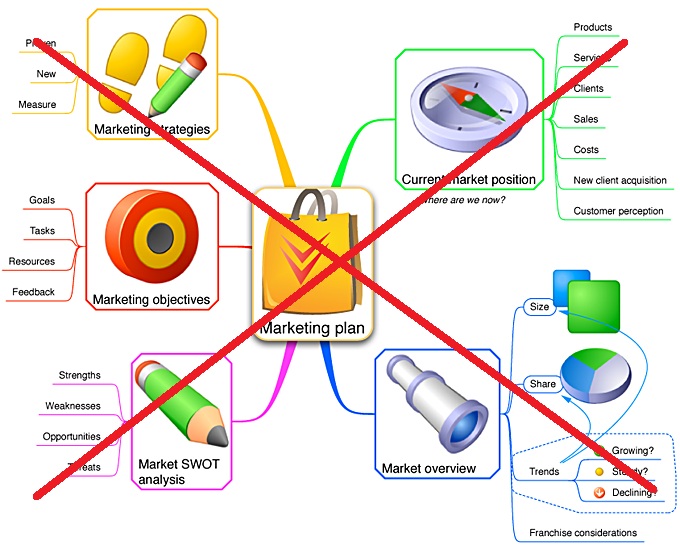
So, let me tell you about Brandon: he is one of the principals of an interesting Angel Investing firm-with-a-twist. On his company’s blog, Brandon offers some of the best advice for testing your new business idea that I have ever read.

Not only that – like all GREAT ideas – it’s simplicity in itself … here’s what Brandon says:

Let me sum this up in one sentence:
As a startup or new business, the amount of time you spend writing up a sexy business plan to pitch investors would be better spent running a $500 PPC campaign testing your idea.

[Note: PPC = Pay Per Click online advertising]

You are lucky enough to live in a world with Google Adwords.  This is a good thing.  The costs of launching a new business online are hastily reducing to zero.  Testing a business idea or even a half-baked, half-assed business-sorta idea, is easy.  So do it.

Stop thinking about writing a business plan (that you mostly copy of some web template – be honest), and start here:

1. Register a domain name.  Doesn’t have to be good.  Starting a bird feeder biz?  Get birdfeederdepot1.com.
2. Get hosting, install the CMS [e.g. WordPress or Blogger] of your choice.
3. Make 3-4 landing pages.  Ask questions.  Find out some key answers to the market you are hoping to serve with your genius new idea.  Offer to sell your service right now.
4. Setup [a Google] Adwords campaign and spend $500.
5. Read the answers you get.  Scour the analytics, the keywords and clicks.  Any sale or response is good.  Email your new ‘customers’ and find out more about them.

The point is, this is so easy and cheap to do, you should do it.  There’s no risk in doing so, and the upside is possibly priceless.

It could save you from wasting 9 months of your life chasing a bad idea.  It could teach you what people really want, not what you think they want.  It makes you get serious.

Brilliant!

Home Business Success?

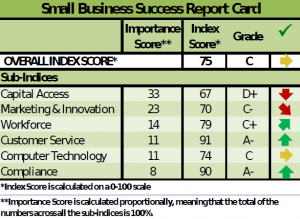
Andee Sellman, friend and occasional $7million7years contributor, refers to the Small Business Success Index study saying:

There are about 6.6 million home based businesses that generate at least 50% of the owner’s household income.

Now, assuming that home based businesses have either no – or very few – staff, I think that means that there are about 18 million home based businesses that are generating less then half the owner’s household income.

Now, think about this: the chances are that the whole household has a maximum of two full-time salaries – IF the owner of the small business runs it purely after hours …

… so, most home based businesses are making less than one full-time salary.

Let’s look at the most successful 6 million of these businesses: what are the chances that many of them are doing much better than “50% of the owner’s household income” – or, a maximum of one full-time wage (but, probably, much less!)?

Not much, I would think.

Now, there are exceptions: if you say that Facebook was a home-based business when it started … or, Apple … or, Google. But, most are just small online/offline concerns … low cost, low revenue, low return.

Chances are, you aren’t going to earn a lot from it, or sell it for a lot.

So, what’s the value of starting a home based business?

Well, unless you’re one of the very lucky ones, it’s in what you do with:

1. What you earn: this is extra income (assuming that you just haven’t thrown your old job in until it replaces your income … plus more) that you SHOULD be investing 100% of (some back into the business … some into outside investments, RE is ideal because the extra business cashflow can help fund any shortfall in the first few years), and

2. What you learn: there is no better way to learn about business than by running a business (preferably, with the resources of sites like Andee’s to help you); sure, my son made a couple of grand between the ages of 12 and 14 running his little eBay business from home … but, the lessons that he learned – not just business lessons, but Life lessons – will become priceless!

No, Michael Masterson’s 50%+ compound growth rate is reserved for businesses that can grow rapidly, have intellectual property that is both desired and protected, and have owners who are inspired by their Life’s Purpose to reach extraordinary heights …

… but, even the most humble home-based business can be a huge turning point in your financial life.

I highly recommend that you give it a go … and, keep trying until you find The One that helps you reach your Number 🙂

When is cheap debt expensive?

Dave Ramsey says to use Gazelle Intensity to pay down all debt, before even thinking about investing. Yet, would he consider running his (rather large) business without an overdraft, or leased cars, equipment, and/or furniture?

I doubt it … he needs to preserve his capital, and put it to better use by growing his business investment (more stock; better marketing; more staff; more training; etc.; etc.)

So, why should personal finance be any different?!

But, Dave Ramsey would argue to pay off all debt, whether it is ‘good’ (e.g. produces income) or ‘bad’ (e.g. credit card loans for consumer goods, like that LCD TV that you just bought).

If you are a regular reader of this blog, by now you will know that my view differs markedly; I say:

Once the debt is incurred, it is no longer ‘good’ or ‘bad’ … it becomes either ‘cheap’ or ‘expensive’.

And, as I mentioned in a previous post

You should only pay off your ‘expensive’ debt!

What makes a debt ‘cheap’ or ‘expensive’? What is the yardstick interest rate? 2%? 5%? 11%? 19%?

Any, all, or none of the above. You see, it’s relative:

– Debt only becomes ‘cheap’ when you have something that produces a better after-tax return [AJC: probably, a MUCH better return to account for the fact that paying off the debt is a GUARANTEED return].

– Otherwise, by default, all debt becomes ‘expensive’ and you should do as Dave Ramsey suggests.

Fortunately, finding suitable investments to offset the need to pay off relatively low-cost debts such as student loans and home mortgages is as easy as finding some great value stocks, a cashflow positive real-estate investment or three, or a small business to buy or begin …

… provided that these are things that you are:

1. Passionate about,

2. Educated in, and

3. Convinced are needed in order to achieve your Required Annual Compound Growth Rate to reach your Number.

I recommend that – if you are pursuing a Large Number / Soon Date – you must pursue your investments with Cheetah Focus … a great example is provided by Eric [AJC: emphasis added]:

I graduated college 2008 from the University of Texas. worked at an oil and gas company in Houston named Flour Daniels. they had massive lay offs in 2009. I worked for a year and managed to save well over 50% of my pay. I reinvested it all into the stock market. I set up a regular investment account and a Roth IRA.

To date my Reg. Stock account is up 30%+ and my Roth IRA is up over 60%. and I still have another month to increase my yearly gains for it

I have had no prior experience with investing/trading. I played safer stocks/ETFs .. Bought on dips and sold when it would pop.

Oh and I also took out a loan from Citi bank.. who sent me a 10,000 loan offer in the mail with a 2% interest for the life of the loan. LOL.. I had to take it. I threw that into stocks also.

Any how my point is. If i had focused on paying off my $28,000 college debt I would have missed all of last year gains. I just made it a goal to beat my debt interest. and I did!

Currently I have enough money to pay off all my debt. but of course i’m not going to do it. I took out 2K from my portfolio to invest in an online woman’s clothing site. We have great style at affordable prices. we are not making huge profits.. but we are selling and that is encouraging.

Did you notice in the image (above) why the gazelle has such intensity?

It’s because the cheetah is coming up fast and furious on his tail 😉