5 Secrets Of Self-Made Millionaires

I’m a voracious reader of anything that purports to teach you how to be rich … when I needed to learn, I read everything hoping to find ‘the answer’ … and, after I made it, I continued reading (but, I must admit that I am more discerning now) mostly out of curiosity (to see what others are saying).

In both cases, I was almost invariably disappointed … hence this blog.

But, I was pleasantly surprised to read an article with a [groan] headline: 5 Secrets of Self-Made Millionaires

… it’s actually not that bad. Not rocket-science, but not anywhere near as bad as most similar articles and books are.

Here are the 5 ‘secrets’ and my take on each:

1. Set your sights on where you’re going

T. Harv Eker, author of Secrets of the Millionaire Mind [another groan] says:

The biggest obstacle to wealth is fear. People are afraid to think big, but if you think small, you’ll only achieve small things.

Wanting to be wealthy is a crucial first step.

I obviously agree; if you don’t understand why, you must be a new reader [Hint: It’s to do with discovering your Life’s Purpose and Your Number / Date]

2. Educate yourself

You’re reading this blog post … and, I wrote it, didn’t I? ‘Nuff said 🙂

3. Passion pays off

See 1. above … ZZZZZzzzzzzzzzz

4. Grow your money

Well, d’uh!

But, Loral Langemeier, author of The Millionaire Maker, adds something sensible:

The fastest way to get out of that pattern [the never-ending cycle of living paycheck to paycheck] is to make extra money for the specific purpose of reinvesting in yourself.

[AJC: I would delete the last two words, which are hokum; it doesn’t cost much to “reinvest in yourself” except time … for example, this blog is FREE].

I like this part [AJC: I bolded the part that I like the best … I like it, because I did it, too; that’s how I raised the capital to expand to the USA i.e. from profits left in the business]:

A little moonlighting cash really can grow into a million. Twenty-five years ago, Rick Sikorski dreamed of owning a personal training business. “I rented a tiny studio where I charged $15 an hour,” he says. When money started trickling in, he squirreled it away instead of spending it, putting it all back into the business. Rick’s 400-square-foot studio is now Fitness Together, a franchise based in Highlands Ranch, Colorado, with more than 360 locations worldwide. And he’s worth over $40 million.

I also like:

If you want to get rich, you need to pay yourself first, by putting money where it will work hard for you—whether that’s in your retirement fund, a side business or investments like real estate.

5. No guts, no glory

If there’s any one secret in all of this, it’s this one:

Iif you are a timid mouse (like me), you either have to learn to roar (like I had to) or learn to live with a Small Number / Never Date.

Getting the Life’s Purpose ‘religion’ is one way to put the fire in your belly … it worked for me.

Oh, and they leave the best secret to last (at least the author feels it’s the best), which is funny because this would then be Secret # 6:

The Biggest Secret? Stop spending.

I agree with everything AFTER the ‘?’ above 😉

If you don’t have the money to invest, don’t spend … it’s simple!

But, I don’t agree with this:

Every millionaire we spoke to has one thing in common: Not a single one spends needlessly. Real estate investor Dave Lindahl drives a Ford Explorer and says his middle-class neighbors would be shocked to learn how much he’s worth. Fitness mogul Rick Sikorski can’t fathom why anyone would buy bottled water. Steve Maxwell, the finance teacher, looked at a $1.5 million home but decided to buy one for half the price because “a house with double the cost wouldn’t give me double the enjoyment.”

Don’t believe that Millionaire Next Door cr*p; some multi-millionaires are frugal – even some Billionaires (most notably Warren Buffett) – but, don’t be fooled into believing that’s the majority of multi-millionaires:

I have a friend who works for a 35 year old Russian immigrant who is now a hugely successful hedge fund manager (yes, he’s survived the GFC as far as I know. I’ll check when I’m on Safari in South Africa with my friend later on this year); my friend overheard him explaining to his daughter that he was going to take the family jet to a business meeting, so she would need to fly on a commercial airliner with her mother to get home from their vacation.

This is what he said to his daughter: “You know that there will be people you don’t know on that plane” … at 8 years old, she had never flown other than by private jet!

Another friend works in MLM and had breakfast with that company’s # 1 distributor – a nice, young lady. She receives a $600,000 check every month. She just bought a mountain in Colorado and a special tractor, so that she could grade her own private ski run.

I hope she puts a lot aside for a rainy day; gives overly generously (money and time) to charity and those in need; and, joyfully spends the rest!

I have a simple rule: spend freely, when it doesn’t make sense not to.

Think about that, and let me know what you think it means …

What difference does 1/10th of 1% make?

Brian Tracey makes an interesting observation of making tiny, incremental changes which accumulate over time to make huge differences.

You could apply this principle to anything: for example, if you want to save 26% of your income (not a bad goal if you want to get rich slowly, with inflation chasing your tail), just start by saving 1/10th of 1% of your income today, and increase that amount by 1/1th of 1% each day until you reach your goal.

Use your ‘golden hour’ to read the personal finance headlines at http://personal-finance.alltop.com/ looking for money saving tips and you’ll find plenty of fuel for your daily 1/10th of 1% increased savings goal.

I’ve committed a blogging faux pas …

It seems that I’ve committed a blogging faux pas … unintentional, but a faux pas nonetheless.

You see, Planting Dollars ‘tagged me’ way back in January and I was supposed to tell you 8 Random Things about Me!

The fact that I only stumbled across the back-link now – not to mention that I have no idea what ‘tagging’ really means, but I’m guessing it’s some sort of ‘chain letter’ in blogging post form – tells you a little about how much I really know about blogging (even though I’ve been doing it for a couple of years, now).

Anyhow, it seems that Planting Dollars and I have some commonality, so here goes:

Planting Dollars has been unlucky enough to break bones on 5 separate occasions. I’ve only done this once, but it was a beauty: broke my tibula (shin bone) and fibula in a compound (multiple breaks i.e. I broke both bones) and complex (because I got to see a sharp end of bone poking through my skin), and have 4 screws in my leg (still there, to this day) and a nice long (36 stitch) scar to remind me of the unpleasant teenage episode.

He can’t get enough of scuba and sharks! In fact Planting Dollars studied abroad in Australia for the sole purpose of having the ability to dive in the Great Barrier Reef and with sharks. On the other hand, I already live in Australia, can barely swim (although, I somehow managed to get some sort of swimming certificate for swimming the length of a pool fully clothed, including shoes … I think I was just progressively drowning, and randomly ended up at the other end), and much prefer card sharks to white pointers. 

Planting Dollars is a myers-brigg ENTP personality type.  Apparently that means he’s “most attracted to the idea of being a renaissance man or jack of all trades.  New experiences and ideas are what motivate me, I cannot stand routine.” As much as I hate ‘pop psychology’, I must also be an ENTP-type as this describes me to a tee … I detest routine, but love “new experiences and ideas”. 

His highest bench press thus far is 350lbs. Mine? About 35 lbs … haven’t you seen my videos?! But, I used to be pretty athletic: an excellent runner, and an avid lacrosse player (I had no idea that those uniforms denoted FULL CONTACT until it was too late!).

Planting Dollars plays the piano and drums and will eventually learn the cello. I love music but have almost zero talent; I try to sing (a lot), but even my kids don’t let me! But my musical tastes are eclectic, to say the least: I have everything from (the real) AC/DC to Pavarotti, Il Divo, Eminem, and The Fugs on my iPod. Oh yes, I also have Kelly Clarkson, and I’m proud of it 🙂

As a kid, Planting Dollars drove his mom crazy wanting to have a lizard as a pet. Now, I’m not sure what this says about me psychologically (but, I can assure you that I have no homicidal tendencies), as a child my sister and I used to hunt for little lizards (calls skinks) when on vacation in the Australian countryside. We would invariably come back with a few in a box (of course, some would always escape and run around the house, which my mom just loved …. not!). I won’t tell you how I fed them … 

Most of his role models are dropouts. I have no role models. I think everyone is equally flawed (no doubt, Ghandi picked his nose; Warren Buffett gossips; and, the Queen swears in private), so we should all be our own man / woman / or both. Still, it doesn’t hurt to learn from others, but I strictly look for ‘how to’ lessons: so, if I go to a Warren Buffett AGM I’m looking for a tidbit of information, not how to duplicate his style. 

Planting Dollars absolutely loves Blue Moon Ice Cream. I’m lactose – and, people (mainly family) – intolerant.

‘Nuff said 🙂

How much is in your emergency fund?

How many months do you have in your emergency fund?

View Results

Loading ... Loading ...

I think this is a good time to take another look at your emergency fund; I’ll explain next week …

In the meantime, answer the survey to let us know how much you have saved specifically as an emergency fund, and leave a comment (if you like) to tell us why!

Would you donate your last penny?

They say that the will to give – to donate – generously is governed by a gene. 

For those readers in – or approaching – MM301 (i.e. you’ve made your millions, now you are struggling with what to do with it), I want to test that gene to its fullest, by asking you a question:

Would you donate your last penny?

I can honestly say that I would not …

Which brings me to a related topic: it seems that many people who come into money take a chunk of it to donate. Perhaps to have the wing of a school named after them, or to do some other ‘good works’.

Whether the sum is $1,000,000 or $100,000 or $10,000, when donating what you consider to be a large sum, think about what you are really donating; you are not merely donating $1,000,000 (or $100,000 or $10,000), you are donating the future value of $1,000,000:

Let’s say that you plan on living for another 40 years, and you can invest your money at 5% above inflation, then the real value of your donation is not $1,000,000 but more than $6.7 million!

[AJC: if inflation runs at 4%, and you can get an average return of 9% over 40 years your $1 million will grow to almost $29 million, but inflation takes away a huge chunk of it!]

When thinking about donating that $1 million [AJC: The Cartwood Family Wing does sound tempting], I’m not really thinking too much about that $6.7 million [AJC: or, $28.8 million … ounch!], I’m actually asking myself:

Would I donate my last $1 million?

You already know the answer to that 😉

But, why?

If all goes belly-up in my financial life, I really may have just given away my last $1 million … in other words: if I lose $6 million, I am now broke (since I already gave away the 7th million of my 7m7y).

That’s why I would never donate a lump sum … instead, I would invest that $1 million for the benefit of charity. Further, I would not even pledge the capital or the income stream in advance, I would simply make the requisite donations annually and anonymously.

It may not get my name ‘in lights’ [boo hoo]; it may not help the charity with capital acquisitions; and, it may not be the most tax-effective method of donation (compared to, say, charitable trusts and the like), but it will help both the charity and me, long-term:

1. The chances are that I can invest $1 million far better than the people running the charity can [AJC: after all, I’ve made 7m7y]

2. It’s likely that the charity – or, some other equally worthy casue – can use $6.7 million more than they can use $1 million, albeit spread over 40 years; but, I admit that I’m just making a wild guess that the world will need philanthropy for at least the next 40 years.

3. If all goes belly up, and I end up becoming the one in urgent need of ‘charity’, I can ‘donate’ my last million (at least the income thereof) to myself and my family.

4. When I die, if I feel so inclined, I can finally donate either the asset or the income stream (or both) to the charity as I will no longer require it as insurance for myself. On the other hand, I may choose to pass it on to my family and let them decide.

I guess nobody will be talking about “AJ Cartwood, the great AustraloAmerican investor, raconteur, and philanthropist” … at least, not during my lifetime 😉

The problem with Henry …

Actually, it’s not the problem with Henry, it’s the problem with HENRY: High Earner Not Rich Yet.

Included in this group, a group that most workers mistakenly aspire to, are those doctors and ceo’s (at least those not in the Fortune 500) that I mentioned in yesterday’s post.

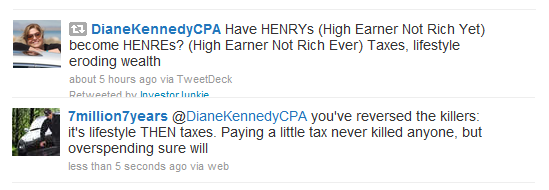
Now, this is only interesting because I can now answer the question posed on Twitter [AJC: you can glance across to the right to conveniently find a link to my Twitter account].

Dianne Kennedy (CPA), I think erroneously, links HENRY’s to taxes then lifestyle, but (as my article some time back about doctors also said), I think it boils down to three non-tax (even though taxes hurt!) issues:

1. As your income grows so does your spending … then some!

2. Keeping up with YOUR Jones (i.e. other high-flying corporate executives and professionals) is VERY expensive

3. You can’t sell a salary package (like I can sell a business, some shares, or a property or two) when you decide to retire

[AJC: You need both a big 401(k) – see reasons 1. and 2. why this doesn’t happen – and a huge golden parachute, which may / may not happen to compensate for reason 3.]

If HENRY’s want to become rich, they have only two choices:

– Get lucky, or

– Invest a very large % of their annual earnings

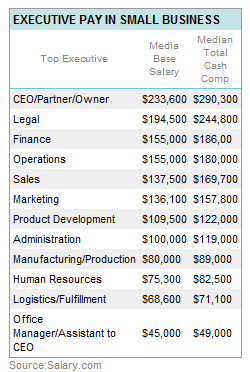
Let’s assume that a HENRY – conveniently named Henry who happens to be ceo of a medium-sized business – is earning $290,000 and has already managed to save $1 million – our consummate Frugal Investor – and has arranged things so that he can continue to save a very hefty 35% of his salary (this is all pre-tax).

After 22 years, Henry will have saved just enough (in Rule of 20 terms) to replace his $290,000 ceo’s salary … by then, inflation adjusted to $661k per year, assuming that he wants to maintain his lifestyle [AJC: more importantly, assuming that he can – and wants to – ‘ceo’ for 22 more years … if he ‘only’ starts with $500k in savings, he’ll need to work for at least 26 more years].

Seems easy, but human nature [read: urge to spend it up] is what it is …

I should know: I was ceo of my own business, employing over a hundred people across 3 countries (USA, Australia, and New Zealand).

I paid myself $250k per year, and had cars, cell phones, laptops, and health insurance all paid for by my company – I reinvested all the remaining profits in these businesses.

I had a $1.65 million house in the ‘burbs, paid for by cash (s0, no mortage), and two children in school (one private, one public). We traveled domestically and/or internationally once or twice a year as a family, ate at ‘normal’ restaurants (and, the occasional top-tier eatery).

I can’t see how I could have saved 1/3 of my salary … I couldn’t even save 10% 🙁

Of course, I could have saved 10% if I really tried, but my point is that it’s very hard to save 30% of even a high salary, unless you gear yourself up to do it from the very beginning.

[AJC: Look, it’s not my job to tell what should happen as you get richer, but the reality of what will happen and how to do better … when you get to $250k you will bring with you exactly the same spending and saving habits as you have today, if not worse. Moral: start MM101 today!]

In other words, don’t divert all of your creative energy into playing Corporate Lotto (i.e. chasing a higher salary) if you want to get rich – or, even to reach a more humble goal, such as becoming debt free (a dumb goal, IMHO).

First – and, as soon as possible – learn how to get rich (or debt free, or …) by taking action right now, with whatever you can bring to the table.

If your salary happens to improve along the way, all the better … but, don’t rely on it!

How much income do you need to be Rich?

In his bestseller, The Number (2006), Lee Eisenberg relates the story of a man who outlined for him what somebody else told him [AJC: already, this sounds like an Urban Myth] about what it takes to be rich:

This is really interesting, because it matches what I was told when I began my Journey (to $7 million in 7 years) by a well-known finance guru; at the time, he said [AJC: paraphrasing; my memory’s not THAT good!]:

In order to live a ‘rich’ lifestyle (i.e. you can drive the cars you want, live where you want, travel whenever and wherever you want) you need an income of at least $250,000 per year.

Now, that was back in 1998 … so, when I bumped into him a year or two ago, I reminded him of what he told me then, and asked him what he thought the ‘number’ was now: he said “$500,000” [AJC: that’s per year].

In fact, that $250k (times the 20 multiple that he also told me that I needed) was the exact basis for my $5 million Number, because I didn’t know how to calculate it any better (then) … and, along with discovering my Life’s Purpose, started the journey that totally changed my life.

Seeing this table, excerpted from Lee Eisenberg’s book [AJC: which, he admits ripping from somebody else … apparently, that’s how these ‘rules’ get written!] only reinforces that … so, just decide whether you want to be “comfortable” (or, “comfortable+”), “kind of rich”, or plain ol’ “rich” and  your Number is virtually set!

Which brings me back to the question of whether CEO’s are rich, in the first place?

[AJC: we already know the Fortune 500 CEO’s are, but what about the ‘ordinary’ CEO’s of all of those small-to-medium-size businesses out there?]

Really, it’s only the CEO’s of those businesses (and, their highly-deserving legal advisors) who can even claim to be “comfortable+”.

Most senior management in these businesses can only claim to be ‘comfortable”, at best …

… so, the real reason why most CEO’s aren’t rich is that they simply don’t earn enough!

My question to you is:

If you know your Life’s Purpose, and if you know your Number (particularly if it’s a Large Number / Soon Date) why are you wasting your time:

– kissing up to your boss,

– back stabbing your work mates, and

– running ragged for your company’s customers?

… just to have the slightest-possible-chance of getting to the ONE job in the WHOLE company that ONLY makes you “comfortable+” AT BEST?

Seems silly to me …

When I crunched those odds (way back in 1990), I very quickly made a rush for the Exit Door at my high-flying corporate job 🙂

Something from nothing …

In The Art of the Start, Guy Kawasaki (founder of garage.com, one of the earliest ‘business angels’) talks about bootstrapping your startup i.e. starting it on a shoe-string …

… he then proceeded to start his own Web 2.0 startup (perhaps only mildly successful, although he did manage to sell it for an undisclosed amount in 2009), called Truemors for only $12,000 (you can read about it, in this excellent post)!

Now, Guy could afford to spend millions, yet he chose to bootstrap, because it made good, commercial sense NOT to spend more.

For most startups, bootstrapping is a necessity, yet how little you spend up front may not have any detrimental effect as far as the success of your business goes, as the HotOrNot.com video above clearly demonstrates.

BTW: to prove that point, Hot or Not was (reportedly) acquired for $20 mill. not long after this video was shot.

My point: don’t let lack of money be your excuse for not starting your own business!

The timeless secret to making money in real-estate!

OK, so if the ‘secret’ to making money hasn’t changed in 50 years …

[AJC: if you didn’t read yesterday’s post, it’s simple: buy a rental property with about 25% down; renovate; trade up and start again; repeat until rich!]

… why are there so few people doing it?

It could be market fever: “the market’s too [insert excuse of choice: hot, cold, near, far, etc.]”; but, I suspect it’s the age old reason: you simply don’t know HOW.

Ok, so let me make it simple: save up a reasonable deposit (15% to 25% works for me), and do the most cost-effective renovation (also called remodeling or rehabbing, depending on what country you live in) possible.

The question is, what are the best ‘bang for buck’ renovations to do?

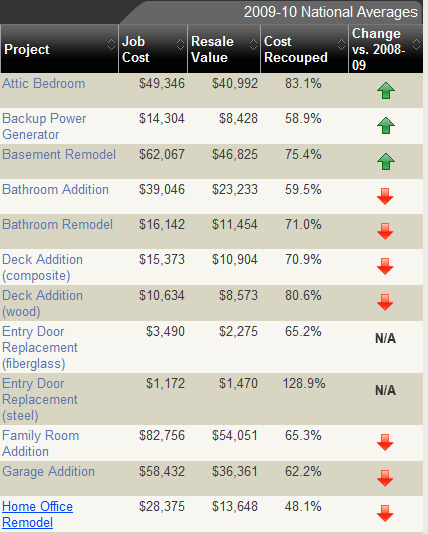
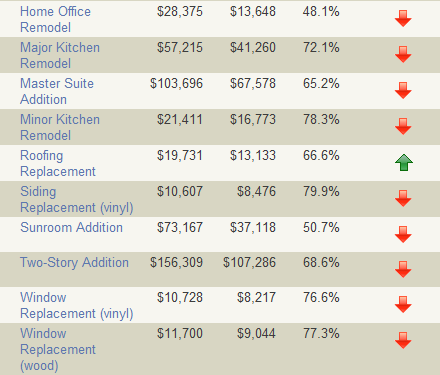
Well, here is a national summary of typical renovation/remodeling projects (including their average cost and how much resale value that they add to the project):

Despite this, I would not go about replacing all of the wooden front doors in my condos with steel doors! In fact, I would still look at:

1. Repaint / recarpet,

2. New blinds, door handles, light fittings (all of these can be quite cheap, as long as they work/look OK),

3. Kitchen remodel (you may be able to resurface the existing cabinets)

4. Bathroom remodel (you may be able to resurface the existing tiles, baths, and vanities)

5. Also, if it’s a house (not a condo), then you should paint the exterior and fix up the garden

6. Again, if it’s a house, perhaps the MOST ‘bang for buck’ rehab that you can do is to add another bedroom (especially to change a two-bedroom house into a three-bedroom house).

If you think it’s expensive, think again … just be very wary of your budget!

Here’s how it panned out for us:

We purchased one condo a street or two away from the beach:

– We bought for about $220k,

– Spent $15k on a rehab (paint/carpet, kitchen/bathroom remodel, door knobs and light fittings),

– Rented it out (we didn’t need to sell it).

It’s now worth $450k to $550k a mere 6 or 7 years later.

We then repeated with a block of 4 condos:

– Bought all 4 for $1.25 million,

– Rehabbed for $200k ($50k each condo), including the fees necessary to retitle from apartments (rental) to condos (rental or individual sale)

– It’s now worth $1.8 million to $2.25 million, a mere 6 years later.

For the four condo’s, we spent $50k in renovations (each condo: $200k total)), which bought us: paint inside/outside, new kitchen bathroom carpet, light fittings, security entrance for the building AND conversion of the front of the building into a private courtyard for one of the apartments, and conversion of the rear laundry into an ensuite bathroom for another condo in the block!

If you think the work is hard and/or time-consuming, we didn’t do the rehab on either project and didn’t even see the second project until 5 years after it was finished! We believe in outsourcing everything 🙂