
Anatomy Of A Startup – Part I

Not strictly about personal finance, but building a startup is one (highly risky) way of making $7 million in 7 years!

It also happens to be one of my twin passions (the other, obviously, being personal finance) … and, one of the key components of my Number was a $500k ‘startup fund’.

I realized – before I even made my 7m7y – that I wanted (amongst other things) to become a ‘venture capitalist’, but I was well aware of the 7-2-1 formula, which goes something like this; for every 10 startups that a VC funds:

7 will lose money (probably the VC’s entire investment)

2 will break-even (maybe even returning the VC’s initial investment, but not much more)

1 will make the other 9 ‘failures’ all worth while!

Based on these numbers, to invest in the ‘bricks and mortar’ world would be simply too expensive … especially if the 9 failures came before the 1 success (obviously, the VC doesn’t know which one will be successful or she would never invest in the other 9), but not so the online world.

It’s not a stretch to see that several – or, even 10 – (potential) Facebooks and Twitters could be created with a $500k investment pool and some smart, committed cofounders. If FaceBook was started with $1,800 (or so the movie implied), then $50k should buy a whole lot for one online business … and, $500k should be enough for all 10 that it might require to find that single, wonderful success story.

So, it seems that I am on the way having met with my two cofounders today. Unusually, I didn’t know them before hand …

But, I’m getting away with myself: this isn’t my first recent such startup (obviously, my older B&M businesses were also startups in their day, eventually being sold for tidy sums). In fact, I have two complete, functional Web 2.0 (whatever that may mean!) sites sitting on a shelf, gathering dust.

With both of those, I made the mistake of building Kevin Costner’s Field of Dreams (because, I already had the relationships with the right IT build team) and thought if they build it THEY – the right cofounders – would come. But, they didn’t 🙁

So, this time, I decided to find my cofounders first (marketing and operations) before funding the IT build. Pretty obvious really … not sure why I didn’t see it at the time. I guess it was the case of having too much money burning a hole in my pocket – and, burn it did!

So, this time, I patented the idea (another waste of money, but more to make sure I wasn’t infringing on anybody else’s turf), put up a couple of ‘stealth-mode’ placeholder sites, and set out to find The Team.

I realized that I needed people with experience in the online space; so I cast a search for “social marketer [my city]” (there’s a neat little tool you can use: google) and found a meetup group that happened to have a ‘mail all members’ facility … so, I joined and spammed all the members with a “looking for partners” message.

You don’t get anywhere in life by being conventional 😉

Today, the three cofounders met (me and the two I found by cold-calling for partners) and agreed that we’re moving ahead with my new idea …


Why climb Mt Everest?

Thanks to all of those who entered my SECOND $700 in 7 Days Giveaway; you still have a couple of hours to sneak in and submit your entry for what looks like a better than 1 in 30 chance to win the first prize of $350 in cash … that’s like $10 just for filling in a 2 second form!

If you refer friends, you will be in the running to win the second ($150), third ($50), and fourth prizes of ($50) CASH as well … right now, I’ll be struggling to give all of those prizes away, so that’s a pretty good hint. But, since you’re late to the party, you’ll have to find the entry form yourself. HINT: xxxx 😉
_______________________
I wasn’t spanked by my readers nearly as much as I expected for sharing my happiness with my mansion purchase (actually, two mansions: one in US and one in Aus), then again the purpose wasn’t to brag but to counter the idea that spending is bad.

In fact, spending is only bad out of context … $7 million in 7 years kind of context … when not spending would be even more absurd.

Anyhow, Josh did pull me up:

What’s the point? Maybe I’m missing something. Maybe it’s because my assets are in the 7-figure range and not the 8-figure range. But why spend $X Million on a home?

I live debt-free in a home that cost $300K. I could have bought a $2M+ home, but it seems so impersonal, pretentious, and secluded. I want people to come over and feel comfortable drinking beer with their feet up on the coffee table, or to let their kiddos run around carefree after coming inside on a rainy day. Even now, some people feel uncomfortable in my house because it is “so nice” for the area in which we live.

Well, why do people climb Mt Everest? What’s the point?

Because (a) it’s there, and (b) they can!

So, I have a very simple rule on spending that has kept me in good stead – through poorer and richer:

I spend money when it doesn’t make sense NOT to!

I became rich because I wanted to travel spiritually (that’s free); mentally (that costs me in time and ‘venture’ capital); and physically (that much traveling costs me a LOT of time/money: hey, I retired at 49 so I WANT to travel Business Class and stay in at least 3/4/5-star hotels).

So I set out to make my $7 million in 7 years to allow me to begin the life that I wanted to live (without needing to work) and was fortunate enough to succeed …

… and, one of the side benefits of that financial success is that I have plenty of cash for cars and houses, and vacations and bling. And, for charitable gifts and deeds 🙂

I write this blog because I wish the same for all of you …

AJC.

PS a big house doesn’t need to be pretentious; ours is homely and welcoming and people love it because they get to hang with us, play tennis, watch movies, and swim 🙂

Beating the ‘more’ bug!

Do you have the ‘more’ bug?

I certainly do, and I think that most of us do … in fact, I’m so sure of it, because I see hundreds of blogs and books solely aimed at eradicating the disease with drastic remedies such as self-flagellating frugality and anorexic debt diets.

Kind of reminds me of how we used to treat ourselves with blood-letting, hole-in-head-drilling, and leeching – actually, all still legitimate remedies in a tiny minority of real-world cases – because we didn’t know any better.

In those days, a ‘real’ doctor, prescribing a drug that they had discovered would have been seen as a heretic or master of the ‘black arts’ (Louis Pasteur, anybody?).

But, I’m getting ahead of myself … first, here’s how Scott (a doctor, plenty of disposable income, so he’s a prime candidate) describes the symptoms:

I think a big dragon that we all face is that human nature of wanting more. We all seem to do it to some degree or another. We’ll live in a 150k-200k house(which was probably an amazing home to our grandparents standards) and while there, we imagine that million dollar pad. Once we get that, we need a 5 million dollar one, etc..etc..and our number continues to climb with the chronic discontent and needing more.

As Scott says, it’s not such much a ‘bug’ as a human condition: to always want more.

To get a little metaphysical: if you were the Ultimate Higher Power and you wanted to design an environment with endless conflict (all the way up from a personal level to a global level), you would fill it with little creatures that you ‘program’ to always want ‘more’. And, you would give them the tools (opposable thumbs, a modicum of intelligence, and inventiveness) to ensure that they create an endless stream of upscaled ‘stuff’ to constantly fuel that desire.

What Eternal fun! 😉

Assuming that the ‘more’ bug is curable … or at least manageable … how do you deal with this seemingly insatiable desire for ‘more’?

Well, if it really is a disease or condition, then I’m not sure how easy it is to switch off the ‘more’ switch; maybe a 12 Step Program for Wants (might be a great online/offline business here for any psychologists who have a side interest in personal finance)?

But, if it is real – and, manageable – then another strategy might be to build in gradual spending/lifestyle increases into your budget. Allow the ‘disease’, but control it …

For example, I drive a BMW M3 Convertible (in Australia, this is a USD$200k car, due to low volumes, importation costs, and exorbitant luxury vehicle taxes) but I really WANT a Ferrari ($500k++).

So, I have given myself a target:

Develop and/or cash out (for a certain amount over purchase price) on my development sites and I ‘reward’ myself with the Ferrari (not as simple as that: I will also need a day-to-day car, so figure a $150k Audi S6 or Maserati Quattroporte, in addition to the Ferrari … repeat every 5 to 8 years). I think that some of the Sudden Money strategies that I posted about recently are ideal for managing this.

Another way to deal with this was suggested by Robert Kiyosaki: he said that he, too, wanted a Ferrari. His wife said that he could only buy one if he generated the income to cover it. So, he bought a self-storage business and used the income to fund the payments on the car … I’m OK with this: even though he’s funding the car, rather than paying cash, the capital is in an income-producing asset – one that really should increase in value over time.

And, it’s not a ‘real’ business, in that it won’t need a lot of ‘hands on’ management … of course, it’s not a real passive investment either. Other candidates could be automated / no staff car-washes; ‘coin’ laundries (the new kind that use cards instead of cash); and, some of the absentee-owner franchises.

[AJC: Just be warned, you probably can’t tax-deduct much – if any – of the vehicle payments. Contrary to what the financial spruikers and shysters will tell you, the IRS is not stupid: why do you need a Ferrari to help the self-storage business / car-wash / coin-laundry produce an income?!]

But, now that Scott mentions it, I do have a hankering for an island ;)

There’s something about Todd …

Poor Todd, where I don’t fear to tread, Todd (now) refuses to go:

Everybody hates Todd Henderson.

In case you haven’t heard, he’s the University of Chicago law professor who unwisely blogged about his financial woes in a post headlined “We Are the Super Rich.”

Mr. Henderson and his wife, an oncologist, make more than $250,000 a year, and apparently they’re struggling to get by. If President Barack Obama gets his wicked way, and tax rates rise for those earning more than $250,000 a year, Mr. Henderson says it will mean real sacrifice in his family.

It’s too easy to pelt Mr. Henderson with rotten eggs, as so many have now done. (He yanked the post, but way too late–and on the Internet, one’s blunders never die.)

Never, ever, ever again blog about how hard it is to live on $300,000 or $350,000 a year at a time when one middle-aged man in four can’t find a full-time job, and one in five can’t find any job at all.

Yeah, I understand that Mr Todd was whinging to people much worse off than him.

But, I’m not afraid to speak my mind – when it comes to money – after all, ever heard of “teach a man to fish …”?

A fund manager’s view …

This is a little different to all of those “this is what a millionaire thinks” posts, because Evan is in a support role (“my role is more brain storming and putting together documents and calculations….then I prepare materials for the planners’ second meeting and beyond”) at a financial planning office that specializes in sucking the blood out of – I mean assisting – high net-worth clients:

My role is more brain storming and putting together documents and calculations. So basically I see almost every balance sheet that may have significant net worth which goes through my office

Since I’m a sample of one, when it comes to high net-worth clients, it might be interesting to see what Evan sees:

The House is almost always Paid off

Prepaying your mortgage is always a hot topic on Personal Finance Blogs.  Everyone once in a while one of the big players in the field will put a post and it will garner tons of comments.  The comments are usually heated and go both ways about how the move is stupid and then invariably someone will say, its a great move.  Regardless of how you feel, most of the high net worth clients’ balance sheet that I see will have either a paid off house, or one with a very low debt to equity ratio.

They Almost Always Own a Business

Almost every high net worth client’s balance sheet has a business on it.  The types of businesses range from the mundane, lawyer who owns their practice, to beyond what I could have imagined as a viable business.

They Almost Always have Investment/Financial Advisors

Almost every single high net worth client/prospect is not hands on when it comes to their own investments.  Some are more active than others when it comes to asset allocation, but for the most part unless they are in the money business (fund managers, hedge fund execs, etc.) they just don’t deal with it.

Since Evan is coming from a position of observation of his sample size of many, I will observe from my position of a sample size of one:

– I found it valuable to have a business; indeed, it’s the ultimate driver of my financial success; even before selling the business I could use the spare cashflows (after attending to the business’ own growth needs) to fund a substantial real-estate and investment portfolio.

– I own a house, and almost always have … now that I am wealthy, I carry no debt on these houses, but started reducing my debt almost in proportion to the increase in my wealth. It’s not a strategy, just a happenstance. But, I will not hesitate to use some (perhaps, up to 50%) of that equity, if required to fund an investment.

– I certainly use an investment advisor – in fact, multiple; but (here is where my experience diverges from Evan’s observations) Evan says: “Almost every single high net worth client/prospect is not hands on when it comes to their own investments.”, yet the opposite is true for me. Could this be observation bias for either Evan (he does work for a financial planning/advisory firm, right?) and/or for me?

I would never hand the keys over to my Future Fortune [AJC: How do you make $1,000,000? Give an ‘investment advisor’ $10 million … and, wait!] to somebody who has not already made their’s … if so, why do they need me?

Thanks for sharing, Evan!

The key to untold wealth!

If you’ve been following this blog for a while, you may have the sneaking suspicion that I’m also a bit of a ‘mad scientist’.

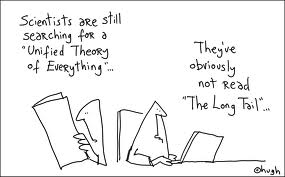
For example, I told you that, like Albert Einstein, I’ve been working on a ‘unified theory’ [AJC: I’m rather proud of this post, so go ahead and pull it out of the 7m7y archives by clicking on this link: The Big Papa lives in the 11th Dimension!].

Unlike Albert Einstein, though, I am (a little more) kempt; (very slightly) less absent-minded;  (a lot) less than genius (even a little more ‘less’ each year); and, have no Germanic accent, although my parents spoke the language fluently (but, never allowed me to learn it … it was their ‘secret language’).

On the positive side, unlike Albert Einstein who reportedly went to his grave with his secret, I have found the Unified Theory of Finance!

After literally years of searching – and, this blog has been a way for me to publicly articulate my thoughts, and get the feedback that I needed along the way [AJC: so, I will need to remember to thank all of my readers – that’s you! – at my Nobel Prize for Finance acceptance speech] – I finally made this Great Discovery (?!) on the weekend.

In fact, the breakthrough came in two parts:

The Search

Because I am (still) enamored with Sponge Bob, I was attracted to “Eugene Krabs“, who left his version of the secret formula for wealth in a seemingly innocuous comment on Free Money Finance’s blog:

I’ve boiled what I’ve read myself down to the following equation:

Wealth = Capital + Risk + Time

(To be clear, capital is the money you have right now to make more money with.)

Technically, any one of those factors can do it for you. For example, if you have a massive amount of capital, or if you take massive amounts of risk and beat the odds, or if you have a lot of time to build your wealth, then you can still become wealthy at the expense of the other two factors.

However, there are downsides to all of these individual factors.

Sensational stuff!

Unfortunately, I can’t thank “Mr Krabs” because he didn’t include any links with his moniker. On the other hand, you may quickly spot a few issues:

1. Clearly Wealth isn’t an additive of capital, risk, and time, it’s really a complex function. But, that can be solved by rewriting the equation as W = C * R * T or, even better yet, as:

W = Fn {C,R,T} i.e. Wealth is a (perhaps, complex) function of Capital, Risk, and Time.

But, understanding the math is not the point – I’m sure that Mr Krabs’ formula is meant as conceptual, not mathematically rigorous – it’s understanding that you need to balance Capital, Risk, and Time, if you want to become wealthy, that’s important … at least, according to a fictional cartoon character who saves every penny that he can get his claws on 😉

2. The more important point is that this version of the formula forgets Return; and, if we substitute Return (e.g. the 9% or 0.09 return that you supposedly get if you stick your money in the stock market for long enough), you actually have something very similar to the basic formula for compounding (which, at least according to Einstein, is the ‘most powerful force in the universe’:

3. Even if I somehow modified Mr Krabs’ simple version (and/or the more complex – but, correct – mathematical representation of compounding) to include both Risk and Return (a.k.a. Reward), the formula IMHO still wouldn’t explain why Warren Buffett is sensationally rich investing in exactly the same stocks that we invest in, yet we manage to lose money (in the short term, in absolute value, and even in the long term, certainly after inflation is taken into account)!?!

Until I can explain that, there is no formula 🙁

The Breakthrough

Still my gut told me that Mr Krabs [AJC: I love using his pen name … I’ll see how many more times I can fit it into this really very serious post!] was on the right track, because his representation did provide the missing simplification that I needed.

But, I kept hitting brick wall after brick wall …

… until last Sunday.

Last Sunday, I took my son and a few friends to play in their weekly teenage tennis competition [AJC: we all got free ‘slurpies’ from a 7-11 Convenience store on the way back home from tennis because it was 7-11 Day: November 7, 2010. Go figure!].

Instead of watching the game, I sat in the car with all my notes – pages and pages of complex math, simple math, all trying to fit Risk, Return, Capital, Time, and so on into a simple, conceptual ‘formula’ … all the while, trying to use it to explain the difference between you, me, and Warren Buffett.

As I said, until I could do that, I had nothing!

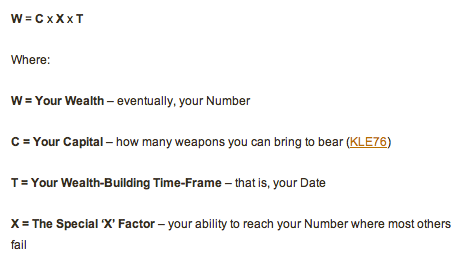
It was driving me crazy! So, I did the only sensible thing: I laid back the car seat and dozed off … but, when I woke up half an hour later, I had it:


“Is that all?”, you say [yawn]

Hell, yes!

Really understand this, and you have the key to untold wealth … in any field of endeavor.

I’ll explain the X-Factor (it can be explained!) in an upcoming post …

AJC.

PS Remember: this ‘formula’ is conceptual and is more correctly (but, still grossly) simplified as:

W = Fn {C,X,T} i.e. Wealth is a (definitely, very) complex function of Capital, The ‘X-Factor’, and Time.

The False War On Debt …

There’s a war raging out there: it’s being fought by authors and bloggers everywhere.

But, is it the right war? Is it a just war? Or, are we just throwing ourselves, by the millions, into a hail of fire: exploding spending, rampant inflation, the death of social security?

Sure, as we sit in the relative safety of our trenches (at least, that’s what we tell ourselves, until a random mortar shell of job loss or unexpected expenses chooses to lob our way) this is not OUR future … it’s somebody else’s, or it’s too far away, or it just can’t happen …

The sad truth is that legions have jumped the wall before us and have been brutally cut down for lack of an adequate nest-egg; it’s sad to see them go over the dreaded wall of retirement (be it their time, or forced on them early) without an adequate safety net … when they do, it’s as though their grim fate had already been sealed.

Broke – or ‘just’ financially crippled – and unable (for financial reasons) to live life as they had hoped, they are a sad, sad lot.

You see, the war that they fought wasn’t – isn’t – a just war. It’s not even a war … well, it shouldn’t even be more than a skirmish.

It’s the War Against Debt!

When it comes to that war, I’m strictly a pacifist; isn’t it better to simply avoid BAD debt?

Of course, that doesn’t mean that we can’t … shouldn’t … defend ourselves.

Far from it: if we find that BAD debt has snuck through our defences, let’s keep an eye on it. And, if we find that it’s also EXPENSIVE debt, then let’s whip out the Big Guns and wipe it out. Quickly, surgically …

… but, let’s not commit Debt Genocide.

You see, unlike the well-intentioned, but largely Debt-McArthyist “ALL Debt Is Bad, So Let’s Wipe It Out” rabble out there, let’s first ask The Missing Question:

What will you do after your debt is paid off?

“Well, start investing of course!”

But, does that REALLY happen? Who better to ask than Money Reasons:

This past February 2010, I became totally debt free, but now what!

I thought that there would be a period where I would break even for a while, and then start to plow about $1,000 extra each month into investments!  So now that it’s seven months later and how much extra did I save or invest?  Not a single cent!

Hang on, the whole purpose of suiting up for battle – for going to war against debt – was so that you could start investing, right? What’s up with that, Money Reasons:

Well it’s been a matter of bad luck with equipment breaking down and needing replaced and spending too much for our past vacation to Hilton Head Island!

But it’s also been a subtle form of LifeStyle Inflation!  Thinking back now, I realize that when wants would arise, I would just go ahead and buy it.  Yeah, I thought about it a bit, but I knew that I had the cash.  Then when your car and lawn mower broke down, I had the cash too…

Money Reasons should have started investing well before all of his debt was paid off … he should have started investing as soon as his expensive debt was paid off and left his cheap debt on a regimen of minimum payments.

The problem with this war is that it’s an unjust war; as TraineeInvestor said: “Debt is a tool. Paying it off is simply choosing not to use the tool.”

Yes, becoming debt free is simply a tactic

If you have to go and fight a war, don’t fight a war against debt …

… go and fight a war for investment 😉

Who cares what a millionaire won’t tell you?

I love (not!) these “secrets of how a millionaire thinks” types of articles, like this one called 10 Things A Millionaire Won’t Tell You [AJC: actually, this one really is quite interesting] …

… the problem is that they mix the poor millionaires in with the rich ones!

I’m not sure that I can define a ‘rich millionaire’ for you (seems like a tautology, but isn’t), but it’s something GREATER than $7 million, because I don’t ‘feel’ rich yet. Wealthy, yes. Wealthy enough to live my Life’s Purpose without ever needing to work again … just.

Extravagant, no … but, it would seem extravagant to you, wherein lies one of the problems: you may consider house with swimming pool and tennis court extravagant now. You may consider private schooling for your kids extravagant now. You may consider a BMW M3 Convertible and a Lexus Hybrid extravagant now.

But, when you become a ‘millionaire’ you won’t: you’ll expect the house + a second home in the country. You’ll expect the BMW and Lexus on the street + the ‘exotic’ in the garage. And, you will only want the best for your kids (unless you already live in a top public school district … then, watch your land taxes!).

You need to pin this down … now … when you are working on your required annual living expenses. Inflate this by 4% per year until you expect to retire (a.k.a. begin Life After Work). Multiply by 20. Add in your one-time costs (e.g. house/s). There’s your Number.

Which brings me back to my point; as the article says:

Some 10 million households have a net worth above $1 million, excluding home equity, almost double the number in 2002. Moreover, a recent survey by Fidelity found just 8 percent of millionaires think they’re “very” or “extremely” wealthy, while 19 percent don’t feel rich at all.

A millionaire, these days, can ‘safely’ spin off about $30k to $50k a year. That’s it.

If that makes me rich, then I was rich when I was still working my first job in my mid-twenties.

So, what does it take to truly feel rich, these days. Somewhere north of $7 million …

… Fidelity says the ‘magic number’ is about $23 million [AJC: citation needed; can anyone find the original Fidelity source for this?] before fat boy gets thong girl.

I won’t argue with that! 😉

Enough is enough!

Early Retirement Extreme wants to slay the ‘enough’ dragon; while, for many, ‘enough’ refers to their income and/or spending, in ERE’s case it refers to his investment net worth:

In terms of the invested assets dragon, I have several. I want to have a $500k net-worth. Once I hit that, I want $750k; then I want $1M. It’s been like that all along. It might just be my biggest source of stress— not being able to rapidly save money, which, rationally, I’m not going to spend anyway. It’s pretty stupid, I know.

And, before you think that “when I’m rich, then I’ll have enough” remember that when people who you and I think are rich (i.e. with net assets in the $5 million to $25 million range) are asked how much they will need before they consider themselves rich, they tend to say: “about double”.

That is, they tend to think that they need about twice their current net worth in order to feel comfortably rich!?

The solution is to prepare your definition of ‘rich’ … in advance!

… and, that should be to have enough money to live your Life’s Purpose. We call that number your Number.

When you get there, STOP because that is – for you – truly ENOUGH.

On the other hand, my ‘dragon’ isn’t income, investment assets, spending, etc., it’s my entrepreneurial gene … I see opportunity in everything and want to invest in it.

Right now, I’m working on my real-estate development projects, partnering with a young entrepreneur in his first bricks-and-mortar venture, and have any number of browser windows open with new technologies that I want to pursue.

Enough!

While it’s all fun, and mentally challenging, and fits totally within my Life’s Purpose, it all still takes money … so, in some ways, it’s no different to any of the other forms of ‘enough dragons’ out there.

So, how do I deal with my ‘enough dragon’?

Well, I built enough ‘fat’ into my Number to allow both the free time and the free cashflow to play with these new ventures: about 10 @ $50k a pop. Unfortunately, just one of my non-property business ventures is already in $100k territory, so I need to tweak by reducing the number of other ventures that I back.

And, as I’ve already said, this is easier said than done 😉

I’m quite happy in my mansion, thankyou!

This is the view from my tennis court (taken just as the house was almost ready to move into). Which neatly brings me to Budgets are Sexy, who asks: “do you you still want to live in a mansion?”

D’uh, yeah!

The problem is that the example that he cites is so far away from being a mansion, that it barely qualifies as my second house which, BTW, I am still trying to get rid of!

On the other hand, this guy is carrying a monthly mortgage payment of $2,200 which, at 4.75%, means roughly a $450k loan, plus his equity of $500k (now) to $1.2million (pre bubble) means that his idea of a ‘mansion’ is a house b/w $1 million and $2 million. About the same value as my house in the USA.

Oh, and I paid cash for both of my houses.

The point here is not to brag, that would be unseemly and [AJC: I know it’s hard to believe from what you read here] is a little out of character. The point is to set your expectations, particularly if your Number points you to a similar $7 Million 7 Year lifestyle.

Look, a $1 – $2 million house is nice, and in a poor area, where land and building costs are cheap, it may very well qualify as a ‘mansion’ …

… but, in a reasonable area, I don’t even think that my new house qualifies as a ‘mansion’ – well, IMHO, barely – yet it cost $5million+ and has a tennis court, heated swimming pool, home theater, sauna room, and each bedroom has it’s own study and en-suite!

Having said that, I agree that the running costs are huge: you can’t wash this many windows and glass balcony panels yourself (we spent $50k+ to install the glass panels plus another $70k on glass windows and doors, alone); you can’t clean a house this big yourself (we have a cleaning lady almost 2 full days a week); you can’t garden a place this big yourself (well, you probably could, but I hate gardening); and, imagine the cost of heating, cooling, and lighting the damn house.

But, if you have the money to live your Life’s Purpose (without ever needing to work again), you give back in more ways than one, and you still have enough money left over to buy the house of your dreams … then I can highly recommend getting the mansion …

… so far, it’s everything it’s cracked up to be 🙂