One of the best tips for small business owners …

One of the very best wealth-building secrets for business owners has nothing to do with improving your business … and, everything to do with turning that spare cashflow into appreciating assets:

Just like buying your first home is a 7million7years key wealth building strategy, so is owning your own property for small business owners, just as the guy in this video recommends … I can’t vouch for his financing strategies as I don’t know enough (but perhaps some of our readers do?) …

… but, simply buying my own office generated in excess of $1 million extra net worth for me in just 5 years.

I bought an office block for $1.27 million; I then completely rehabbed it (including new offices, workstations, phone system, and computer equipment) for another $500k, which I leased over 5 years (with a $1 balloon/final payment).

The mortgage interest and the lease payments were 100% tax deductible from my business income (actually, I charged myself a high commercial rent as the property was in a different company name).

I sold the building for nearly $2.5 million just 5 years later!

You gotta know your customer …

If you’re in business, then you had better get to know your customer. I’m sure that you’ve heard that before, but what does it really mean?

The true meaning hit home for me not long after I received this unsolicited e-mail promoting a new rating service for bloggers:

For the first time, publicists will be able to research, connect and manage Social Media relations in a single integrated platform.  MyMediaInfo has scored thousands of blogs based on key metrics creating the MMI score.  A trial is available at http://mymediainfo.com/register.jsp or give us a call at (888) 901-3332 to speak to a product specialist.

Excellent!

Point 1 of getting to know your customer:

Bloggers are vain/curious … they want to know that their blog is being read, and how it rates against other blogs [AJC: c’mon … if you’re a blogger, you can’t tell me that you aren’t checking your site stats quite often!].

I’m no exception, so I click through to their web-site and am sent a confirmation message:

Thank you for registering for a free trial of MyMediaInfo. A product expert will call you within 1 business day to activate your account and provide a brief tutorial.

Bummer!

Point 2 of getting to know your customer:

Bloggers are shy; no way does a blogger want to hand over their personal contact details and phone number to anybody [AJC: except maybe the publisher of the New York Times].

Here’s what I said:

Uh, this is the internet and the world of bloggers … we stay semi-anonymous, so don’t expect a big take-up on providing phone numbers!
 
I recommend that you provide a trial link that speaks for itself and only requires an e-mail address to register … bloggers will only be interested in seeing how their own site ranks, anyway 🙂

You gotta know your customer 😉

If you’re also a blogger, would you have registered and given your phone number? Maybe you’re not as shy as me?

The One Minute Business Checkup!

My blogging friend, Andee Sellman has unveiled a corker … but, I have a STRICT no advertising, no product placement or promotion policy …

[AJC: it’s the only way that I could think of to convince people that I’m genuine, after all, do I want to say to people “I made $7 million in 7 years, plus an extra $4 a week from my blog” 😉 ]

.. so, I’ll just gently lead in with a story instead:

Many years ago, in a very short-lived experiment, my parents bought my sister a flower shop [AJC: mistake # 1].

However, because they knew that she wouldn’t take any of their advice (just the shop sans advice) they asked me to take the other 50%, which I agreed to [AJC: mistake # 2].

Unfortunately, I had no business experience in those days, so it was like ‘the blind leading the blind’ … however, I did go looking for help.

One of the first things that I tried to do was get some help on the NUMBERS that the shop should run according to; things like:

– What % of our sales should the flowers and other materials that we bought account for?

– What staff and other administrative costs should we allow?

– What salary should my sister draw?

Unfortunately, my accountant wasn’t much help [AJC: he basically told me to come back when I had a tax problem … when the problem was, we weren’t making any money, so there was no tax!], and I did find a benchmarking report on florist shops, but it didn’t really tell me what the numbers meant or, much more importantly, what to do with them.

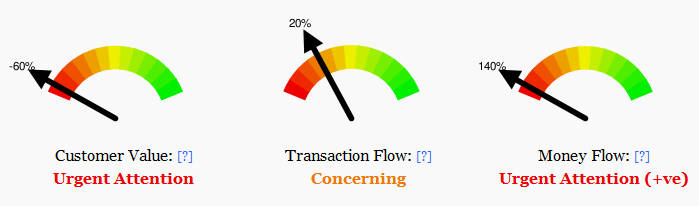
That’s why I was really interested when Andee sent me a link to his new tool – I’ve checked and it is totally free – called the One Minute Business Checkup … I think it would have been of great benefit – even though it is fairly simple, and works on just three (that I could see) critical benchmarks:

A. CUSTOMER VALUE MEASURE

This measure looks at how much of the customer value you are retaining in your business by looking at the value the customer pays you and deducting the cost you incur to make those sales.

From experience we know that if the customer value measure falls below 20% a business will struggle and may fail completely so that is why the benchmark is set at 20%. i.e. retaining 20% of the customer value as a return to the business owner.

Example of Measure

Sales   $500,000
Product $250,000  
Business Owner $50,000  
People $50,000  
Marketing Costs $20,000  
Distribution Costs $30,000  
Total Costs   $400,000
 
Customer Value Retained   $100,000
 
Percentage to Sales   20%

B. TRANSACTION FLOW MEASURE

The transaction flow measure is about determining the volume of sales that is running through your business. A business may have very high customer value (margin) but only a trickle of sales to take advantage of that value.

Our quick way of measuring transaction flow is to look at administrative cost compared to the sales in a business.

We have found that to be sustainable a business needs to spend no more than 12% of sales on its administrative costs. Often small businesses need to INCREASE SALES rather than decrease administrative costs to achieve this percentage.

Example of Measure

Sales $500,000
Administrative Wages $30,000
Administrative Expenses $20,000
Total Costs $50,000
 
Percentage to Sales 10%

C. MONEY FLOW MEASURE

The money flow measure is designed to find where the money is hiding in your business. Does money flow easily or are there places in your business where it gets ‘stuck’ and takes time to flow through to you.

A very significant place that money hides in your business is called working capital. There are three significant items:

  1. Inventory – this can be raw materials, work in progress or finished goods
  2. Accounts Receivable – this is money owed to you from customers
  3. Accounts Payable – this is money you owe your suppliers

Money can get stuck in inventory and accounts receivable. It can also be lost from the business by undisciplined payments to suppliers.

The activity in your business can be measured by sales and this needs to be compared to the working capital invested in your business. We have found that to be sustainable and to give your business the best chance to grow, working capital should be no more than 12% of sales. Beyond this, too much of your money gets tied up in the business and is not available to fund growth.

Unlike the other two measures the money flow measure can be negative.

Negative working capital is a very dangerous situation needing urgent attention.

Example of Measure – Positive Working Capital

Inventory $30,000
Accounts Receivable $55,000
Accounts Payable -$35,000
 
Working Capital $50,000
 
Sales $500,000
 
Percentage to Sales 10%

Example of Measure – Negative Working Capital

.

Inventory $30,000
Accounts Receivable $55,000
Accounts Payable -$95,000
 
Working Capital -$10,000
 
Sales $500,000
 
Percentage to Sales -2%

If you have a small business, I recommend that you give this a try [ http://oneminutebusinesscheckup.com/ ] and let me know what you think?

Stuck for a new business idea?

I’m not sure why anybody would be stuck for a business idea?! We get at least one million-dollar idea a day [AJC: you may not think so, but it’s anytime that you are dissatisfied … inside every problem is a million dollar solution just waiting to break out], but we either fail to recognize it or – more likely – act on it.

I have two solutions:

1. Carry a small pen and a notepad (yes, an iPhone or PDA is a great substitute) and …. use it!

Write down every idea that you get, then make sure that you act on each: do something to verify that your first idea has / hasn’t merit and … act further: do some research, talk to somebody in the industry, etc., etc. If you feel, at any stage, that it isn’t for you, put a line through it and REPEAT for Idea # 2 and so on.

2. Or, if you are The Vacant Parking Lot Of Business Ideas, don’t fret … just buy this book (Hint: buy the .pdf from his web-site at half the price that Amazon charges).

Disclaimer: I haven’t read the book, but that’s not the point … as far as I am concerned, it only needs to give you a list of ideas to explore – any additional valuable content is a bonus.

Still not sure that you want to spend the ten bucks on helping you reach your Number? Shame on you … but, here’s an excerpt, anyway:

Travel or invest?

Ryan from Planting Dollars asks:

Having been raised by self made real estate millionaires it’s not shocking that I agree with the vast majority of what you have to say.  The reason I’m emailing you is because I was wondering if I could get your advice.

As a 23 year old recent college graduate I understand the power of real estate investing and building businesses, but at the same point would like a nomadic lifestyle and be able to travel while living frugal at a young age.  In my experience real estate and most business ventures aren’t possible with this lifestyle.  So I’m simply wondering:

If you were in my situation, how would you perceive this challenge and what types of businesses would you pursue?

Simple: anything internet!

Specifically, anything internet that trades in downloadable products and services (information products are ideal), or of the ‘virtual infrastructure’ type (e.g. FaceBook) … of course, once you become successful, you will need staff and support of the financial kind, and these require phyical access more often than not [AJC: Venture Capitalists are soooo 90’s 🙂 ].

That’s the short answer; now for the long answer 😉

The first thing I would suggest that Ryan do is to ask the “self made real estate millionaires” who raised him for their advice … after all, they’ve been there / done that … know Ryan better than possibly anybody else … and, being a parent myself I have no doubt that they ABSOLUTELY have his best interests at heart!

As to the second part of Ryan’s question, which asked whether I would “place travel and new experiences in [my] twenties as more important or less important than investing and capturing the time value of money?” 

The easy answer is that (by some coincidence) I just addressed this in some small way in yesterday’s Video-on-Sunday post …

…. but, the harder answer is “it depends”:
 
– I would rank those Life Experiences very highly

BUT

– If the desire to be an entrepreneur burns bright, and you have a rip-snorter of an idea just bursting to get out … well THAT can be the “new experience” that Ryan mentions, and it may very well more than make up for itself by funding your future travels.
 
I would be willing to delay a boringly ‘normal’ savings plan a little for those one-of-a-kind of Life Experiences.
 
Let’s say that you do decide to compromise, by being that nomad, yet starting a business; what’s the ideal business for this sort of traveling, hands-off lifestyle?

As I said above, anything Web, however I suggest that you buy a copy of the 4-Hour Work Week first!
 
But, I would also say not to be so quick to discount real-estate …

… I maintained 5 condo’s and a small’ish office block in Australia whilst I was living in the USA.

Buy anything by Dolf De Roos and Dave Lindahl, both of whom claim to own real-estate in far flung places (Dolf across the world, and Dave across the USA) and learn all you can about ‘hands off’ real-estate ownership; it can be done.
 
Of course, Ryan still has direct access to Millionaire RE mentors … so, he should first ask his parents what they do with their RE investments when they wish to travel?

A (post)Vacation Question – Part III

Now that we’re back from vacation I can retain my blogger’s right to semi-anonymity, yet risk little by answering Mike’s [and, some of our other readers’] question:  “Which beach in Australia is this?”

Noosa in Queensland.

After discussing the real-estate ‘deals’ of Bill the shaved ice man, and Massimo the ice-cream man [AJC: did I mention him?], while buying – naturally – shaved ice and icecream, as one does when in Noosa on vacation, now that we were finally home and ready for a change of scenery …

… we discussed bank-financing of real-estate on our way back from buying ice-cream at the 7-Eleven store not far from our own home 🙂

The conversation went something like this:

Son: “Why has the bank invited you to their private corporate box at [a certain upcoming international sporting event]?”

Father: “Well I have a lot of money on deposit with them”

Son: “But, they have to pay you money [interest], aren’t their important customers the ones that they lend money to and who have to pay the bank money?”

Father: “Good point!”

So, I explained to my son that I am now both a borrower and a lender to my bank:

– As a lender, they pay me roughly 3% on the money that I have sitting in their bank,

– As a (recent) borrower, they charge me roughly 7% (interest + bank fees and charges) on the money that they lend me.

Son: “So, they only make 4% interest … is that enough for the bank to make money on?”

Father: “Don’t feel too sorry for the banks!” 😉

As I explained to my son, the bank is like any other business buying a product for $3 (or, in the bank’s case, borrowing money for 3%) and selling that same product for $7 (or, in the bank’s case, lending money for 7%):

They are operating on (at least in this example) a 133% Gross Margin.

Most people DREAM of having a business that operates on 133% Gross Margin …

… of course, the banks have costs:

– They have to carry stock (i.e. pay interest on funds deposited) even if they don’t sell it (i.e. lend it) … unlike a ‘normal business’ the bank has these great treasury departments who simply put this ‘spare money’ into the short-term money market and earn interest,

– They have the usual staff, office lease, and overhead expenses of any other business,

– They have the risk of fraud / credit default on the money that they lend out.

All of this is factored in to produce a Net Profit that is amongst the best of any type of business (GFC aside). This got my son thinking:

Son: ” So, why don’t you put your money in a safety deposit box and lend it out to other people instead of letting the bank make all the profit on your money?”

Well, as I explained, I actually do: I have a finance company of my own, and we look at our finances this way; the interest that we charge our clients is treated as ‘fees’ … we divide that Fee Income (very roughly) into three parts:

– 1/3 goes to pay the bank’s interest and fees on the money that we borrow from them to lend to our clients,

– 1/3 goes to pay our staff, rent, and overheads, leaving

– 1/3 which goes to our [AJC: my] profit.

This is strikingly similar to the ‘standard’ restaurant formula:

– 1/3 goes to pay for the raw material [AJC: pun intended 😛 ],

– 1/3 goes to pay their staff, rent, and overheads, leaving

– 1/3 which goes to their profit … of course, that’s the theory but the reality for restaurants and many other businesses is vastly different (but, that’s a subject for another post).

So, why don’t I do what my son suggests for the bulk of my money?

Simple: I don’t have the ability to handle the credit / fraud risk!

But, the bank can because they have the people, the systems, and the sheer bulk of money out there which effectively spreads their risk (IF they have followed sound credit lending policies ….enter housing crash and GFC).

Later on this week, though, I will tell you how YOU can become the bank … without the risk.

Stay tuned!

A Vacation Question – Part II

But, what about the other financial question that my son asked while we were on vacation?

Well, we were walking along the beach and Bill, the shaved ice vendor, drove past with his little all terrain vehicle pulling his ‘shop’ behind only to stop a few yards up the beach to tempt my son – and, the many other children running along the sand and swimming in the warm surf.

Naturally, I  quickly became $3.50 poorer and my son had his paper cone filled with shaved ice with various color sweeteners poured over it (he chose ‘rainbow’ flavoring), which got us talking:

You see, it’s popular folk-lore that Bill, who has been selling his flavored shaved ice along the beach for 20 to 40 years, owns many of the apartments in the vacation rental buildings all around [AJC: check out the aerial shot in yesterday’s post] … if true, then Bill is the poster-child for the Wealth Alchemist i.e. turning temporary cashflow into long-term assets.

It’s not hard to see that Bill turns over thousands of dollars a day, most of it costing him nothing (little staff, few overheads, little-to-no-cost-of-goods-sold), after all, how much can ice cost to make?!

Instead of spending all of that money, it’s not a great leap to assume that Bill saves up enough for a deposit to buy a property every now and then; we figure $1 million worth of property each year (with 20% initial equity).

Here is my son’s question:

“Would he pay cash for the properties, or would he just save up enough for a deposit and borrow the rest?”

Now, this is a seemingly simple – yet terribly interesting – question; one that we could labor over for many posts … instead, we’ll look at this another way, by asking:

“Does Bill need the property for income now or for its future value (hence, future income)?”

The answer is clear: Bill has plenty of income now, but what does he do if his income stops?

Presuming that he can’t rely on being able to sell his business (for example, the council could decide that they no longer want people peddling ice on their beaches), then Bill will probably want his properties to generate a replacement income “one day”.

So, which would do that better? When Bill moves into MM301, it’s likely that owning the properties outright and living off the rental treams that they throw off will be best …

… until then, Bill has to (in my opinion) work on the strategy that will produce the most properties by the time he wants to retire.

So, I had to explain the concept of leverage to my son:

SCENARIO A: If you purchase a property for $100k CASH and it doubles in 10 years, then you have $200k of property. Well done!

SCENARIO B: But, if you purchase TWO $100k properties, putting $50k deposit into each and borrowing $50k for each from the bank, then in 10 years (assuming they both double), you now have $400k of properties, of which you owe the bank $100k (assuming that you haven’t paid down any of the loan in the meantime), leaving you with $300k of property … a $100k improvement over Scenario A.

At least, that’s what the property spruikers would have you believe …

… because, they have conveniently forgotten that in Scenario A, you also have some rental income (after, say 25% costs) coming in, whereas in Scenario B that income would be largely offset by interest owed to the bank.

The question is, is that differential in income ‘worth’ $100k over 10 years?

Let’s assume that we can get a 5% return from our Scenario A property (after costs), giving us $5k a year initially (when the property is worth $100k), increasing over time to $10k a year (when the property increases to $200k in value). It doesn’t take a genius to figure that this comes to less than the extra $100k that Scenario B gives us (if you assume an average $7,500 per year rent for the 10 years, we are comparing $75k in rent for Scenario A to $100k in additional capital gain for Scenario B).

Now, add the benefits of:

– 80% gearing (i.e. only making a $20k down payment in our example), which should buy you 5 properties instead of Scenario B’s 2 properties (cost = $500k; worth in 10 years $1 mill., less $80k loan on each = $600k v $300k for Scenario B and $200k for Scenario A. Get it?),

– Increasing rents offsetting fixed interest rates (possibly producing some positive cashflow from each of our 5 properties as time passes),

– Tax deductibility of any excess of interest over income in the early years (a.k.a. negative gearing),

– And, any additional tax and depreciation benefits of 5 properties v only 2

… and, it’s just possibly a ‘no brainer’, even if that does make some of those scummy spruikers right 😉

But, how does Bill pay his bills?

Well, that depends on how much excess of income the properties produce by the time Bill is ready (or has) to retire …

… if  insufficient to pay Bill’s bills, he can sell enough properties to pay off the bulk (or all) of the bank loans, thus forcing a positive cashflow situation (assuming the properties aren’t total dogs, which is highly unlikely in this well sought after tourist area, which boasts near 100% year-round occupancy) and that (after a reserve to cover costs of vacancy, property management, and repairs and maintenance) is his infltation-protected income for the rest of his life.

Then Bill can spend the rest of his days lazing on the beach … buying shaved ice from the next shmuck who chucked in his chance at earning a college degree for the life of a beach bum 🙂

Some business valuation advice …

While we’re on the subject, here is some good advice on valuing (and, improving the value of) you business from a business broker …

… if you like the info, here are the next three videos in the series:

http://www.youtube.com/watch?v=pbIbNZ-mHpA&feature=related

http://www.youtube.com/watch?v=4iwSIlo8VDA&feature=related

http://www.youtube.com/watch?v=XfKFvMUmc8c&feature=related

That’s it!

BTW: The last video is the only one that really answers the question about how to value a business 🙂

How to value your business …

roiLast week I told you about a reader who thought that he wanted to sell his business, but pretty quickly realized (after a bit of prodding from me) that he was really selling a product as he had not made any sales as yet.

So, this week, I wanted to cover the basic ‘street smart valuation’ methods for selling (or, part-selling) various types of businesses:

1. Professional Practices

These types of businesses (e.g. accountants, finance/insurance/stock brokers, doctors, attorneys, etc.) generally are the easiest to value as their sale price is usually governed by industry-standard formulas, often based on some multiple of fees rather than profits.

So, an insurance broker may sell for, say 2 x annual fees/commissions.

The easiest way to find out how to value your professional practice is to buddy up to a few of your peers and see what experience they have and to ask your industry association. It is also useful to see if your accountant (or another) has experience with any of their clients who may have bought/sold practices in your specialty.

2. Small businesses

Most other sole practitioner and/or small businesses sell for a multiple of their profit (per their most recent income tax returns); typically the business is bought/sold for a multiple of 3 – 5 times after-tax profits, but the range can vary widely.

Brad Sugars claims that his opening (and usually closing!) bid is zero … but, he may take the over the business’ leases (premises and/or equipment); since most small businesses lose money – barely paying their owners a ‘salary’ – this can be a surprisingly good deal!

Of course, if a large company (preferably one listed on a stock exchange) wants to acquire you – and, you can demonstrate a history of good profits – you may be able to negotiate a larger multiple … perhaps heading in the direction of the multiple that the public company itself is getting on the stock exchange (you can find a company’s P/E ratio on any good finance web-site).

Somewhere around 7 to 10 times after tax profits would be considered outstanding.

3. Venture Capital Ready

Let’s say that you have a small business and feel ready to take it to the next level, but you need some additional cash, effectively by selling them part of your business (i.e. trading some of their cash for a lot of your equity) … after watching Shark Tank you feel that you are ready to negotiate with some venture capitalists. What will they pay for a share of your business?

Well, you really need to know what sort of return they expect on their money:

If a company does have the qualities venture capitalists seek including a solid business plan, a good management team, investment and passion from the founders, a good potential to exit the investment before the end of their funding cycle, and target minimum returns in excess of 40% per year, it will find it easier to raise venture capital.

Think about it; a venture capitalist may invest in 10 businesses and lose their money on 7 of them, break even on 2, and rely on your business to make up for the other 9 duds 😉

If they could make (say) just 4% on their money just by letting it sit in the bank, then surely they’re going to need at least 10 times that return if they give it to you on a 10-to-1 failure:success ratio, aren’t they?

Now, 40% returns means that if they give you $1 million, they will expect to be able to get out in 5 years and walk away with well over $5.25 million!

So, here (in simple terms) is how they will make their offer to you (if you are still in self-delusional mode and think that you will be making the offer to them, watch some more Shark Tank!?):

1. Assess how much investment they will need to make in order to meet the growth needs of your business (this WON’T include giving you a pay-rise or any cash in your pocket … at least, not until THEY cash out first),

2. Decide how long they are prepared to wait to realize their investment (i.e. take their cash out by selling or IPO’ing the company)

3. Calculate the % and $ return they would need (in our example, this is the $5.25+ million that I mentioned above)

4. Assess what sale price the business is likely to get

5. Divide 3. into 4. and this is what minimum % of your company they will expect to get for their investment (in our example, this is $1 mill.)

So, if they think you have a $10 mill. business on your hands, they will want at least 53% of the company for their $1 mill. investment …

… and, I assure you, you will only get the $1 mill. if you are already doing really well 🙂