Be the bank!

My son asked why I don’t just plonk by money into a safety deposit box to tap into those wonderful gross margins that banks earn buy ‘buying’ your money at 3% and ‘selling’ it back to you (or to other people/businesses) at 7%.

That lead to a great discussion on P2P lending, which partially addressed the problem of risk for me: P2P offers filters to allow you to sort loans; ratings to allow you to evaluate loans; and FICO-based ‘risk rated’ interest rates (circa 10%) to go along with all of this.

But, that doesn’t satisfy me …

And, it’s not because the banks have MUCH better systems to evaluate and manage loans and it’s their core business, it’s because I can do much better with my limited capital than P2P levels of interest.

Here’s two things to think about:

– Does P2P provide the annual compound growth rate that YOU need to reach your Number?

– Do you have the bank’s virtually UNLIMITED access to capital or is the amount that you can apply to P2P as a % of your Net Worth limited?

These points are critical: you have a limited amount of investment resource available to you and (probably!) a very large Number / soon Date to achieve using what you currently have as a springboard.

Now, let’s flip to the other side:

Banks dig into their ability to borrow (which IS the basis for their entire business, investment banking / asset management services aside) and lend to us for what?

Either to SPEND (on consumer items, if we are dumb) or to INVEST (in our homes, businesses, etc.) if we are smart.

So, let’s put those things together to create our own ‘bank’:

1. We have limited cash to ‘lend’ at our disposal, so we need to find a way to tap into vast amounts of borrowing power just like the banks.

2. Well, we don’t have the Regulations, Reputations, and Resources (e.g. access to the capital markets) that allow the banks to borrow (then lend) so much, but we do have something that allows us to achieve effectively the same huge jump in personal borrowing capacity: the spare equity in our houses.

[AJC: You knew there was a catch! If you don’t have a house, have GFC’ed your equity out the window, or otherwise don’t have enough equity built up yet, bookmark this post and take the rest of the day off …]

3. If you DO have spare equity in your house, and can refi. to a fixed rate loan that locks in your borrowings circa 4% or so then you are probably now sitting on a relatively large sum of cash to lend, just like a bank (relatively speaking!).

4. So, you can either:

– Do, what the banks do and lend to somebody who needs the cash at a higher rate; e.g. P2P where you may get 10% for each 4% ‘unit’ that you supply … a VERY healthy 150% gross margin (plus, you have NO staff or overheads), OR

– Do, what I would recommend: cut out the middle-man and lend the money to yourself!

What would you do with that money that you have borrowed?

What any sensible investor would do with money that they borrow from the bank – depending upon their Number and their appetite for risk:

– Buy some investment real-estate,

– Buy stock [AJC: a friendly ‘bank manager’, no margin calls …. sweet],

– Start a business … it could even be a P2P lending business 😉

That last one isn’t such a joke; I would be more tempted to invest IN a P2P business than I would be to lend VIA a P2P. Why?

It’s simple … the former gives me ho hum 10% returns (with some credit risk attached), whilst the latter gives me access to potentially, unlimited returns!

Are you worried about the risk of business failure?

Well, if the P2P site goes under, isn’t my risk of capital loss the same as if my cash was sitting in their investment accounts [AJC: which is one of the reasons why the SEC is VERY interested in regulating P2P, all of a sudden … but, until they do … 😉 ]?

Peer to Peer Lending. A 7m7y tool?

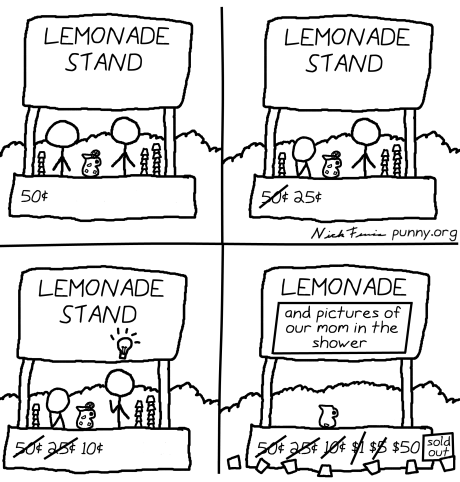
In my last post, I suggested that banks are profitable businesses because they have such a large mark-up. If they’re so great, my son asked, why don’t I simply plonk my cash into a safety deposit box and dole it out to willing borrowers like some kid with a lemonade stand?!

Why not, indeed?

The simple and obvious answer is risk, which the bank handles, I said to my son, with a combination of volume (to spread risk), people (to manage risk), and systems (to assess and ‘price’ risk).

However, Rick Francis offers perhaps a better-lemonade-stand-solution (?) … Peer-to-Peer Lending:

There is a fairly easy way to become the bank- peer to peer lending. It doesn’t remove the risk of default but does allow for diversification and there is a framework to asses the risk. They break loans into many small pieces that different individuals fund, so you don’t risk too much on any one loan.

Yep, P2P Lending certainly helps to address one of the banks’ three mechanisms for handling risk: you can spread your loans (the bank lend $400k many/many times over … you lend $40 many/many times over).

But, what about the experienced PEOPLE? It can take some time/trouble to sift through all of those loan apps listed on the leading P2P sites, as Jake points out:

P2P lending requires you to pick through hundreds of loan apps, and filter it to the set that you believe has the best risk / return ratio.

Then you have to diversify – invest in many loans so that a single default will not wipe you out. I think that you should invest no more than 1% of your portfolio into a given loan – so lets say you need to invest in at least 100 loans. Unfortunately, that requires you to pick through probably 1,000 applications hand-by-hand (you already discard the vast majority based on search criteria).

That’s frankly just too much work to be worth it, no?

it’s worth it for the bank, but probably not worth it for you and me (even though you can filter/sort the loan applications by various criteria) ‘just’ to get that 10% return that Rick has experienced …

And, we still haven’t addressed the risk management SYSTEMS that the bank applies, what does P2P offer there? Many sites, as Rick pointed out, offer some sort of FICO-based ranking, but banks rely on a lot more than that (for example, where’s that little thing called ‘collateral’?!) …

The only compensation for these last two (PEOPLE and SYSTEMS), that I can see, is that P2P borrowers may not want to default for a combination of:

– Getting locked out of the P2P sites … perhaps a similar mechanism to eBay’s Rating system is available?

– Perhaps it’s enough that P2P borrowers appreciate the opportunity that they have been given and don’t wish to abuse it by defaulting?

It is perhaps these two reasons that help to explain why micro-lending in 3rd world countries has such a low default rate?

But, it’s the simple logistics that Jake pointed out that put the kibosh on P2P for me …

Have you had any experience with P2P and would you use it again?

A (post)Vacation Question – Part III

Now that we’re back from vacation I can retain my blogger’s right to semi-anonymity, yet risk little by answering Mike’s [and, some of our other readers’] question:  “Which beach in Australia is this?”

Noosa in Queensland.

After discussing the real-estate ‘deals’ of Bill the shaved ice man, and Massimo the ice-cream man [AJC: did I mention him?], while buying – naturally – shaved ice and icecream, as one does when in Noosa on vacation, now that we were finally home and ready for a change of scenery …

… we discussed bank-financing of real-estate on our way back from buying ice-cream at the 7-Eleven store not far from our own home 🙂

The conversation went something like this:

Son: “Why has the bank invited you to their private corporate box at [a certain upcoming international sporting event]?”

Father: “Well I have a lot of money on deposit with them”

Son: “But, they have to pay you money [interest], aren’t their important customers the ones that they lend money to and who have to pay the bank money?”

Father: “Good point!”

So, I explained to my son that I am now both a borrower and a lender to my bank:

– As a lender, they pay me roughly 3% on the money that I have sitting in their bank,

– As a (recent) borrower, they charge me roughly 7% (interest + bank fees and charges) on the money that they lend me.

Son: “So, they only make 4% interest … is that enough for the bank to make money on?”

Father: “Don’t feel too sorry for the banks!” 😉

As I explained to my son, the bank is like any other business buying a product for $3 (or, in the bank’s case, borrowing money for 3%) and selling that same product for $7 (or, in the bank’s case, lending money for 7%):

They are operating on (at least in this example) a 133% Gross Margin.

Most people DREAM of having a business that operates on 133% Gross Margin …

… of course, the banks have costs:

– They have to carry stock (i.e. pay interest on funds deposited) even if they don’t sell it (i.e. lend it) … unlike a ‘normal business’ the bank has these great treasury departments who simply put this ‘spare money’ into the short-term money market and earn interest,

– They have the usual staff, office lease, and overhead expenses of any other business,

– They have the risk of fraud / credit default on the money that they lend out.

All of this is factored in to produce a Net Profit that is amongst the best of any type of business (GFC aside). This got my son thinking:

Son: ” So, why don’t you put your money in a safety deposit box and lend it out to other people instead of letting the bank make all the profit on your money?”

Well, as I explained, I actually do: I have a finance company of my own, and we look at our finances this way; the interest that we charge our clients is treated as ‘fees’ … we divide that Fee Income (very roughly) into three parts:

– 1/3 goes to pay the bank’s interest and fees on the money that we borrow from them to lend to our clients,

– 1/3 goes to pay our staff, rent, and overheads, leaving

– 1/3 which goes to our [AJC: my] profit.

This is strikingly similar to the ‘standard’ restaurant formula:

– 1/3 goes to pay for the raw material [AJC: pun intended 😛 ],

– 1/3 goes to pay their staff, rent, and overheads, leaving

– 1/3 which goes to their profit … of course, that’s the theory but the reality for restaurants and many other businesses is vastly different (but, that’s a subject for another post).

So, why don’t I do what my son suggests for the bulk of my money?

Simple: I don’t have the ability to handle the credit / fraud risk!

But, the bank can because they have the people, the systems, and the sheer bulk of money out there which effectively spreads their risk (IF they have followed sound credit lending policies ….enter housing crash and GFC).

Later on this week, though, I will tell you how YOU can become the bank … without the risk.

Stay tuned!

Call me … make it happen!

OK, so he wants you to buy five houses this year … and, he gives you the quick ‘hard sell’ at the end … but, the basic philosophy – to me – is sound:

– Houses are depressed in the USA, but so are interest rates,

– Unless the USA ‘double dips’ prices will begin to go up (when?)

– You can fix an incredibly low interest rate on your primary residence (can the bank rewrite the mortgage if you move?)

– You MAY be able to receive enough rent to cover most/all of the mortgage

– Who says you need to buy five houses (except for this Realtor!?) … just think about one for now

Do the numbers for your area/s of interest (price of house, monthly cost of mortgage, likely rental income, other expenses such as 6% – 9% property management etc.) … if you can even come close to breaking even, could you find a better return on your deposit plus the cumulative cost of any monthly shortfall (or gain of any monthly excess)?

Now, run the numbers again assuming that the US market stays flat for another 5 years before some sort of rebound … maybe it still makes sense?

Have you run the numbers? If so, what do you think?

A Vacation Question – Part II

But, what about the other financial question that my son asked while we were on vacation?

Well, we were walking along the beach and Bill, the shaved ice vendor, drove past with his little all terrain vehicle pulling his ‘shop’ behind only to stop a few yards up the beach to tempt my son – and, the many other children running along the sand and swimming in the warm surf.

Naturally, I  quickly became $3.50 poorer and my son had his paper cone filled with shaved ice with various color sweeteners poured over it (he chose ‘rainbow’ flavoring), which got us talking:

You see, it’s popular folk-lore that Bill, who has been selling his flavored shaved ice along the beach for 20 to 40 years, owns many of the apartments in the vacation rental buildings all around [AJC: check out the aerial shot in yesterday’s post] … if true, then Bill is the poster-child for the Wealth Alchemist i.e. turning temporary cashflow into long-term assets.

It’s not hard to see that Bill turns over thousands of dollars a day, most of it costing him nothing (little staff, few overheads, little-to-no-cost-of-goods-sold), after all, how much can ice cost to make?!

Instead of spending all of that money, it’s not a great leap to assume that Bill saves up enough for a deposit to buy a property every now and then; we figure $1 million worth of property each year (with 20% initial equity).

Here is my son’s question:

“Would he pay cash for the properties, or would he just save up enough for a deposit and borrow the rest?”

Now, this is a seemingly simple – yet terribly interesting – question; one that we could labor over for many posts … instead, we’ll look at this another way, by asking:

“Does Bill need the property for income now or for its future value (hence, future income)?”

The answer is clear: Bill has plenty of income now, but what does he do if his income stops?

Presuming that he can’t rely on being able to sell his business (for example, the council could decide that they no longer want people peddling ice on their beaches), then Bill will probably want his properties to generate a replacement income “one day”.

So, which would do that better? When Bill moves into MM301, it’s likely that owning the properties outright and living off the rental treams that they throw off will be best …

… until then, Bill has to (in my opinion) work on the strategy that will produce the most properties by the time he wants to retire.

So, I had to explain the concept of leverage to my son:

SCENARIO A: If you purchase a property for $100k CASH and it doubles in 10 years, then you have $200k of property. Well done!

SCENARIO B: But, if you purchase TWO $100k properties, putting $50k deposit into each and borrowing $50k for each from the bank, then in 10 years (assuming they both double), you now have $400k of properties, of which you owe the bank $100k (assuming that you haven’t paid down any of the loan in the meantime), leaving you with $300k of property … a $100k improvement over Scenario A.

At least, that’s what the property spruikers would have you believe …

… because, they have conveniently forgotten that in Scenario A, you also have some rental income (after, say 25% costs) coming in, whereas in Scenario B that income would be largely offset by interest owed to the bank.

The question is, is that differential in income ‘worth’ $100k over 10 years?

Let’s assume that we can get a 5% return from our Scenario A property (after costs), giving us $5k a year initially (when the property is worth $100k), increasing over time to $10k a year (when the property increases to $200k in value). It doesn’t take a genius to figure that this comes to less than the extra $100k that Scenario B gives us (if you assume an average $7,500 per year rent for the 10 years, we are comparing $75k in rent for Scenario A to $100k in additional capital gain for Scenario B).

Now, add the benefits of:

– 80% gearing (i.e. only making a $20k down payment in our example), which should buy you 5 properties instead of Scenario B’s 2 properties (cost = $500k; worth in 10 years $1 mill., less $80k loan on each = $600k v $300k for Scenario B and $200k for Scenario A. Get it?),

– Increasing rents offsetting fixed interest rates (possibly producing some positive cashflow from each of our 5 properties as time passes),

– Tax deductibility of any excess of interest over income in the early years (a.k.a. negative gearing),

– And, any additional tax and depreciation benefits of 5 properties v only 2

… and, it’s just possibly a ‘no brainer’, even if that does make some of those scummy spruikers right 😉

But, how does Bill pay his bills?

Well, that depends on how much excess of income the properties produce by the time Bill is ready (or has) to retire …

… if  insufficient to pay Bill’s bills, he can sell enough properties to pay off the bulk (or all) of the bank loans, thus forcing a positive cashflow situation (assuming the properties aren’t total dogs, which is highly unlikely in this well sought after tourist area, which boasts near 100% year-round occupancy) and that (after a reserve to cover costs of vacancy, property management, and repairs and maintenance) is his infltation-protected income for the rest of his life.

Then Bill can spend the rest of his days lazing on the beach … buying shaved ice from the next shmuck who chucked in his chance at earning a college degree for the life of a beach bum 🙂

A Vacation Question – Part I

As we bask in the sun, a couple of interesting financial questions popped up, both voiced by my 15 y.o. son.

The first was as we picked up our rental car and were offered the choice between the ‘standard insurance’ with its $3,300 deductible (regardless of fault!) to which I said “yes please” just as the guy next to me (receiving the similar offer for his rental car)  just as immediately said “yes please” to the alternative offer of ‘reduced deductible’ insurance for an additional $29 per day.

“Why is it that two people can immediately make opposing financial decisions” was the gist of my son’s question (actually, it was “why didn’t you pay the extra $29 a day, too, Dad?”). 

Well, it isn’t because I know that car rental companies rake in approx. 25% of their profits from their insurance scams … I mean, schemes … it’s because he is thinking MM101 and I am thinking MM201.

If you don’t have the $3,300 (actually, an extra $3,000 because the ‘reduced deductible insurance’ still leaves you to pay the first $300 of any incident) then the decision is reasonably simple:

Can I afford to pay the daily rental INCLUDING the extra $29?

– If YES then rent the vehicle WITH the reduced deductible coverage.

– If NO, then you can’t afford to rent the vehicle, so you had better look at the bus/train option.

Now, the other guy probably would have had a heart attack if he had to fork over an unbudgeted $3k all of a sudden – as would my son, with his limited eBay-plus-allowance income – but, not me: $3k is a figurative drop in the 7m7y financial ocean.

So, I have a different set of questions because I CAN afford to pay the $3,300 deductible … easily, even though I wouldn’t like to pay it:

What is the daily cost of the waiver? How many days will I be renting for? What is the likelihood that I will have an accident in that period? How much will I be ‘saving’ in deductible if I do have an accident?

Now, three out of the four questions are trivial, and I was able to simply explain to my son that over a three day rental, the extra daily charge would cost me close to $100 and ‘save’ me $3k if I happen to have an accident.

But, what about the likelihood of having the accident? In my son’s (and, perhaps the other renter’s) eyes, the answer was “very likely” … but, the truth is that I don’t know for sure, making this potentially a very hard ‘actuarial’ problem to solve.

[AJC: in fact, I do know that the chances of a policy holder making a claim on their insurance policy is about 14% 😉 ]

But, there is another – more financial – way of looking at this situation … one that works for most complicated financial problems where a critical piece of information may be missing: find the break-even point.

In this case the break even point is trivial to calculate: it’s simply to calculate how many days of additional charges it would take to ‘pay off’ the additional $3,000 of the deductible.

The answer is: $3,000 / $29 per day = 104 days (rounding up a little).

So, my thought process was simple:

– Can I afford the $3k deductible? No doubt about it!

– How likely is it that I will have an accident in less than 1/3 of a year? Not very likely, considering that my last ‘bingle’ was so long ago that I can’t remember it.

Clearly it’s a bad bet … and, obviously so otherwise the rental companies wouldn’t offer it 🙂

Now, this obviously applies to all insurance situations, so you don’t need to be an actuary. Instead, and as I told my son, think about the worst case scenario:

– If you could afford to cover it in the event that it came up, don’t sweat it,

– But, if you can’t afford to cover the cost, then you have no choice but to insure it or risk your financial health.

Until you reach 7 million, insure it or don’t do it

… a financial lesson to warm the cockles of many an insurance brokers’ heart 😉

Xmas in Australia …


Being able to call two countries ‘home’ is a luxury that few can afford, and it opens up some interesting points – and counterpoints – of view.

For example, I came back to Australia with a new appreciation for the infrastructure that such a sparsely populated country has. To put it into perspective, my two homes of Australia and Illinois share around the same population (circa 20 million), yet Australia:

– has the land mass of the entire contiguous states of the USA (i.e. the 48 U.S. states located on the North American continent south of the U.S. border with Canada),

– has 4 or 5 major national banks (IL has no equivalently sized banks of its own),

– 2 national (and international) airlines (IL has none that I am aware of),

– A national system of roads, a number of ports, 3 layers of government, etc., etc.

Other points of difference are more subtle, yet even more interesting (at least, to me); one of my favorite being that Xmas and New Year in Australia is summertime!

This means that Australia partially shuts down from about the last week in December until the end of the first week or two in January; for example, attorneys and accountants will shut their offices entirely for 2 to 4 weeks and most factories will shut off production entirely for at least 2 weeks.

And, bloggers will put down their ‘pens’ 😉

What do Aussies do in that time?

We vacation!

For example, I am writing this post from my rented vacation apartment in a very warm part of Australia while my daughter finishes her first ever surfing lesson …

Aussies have no trouble vacationing, in fact every Aussie worker from the humblest production line worker to the highest paid corporate executive receives a minimum of 4 weeks paid vacation each year (plus 5 to 8 days paid ‘sick leave’, and 9 or so paid public holdays, all for a normal 36 to 40 hour work week).

Oh, and until recently, employers had to pay an additional 17% bonus on their employees’ normal salary while they were on vacation!

I remember laughing when I first arrived in the USA, where vacations are usually accrued at only 2 weeks per year, at seeing advertisements urging Americans to take their vacations … it seems that we have the opposite problem in Australia, we have to encourage our employees back to work!

Tomorrow, I’ll try and bring this preamble back to some sort of personal finance angle 🙂

Rent Wealthy?

It’s only a couple of weeks since I told you about a new way to measure wealth, and here is an article on a respected blog telling you how to go about renting ‘stuff’ that you might need, so that you can appear wealthy!

Now it might surprise you, unless you’ve read my original post, that I think the best ‘bang for buck’ way to be wealthy is to be Rent Wealthy …

… this is where, instead of owning that villa in France, you rent it. Instead of owning that luxury yacht, you charter it (with crew and caviar, of course. After all, you are wealthy!). And, instead of owning that expensive personal jet, you call up Warren Buffett’s company, Net Jets, and charter one (no maintenance or holding costs, either!).

And, the Get Rich Slowly article says that you can now:

… rent designer bags, sunglasses, and jewelry. Yep, companies like Avelle, Bling Yourself, and Wear Today, Gone Tomorrow will rent merchandise by the likes of Chanel, Hermès, Louis Vuitton, Prada, Chloé, Herve Leger, and more. For a monthly fee, you can carry the “it” bag.

One site, for example, will rent a vintage Birkin bag for $600 per week. The cost to buy a vintage Birkin is about $17,000 (I’ll give you a moment to stop choking…mmkay, better now?). A Coach bag that retails for $350 can be rented for about $30 a week, or $20 per week if you keep it for a month.

As the author points out, you can actually own the Coach bag in 4-and-a-half months, so renting would seem pretty stupid when you can just save up for one or two nice handbags and use those throughout the next year or so.

But that’s not the point: renting, financing, or even buying this sort of consumer item with cash is likely to be sudden death for your personal financial well-being (remember The 5% Rule for your personal possessions, including your car?!) …

… unless, of course, you are already rich!

And, that’s where I disagree with the author: I am not comparing the cost of purchasing the $350 Coach bag against renting it … I’m comparing owning, say, 12 of them (after all, what rich person can get by on just two changes of purse in a year? Ask Paris Hilton … ) against renting 12 to 24 of them – one or two per month!

And, you don’t have to worry about them taking up space in your closet – collecting dust – after you have already been seen in public with them …

Clearly, renting is a ‘no brainer’ 🙂

That’s why I like being Rent Wealthy; I can have pretty much whatever I want [AJC: within reason, and remembering my 10-1-1-1-1 spending thresholds to make sure it’s something I really want or need] without any albatrosses around my neck.

Once you reach your Number, and if you are rich enough, try being Rent Wealthy for a while … I think you’ll like it 😉

Inspiration at the pump …

When your car runs out of gas, you go to the gas pump …

… when I run out of inspiration (as sometimes happens … not often, but sometimes) I go to the bloggers ‘gas pump’: Alltop.com, a compilation of articles from the best blogs on the web in almost any category that you would care to name.

I got excited when I saw the headline, there, of a CNNMoney article titled: Real estate in your retirement portfolio.

Excited, that is, until I read the first paragraph:

Question: How do REITs work? And is it prudent to have them in a diversified retirement portfolio?

This is the problem with the financial press in the USA: it’s directed to packaged financial products e.g. stocks, funds, REITS, and the list goes on … this is why average (and, 99% of  ‘above average’) Americans will remain relatively poor.

It’s ironic then that the wealthiest Americans (and, I would suggest this to also be the case in all developed countries) made their money in business (including the business of investing) and keep their money in real-estate.

According to an otherwise (and, unfortunately) highly flawed book that I reviewed some time ago, the rich keep their money for generations ONLY if they split their assets roughly one-third in a business, one-third in paper (stocks, bonds, mutual funds, etc.) and one-third in real-estate (incl. their own home) … since I called this “the most dangerous idea in retirement planning that I have ever read” (and, you will have to read this post to find out why), I had better give you my much simpler formula:

As I transition into Making Money 301 [protecting my wealth], I would happily keep 95% of my net worth in real-estate (incl. no more than 20% in my own home; remember The 20% Rule?) … and, I am NOT talking about REITs here, I’m talking buy/hold income-producing real-estate.

It’s certainly not the only strategy, but it’s one of the simplest and, IMHO still the best 🙂