The Ideal Perpetual Money Machine …

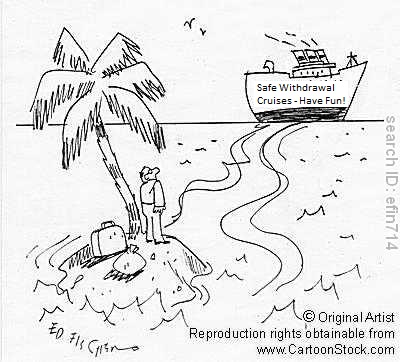
So,  it seems that creating a mix of bonds and stocks and then picking some magic withdrawal rate (e.g. 4%) is not the ideal way to plan our retirement (a.k.a. life after work) after all …

… instead, it seems that we need to create our own Perpetual Money Machine: a renewable resource of cash 😉

The ideal Perpetual Money Machine – at least, according to my liking – is Real-Estate (more wealthy people build their own Perpetual Money Machines using real-estate that any other investment, even more so than cash, CD’s, bonds, mutual funds, or stocks):

1. Real-Estate (particularly commercial real-estate, when purchased well) protects your capital and keeps pace with inflation; it will last as long as you do, and then some!

2. Real-Estate (when managed well -and, this is something that you CAN confidently outsource) protects your income (i.e. net rents; they will grow with inflation).

3. The bumps in your real-estate road can be managed with insurance and provisions: you can insure against most catastrophic losses (and, you can spead your RE investments to minimize even those risks), and you can keep a % of your rents (and, starting capital) aside to help smooth your income stream (against vacancies, repairs and maintenance, etc.).

For example, with $7 million (aiming for a $350k per year gross income – indexed for inflation – which should net $200k – $250k after tax), you could:

1. Keep $500,000 as a two years of living expenses cash buffer (one year to allow for the rents to start coming in, another year “just in case”),

2. Invest $6.5 million CASH into 5 x $1.0 million to $1.25 million dollar properties (allowing for closing costs, etc.),

3. Which should provide 5 x 7.5% x $1.0 million to $1.25 million = $400,000 gross rental income

4. Of which you would pay tax of 30% (say) and divert another 25% of the remainder to your ’emergency / provision fund’ leaving $215k (PLUS, tax benefits such as depreciation, tax deductions of cars, certain travel and other business expenses etc.).

After every few ‘good years’, you can trim your provision fund back to two years of living expenses, allowing you to buy some more real-estate (therefore, providing the basis for another future pay rise!).

If you don’t like real-estate, then you can always lower your spending expectations and dust off your bond-laddering books 🙂


The fundamental rule of money?

Here’s the difference between conventional personal financial advice and 7m7y thinking in one slide; according to Brian Taylor the fundamental rule of money is to:

Either earn more than you spend or spend less than you earn.

Simple … and, much better than the alternative (spending more than you earn) …

… but, wrong!

There is only one fundamental rule of money:

Earn more than you spend

Can you see why? Your financial future depends upon it 🙂

Fitting a square peg into a round hole …

The real problem with any of the so-called ‘safe withrawal rates’ that we explored yesterday – with 4% currently being perhaps the most popular amount advocated – is that they all assume a fixed annual spending amount, but are actually generated by a totally volatile (some would say random) portfolio.

We’re trying to fit a square peg (fixed annual spending) into a round hole ( a ‘random walk down Wall Street’) 😉

But 7m7y readers have an even more fundamental problem with planning our ‘retirement’ based on this type of common industry wisdom: we are planning on retiring early, hopefully, with a very large Number and a soon Date!

Most retirement models assume a 30 to 35 year retirement lifespan …

… I don’t know about you, but I retired at 49 and intend to live AT LEAST another 40 years 🙂

Many of my readers will be aiming to reach their Numbers even sooner .. and, may expect to live even longer!

The bottom-line: traditional retirement planning models don’t work, because we need money that will last as long as we do … we need a Perpetual Money Machine, because we don’t know how long we will live once we stop working.

A Perpetual Money Machine is anything that:

a) Protects your capital over the long-run, even allowing for the ravages of market changes and inflation, and

b) Produces a reasonably reliable stream of income, that also (at least) keeps pace with inflation.

Neither stocks nor bonds – the traditional tools of retirement investing – fit the bill for us:

1. Stocks are too volatile, and the income tends to be artificial (e.g. so-called dividend stocks attempt to fix the level of dividend provided even as the company’s profits fluctuate).

[AJC: Raiding marketing, R&D, and other seemingly non-essential budgets in lean years in order to protect the dividend stream is – to my mind – the mark of a poorly run company]

2. Bonds provide a very safe return, but the % returned each year is too low, meaning – at least, to me – an unnecessarily reduced lifestyle, especially after allowing for reinvestment to try and keep up with inflation.

That’s why my Rule of 20 is exactly that: a planning rule, NOT a 5% spending rule!

[AJC: Otherwise, I would have called it the 5% Rule, d’oh!].

In other words, my advice for PLANNING your Number, is to decide what initial income you want and multiply that by 20 in order to find your Number

… but, my advice for LIVING your Number is to turn on your Perpetual Money Machine and live off whatever it happens to produce, after allowing for taxes and provisions against inflation and contingencies.

The Myth of the Safe Withdrawal Rate …

I have noticed an unusual phenonemom: I write a post on one theme and your (i.e. our readers’) comments explore another one entirely!

This is a GOOD thing … it means – I hope – that we are building an online community dedicated to the idea of linking our finances to our life, rather than simply attempting to fit within society financial ‘norms’.

Case in point: I wrote a post exploring various windfalls, and the comments lead us down the path of exploring so-called ‘safe withrawal rates’, which is the idea that there is a Magic Percentage of your Number that is ‘safe’ to withdraw to live off each year.

The problem is, what % do you choose?

For example, I have proposed the ‘Rule of 20’ for calculating your Number, which seems the same as proposing a 5% ‘safe withdrawal rate’, but Jake disagrees:

A 5% drawn-down rate on the pot of gold is a little on the risky side if you want the money to last.

After looking at a bunch of data, I feel that a draw-down rate of 2-3% is too conservative, but 5-6% to aggressive. 4% or so seems right. I know, only 1% off from your value but over time it makes a huge difference.

So, Jake has highlighted one problem with selecting a ‘safe’ withdrawal rate … if you are out by even 1% your spending can be over (or under) the ideal by 20%. I don’t know about you, but a 20% payrise (or paycut) is a pretty big deal … people quit their jobs over less!

So, what do the experts recommend?

Believe it or not, there is support out there for just about any annual % of your nest egg that you may choose to spend, for example:

7% – Not so long ago, the financial services industry proposed spending as much as 7% of your portfolio each year in retirement.

6% – More recently, Paul Graangard wrote two books proposing a bond-laddering and stocks strategy that supported a spending rate as high as 6.6% of your portfolio each year.

5% – Investment funds routinely allow spending of 5% of the portion of their investment portfolios dedicated to simply keeping up with inflation. Indeed, my Rule of 20 appears to support this withdrawal rate, too.

4% – A large number of studies – probably, the most famous of which is the so-called Trinity Study – advocate spending up to 4% of your initial portfolio (ideally, 50% stocks and 50% bonds, rebalanced each year), which provides somewhere between a 90% and 100% certainty that your money will last at least 35 years.

3% –  A whole slew of new retirement planning tools (generally using a Monte Carlo approach to modelling tens, hundreds, or even thousands of potential economic scenarios) have been released over the last 4 or 5 years by the financial services industry, purporting to analyse hundreds of alternative economic scenarios to try and model what would happen to your retirement portfolio (i.e. simulating changes in interest rates, market booms and busts, etc.) to find the ideal ‘safe’ withdrawal rate. The trouble is that a lot of these advocate very low withdrawal rates, typically in the 2.5% – 3.5% range. 

2% – Some even advocate a totally ‘risk-free’ approach to retirement savings by investing close to 100% of your retirement portfolio in inflation-protected bonds (i.e. TIPS); historically, these have provided a 2% return, after inflation and with total protection of your starting capital.

So, which is right?

None, as TraineeInvestor explains in his comment to my post:

I’m not fan of draw down models either. If you have to spend your capital to avoid eating cat food (or the cat) or are working with a very limited time period fair enough. But with a sufficiently long time horizon, my view is that any draw down rate is dangerous – in fact I would be uncomofortable if my nest egg was not growing at at least the rate of inflation (after taxes and spending).

Another way of looking at it is that if you are relying on draw down of capital for living expenses you are very vulnerable to adverse events. No thanks – I’d rather sleep soundly at night.

Me too! 🙂

The One Minute Business Checkup!

My blogging friend, Andee Sellman has unveiled a corker … but, I have a STRICT no advertising, no product placement or promotion policy …

[AJC: it’s the only way that I could think of to convince people that I’m genuine, after all, do I want to say to people “I made $7 million in 7 years, plus an extra $4 a week from my blog” 😉 ]

.. so, I’ll just gently lead in with a story instead:

Many years ago, in a very short-lived experiment, my parents bought my sister a flower shop [AJC: mistake # 1].

However, because they knew that she wouldn’t take any of their advice (just the shop sans advice) they asked me to take the other 50%, which I agreed to [AJC: mistake # 2].

Unfortunately, I had no business experience in those days, so it was like ‘the blind leading the blind’ … however, I did go looking for help.

One of the first things that I tried to do was get some help on the NUMBERS that the shop should run according to; things like:

– What % of our sales should the flowers and other materials that we bought account for?

– What staff and other administrative costs should we allow?

– What salary should my sister draw?

Unfortunately, my accountant wasn’t much help [AJC: he basically told me to come back when I had a tax problem … when the problem was, we weren’t making any money, so there was no tax!], and I did find a benchmarking report on florist shops, but it didn’t really tell me what the numbers meant or, much more importantly, what to do with them.

That’s why I was really interested when Andee sent me a link to his new tool – I’ve checked and it is totally free – called the One Minute Business Checkup … I think it would have been of great benefit – even though it is fairly simple, and works on just three (that I could see) critical benchmarks:

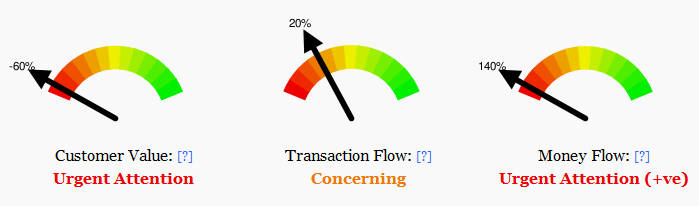
A. CUSTOMER VALUE MEASURE

This measure looks at how much of the customer value you are retaining in your business by looking at the value the customer pays you and deducting the cost you incur to make those sales.

From experience we know that if the customer value measure falls below 20% a business will struggle and may fail completely so that is why the benchmark is set at 20%. i.e. retaining 20% of the customer value as a return to the business owner.

Example of Measure

Sales   $500,000
Product $250,000  
Business Owner $50,000  
People $50,000  
Marketing Costs $20,000  
Distribution Costs $30,000  
Total Costs   $400,000
 
Customer Value Retained   $100,000
 
Percentage to Sales   20%

B. TRANSACTION FLOW MEASURE

The transaction flow measure is about determining the volume of sales that is running through your business. A business may have very high customer value (margin) but only a trickle of sales to take advantage of that value.

Our quick way of measuring transaction flow is to look at administrative cost compared to the sales in a business.

We have found that to be sustainable a business needs to spend no more than 12% of sales on its administrative costs. Often small businesses need to INCREASE SALES rather than decrease administrative costs to achieve this percentage.

Example of Measure

Sales $500,000
Administrative Wages $30,000
Administrative Expenses $20,000
Total Costs $50,000
 
Percentage to Sales 10%

C. MONEY FLOW MEASURE

The money flow measure is designed to find where the money is hiding in your business. Does money flow easily or are there places in your business where it gets ‘stuck’ and takes time to flow through to you.

A very significant place that money hides in your business is called working capital. There are three significant items:

  1. Inventory – this can be raw materials, work in progress or finished goods
  2. Accounts Receivable – this is money owed to you from customers
  3. Accounts Payable – this is money you owe your suppliers

Money can get stuck in inventory and accounts receivable. It can also be lost from the business by undisciplined payments to suppliers.

The activity in your business can be measured by sales and this needs to be compared to the working capital invested in your business. We have found that to be sustainable and to give your business the best chance to grow, working capital should be no more than 12% of sales. Beyond this, too much of your money gets tied up in the business and is not available to fund growth.

Unlike the other two measures the money flow measure can be negative.

Negative working capital is a very dangerous situation needing urgent attention.

Example of Measure – Positive Working Capital

Inventory $30,000
Accounts Receivable $55,000
Accounts Payable -$35,000
 
Working Capital $50,000
 
Sales $500,000
 
Percentage to Sales 10%

Example of Measure – Negative Working Capital

.

Inventory $30,000
Accounts Receivable $55,000
Accounts Payable -$95,000
 
Working Capital -$10,000
 
Sales $500,000
 
Percentage to Sales -2%

If you have a small business, I recommend that you give this a try [ http://oneminutebusinesscheckup.com/ ] and let me know what you think?

Three feet from gold …

This video summarizes a book hailed as the successor to Napoleon Hill’s classic: Think and Grow Rich. I’m not sure that you can just think your way to $7 million in 7 years … but, having a burning reason why you might need that much / that soon sure seemed to help me.

But, I can’t help feeling: did I think, therefore attract … or did I happen to think and happen to attract? I guess we’ll never know for sure, as we are all an Experiment of One 🙂

Reader Poll: Manifesting Millions?

IMPORTANT: Please read this post in full, THEN choose the FIRST answer that applies.

How much money have you manifested in the last 18 months?

View Results

Loading ... Loading ...

There are two groups of people in this world:

– those who believe that there are two groups of people in this world, and

– those who don’t 😛

At the risk of parodying myself, I think there are two groups of people in this world:

– those who believe in The Secret, and

– those who don’t.

I want to conduct an experiment, right here / right now, to see if The Secret works …

First though, in case you’ve been living in a cave for these past few years (in which case, you have probably already developed powers far beyond those of The Secret), you will already know that The Secret is the most recent in a long series of books, blogs, and banter about the ‘power’ of creative visualization …

… see it in your mind and you will manifest it into reality.

Believe it, and it will be so.

I don’t know how The Universe works, so I can’t tell you whether I manifested my millions (perhaps by concentrating on my Life’s Purpose and the Number required to get me there) or was merely driven to make it at all costs … you could certainly mount an argument either way.

Also, I am an experiment of one …

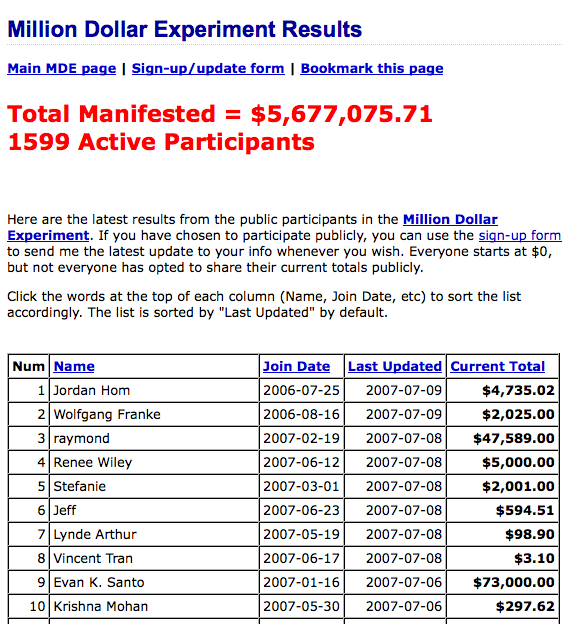
Fortunately, we have Steve Pavlina who is an expert in these matters, and  is also the creator of a very interesting project, aptly called the Million Dollar Experiment:

The goal of this experiment is to attempt to use the power of intention to manifest $1 million for each person who chooses to participate.

From what I can see, the experiment ran from November 2005 until July 2007 … just over 18 months. Here’s what happened:

In that 18 month period, nearly 1,600 participants reported ‘manifesting’ anywhere from $504,873.56 (in just one day; if you choose to believe him) down to just one cent.

The average was closer to $3,500 in less than a year, with the median being just $180.

I’m not sure what you would count as a worthy ‘manifestation’ amount (I mean, would you dream of anything less than $10k in a year?), but 120 people – just 7.5% of those participating – ‘manifested’ $10k or more in that period.

Cast your mind back 18 months: how much have you manifested in that timeframe? I guess by ‘manifested’, I mean by following Steve Pavlina’s instructions to his own readers:

Only count the new money you feel has come into your life as a result of your participation in this experiment (i.e. the manifestation of this intention), not your regular income. Obviously your interpretation of that will be subjective, but this is a subjective experiment. Just do your best, and trust your intuition.

Just pretend that you signed up to Steve’s experiment 18 months ago … what money (if any) that came into your life since then would you have reported on Steve’s blog?

Oh, and feel free to tell me what you think about the power of The Secret, Steve’s Million Dollar Experiment, and/or this post … but, don’t forget to scroll back up to the top and make your poll choice first 🙂

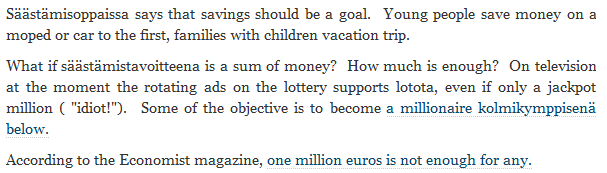
Popular in Finland …

I seem to be popular in Finland these days, with my blogging friend over at Kohti taloudellista riippumattomuutta still sending me the most new visitors daily [AJC: reciprocating may be a little hard as I am guessing that more of his readers are fluent in English, than my readers are in Finnish].

I also receive referrals from my other Finnish blogging friend Tarkan markan blogi, who asks (thanks to Google Translate) Million Not Enough For Any:

And, The Economist does raise a valid point:

How much money do you need to count as wealthy in the first place? Merrill Lynch’s wealth-management report starts counting at $1m in “investible assets”. That excludes people’s main homes, which may seem reasonable. But it means that a Londoner who sells his home and decides to rent can suddenly find himself “rich”.

After all, a portfolio of $1m these days would generate an income of only $30,000 if invested in Treasury bonds, which does not leave much scope for the playboy lifestyle.

I’m not sure what amount that you need to be ‘rich’ – I define it in terms of having enough to live your Life’s Purpose – but, I certainly agree that $1 mill. (even if it doesn’t include your own home) simply doesn’t cut the mustard 🙂

Is he really a clever dude?

[Disclaimer: Artist’s rendering of AJC … any resemblance to other bloggers living or dead is purely coincidental]

Have you noticed that I don’t have a category for debt on this blog?

[AJC: you can click on any of the keyword/categories in the orange header-banner above to see a list of blog posts focusing on that subject]

It’s not because we don’t talk about debt, as we clearly do

…. it’s because, to me, creating or paying off debt is just the same as investing (after adjusting for tax: a dollar saved in interest, is the same as a dollar earned in interest or investment income, right?).

That’s why I was genuinely interested in finding out what was going through fellow-blogger Clever Dude’s mind when he loudly proclaimed:

We’re Free of Consumer Debt!!!!!!

As of today, we have paid off all $113,000 of our student loans, auto loans and credit card debt.

We are debt free!!!

My fellow blogger is right to be proud of his achievement … but, does that make it the right investment choice?

Check it out:

He paid off $113k … now, this is no small achievement, some people don’t even save that in their entire lifetime! Still I couldn’t resist asking Clever Dude for some details:

The rate on the student loans was 6.25%. The 2nd mortgage is 7.875%. First was 5.25%.

I chose to pay off the student loan because it was more manageable and I could get it off the books faster than the 2nd mortgage. Mathematically, the 2nd mortgage makes more sense until you factor in the tax deduction which brings them down to about equal.

I also wanted to know a little about his current net worth (after the mammoth debt-payoff feat) – nosey, aren’t I?! Anyhow, Clever Dude was happy to share:

Don’t mind the math as I rounded:

Cash: 17%
Investments: 37%
Home Equity: 6%
Autos: 17%
Personal Property: 12% (if I could sell it all right now)
Whole Life Insurance: 5% (yep, I got it, it’s expensive, but I’m not giving it up!)

So, Clever Dude has ‘invested’:

-> $113k in loans returning (by avoiding having to pay) around 6.25% after tax

-> 17% of his net worth in cash returning (I’m guessing here) 2%?

-> 6% of his net worth in his home returning some unknowable amount in future (potential) capital gains

-> 5% of his net worth in insurance ‘investments’ of dubious value after (often) exorbitant fees

-> 29% in (presumably) depreciating ‘assets’ such as autos and personal property

Now that he is debt-free, what  will drive Clever Dude’s investment strategy from here on in? He says:

Investing and savings are next up in our planning. Honestly, we’ve spent so much time just thinking about debt, we haven’t spent much time on the future. Now is the time.

Now, I’m not here to pick holes in Clever Dude’s investment strategy as he had a strategy and moved mountains to achieve it – not to mention, that we know so little about Cleve Dude’s true financial situation that we are in no position to advise / criticize …

…. but, I do want to use this example to show why following a blind – and, in my mind totally arbitrary – investment goal such as “reducing debt” is not always the best idea:

Clever Dude has only 37% of his net worth in investments right now (OK, he is working on his Master’s Degree, so he has had other things on his mind) and has limited the bulk of his net worth’s returns to only 2% to 6% (or so) by almost-totally focusing on paying debt.

Why?

So, that he can start “investing and saving”!

Now, does that make sense to you?