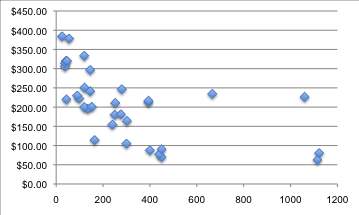
Aside from the obvious [AJC: Believing that you can turn $1k into nearly $6k in just 2 weeks is obviously stupid, right?] …
… there’s a basic reason why you are doomed to failure with FOREX (i.e. foreign exchange) trading activities. First, though, let me explain what FOREX is for those who don’t yet know:
The foreign exchange market (currency, forex, or FX) trades currencies. It lets banks and other institutions easily buy and sell currencies. The purpose of the foreign exchange market is to help international trade and investment. A foreign exchange market helps businesses convert one currency to another. For example, it permits a U.S. business to import European goods and pay Euros, even though the business’s income is in U.S. dollars.
In a typical foreign exchange transaction a party purchases a quantity of one currency by paying a quantity of another currency. The foreign exchange market is unique because of … the extreme liquidity of the market [and] the variety of factors that affect exchange rates. As such, it has been referred to as the market closest to the ideal [i.e.] perfect competition.
My dire ‘doomed to failure’ prediction comes about because of that last sentence: FOREX “has been referred to as the market closest to the ideal [i.e.] perfect competition”.
Think about it: for every dollar, drachma, or rupee that you buy … somebody has to be on the other side selling. And, since you are ‘betting’ on the relative strength of one currency versus another, you are effectively betting opposing arguments.
You have the same points spread on the ball game, but you are betting on opposing teams … one winner, one loser.
Now, who do you suppose has better information? You, or the other guy?
Who do you suppose has better FOREX training and more experience? You or the other guy?
You are the amateur, the other guy is (probably) the professional who does this for a living …
Now, you can argue that people are trading currency because they are moving country, so the ‘relative strength’ argument doesn’t apply … or, that they are government agencies moving in and out of foreign positions for stability and political reasons … or, that they are corporates moving funds between various international subsidiaries …
Which all be true and yet another reason why you are gambling and they are expertly managing their portfolios.
The same double-sided coin argument applies to options trading … indeed, most other forms of trading: you bet one way and the person on the other end of the transaction has bet the other way. And, they probably know what they are doing …
… best case is that they are equally naive as you 😉
One winner, one loser.
So, that means that 50% of the traders out there must be winning and the other 50% losing?
Well, the stats – somewhat surprisingly – tell a different story; cast your mind back a few weeks, where taloudellinenriippumattomuus mentioned a Taiwanese study that found that (after costs) only 0.16% (or 1.6 per thousand) of traders [AJC: in this specific case, Day Traders, but I doubt whether FOREX or stock option traders fare much better] actually made a profit!
I’m sure that plenty of our readers have made – and lost – relative fortunes trading; if so, I’d love to read your comments …
If you ask most people what they want out of life, it’s “to be happy” … go ahead, try and ask a few people!
But, Julia Baird, the deputy editor of Newsweek has an interesting viewpoint:
The most inspiring people are those least obsessed with their own happiness, especially those who stride confidently across the globe to create, evoke change, or wrest from life what they will. Eleanor Roosevelt believed happiness “is not a goal, it’s a byproduct.” I think she might be right.
Your Life’s Purpose then is the Goal that Julia refers to – and, money (i.e. Your Number) may be the tool to get you there – with happiness the outcome … at least, that’s how I see it.
And, it may serve to explain why Money and Happiness seem to be intrinsically linked, as Julia goes on to say:
The most recent findings, for example, are that wealth makes you happy
I have a personal viewpoint on this (from experience of both sides of the wealth equation), but I would be interested to hear what you have to say?
Today’s Video On Sunday has absolutely NOTHING to do with money, other than that it may help you win a few bets at the pub 😉
And, my American readers [I hope!] will appreciate learning a little about cricket …
… which is best explained, IMHO, by comparing it to that great American institution: baseball. In fact, cricket is just like baseball, except:
– There are only two ‘bases’: imagine home base being where the batsman (a cricket term for the guy hitting the ball with the bat) stands, and that ‘first base’ is shifted to sit on top of the pitcher’s mound – except that there is no mound, so the pitcher (in cricket terms: the bowler) has no height advantage.
– There are 11 players a side, but two batsmen are on the ground at the same time; one stands at ‘home base’ to hit the ball and the other stands at ‘first base’ near the where the bowler (aka pitcher) will be.
– There are only two innings per side, but each innings is over when ALL of the batsmen from each side is ‘out’ (actually, 10 from each side, because you need 2 on the ground at the same time).
If you can imagine those differences, let me walk you through the video which covers the 3 main aspects of the game:
Bowling
– The bowler cannot whip the ball (which is VERY hard, much like a baseball … perhaps a little harder) with his elbow, as he MUST bowl with a ‘straight arm action’. A little curious I know, but he gets speed by running as far/fast as he likes, until he reaches a line just behind ‘first base’ than releases the ball; the combination of the run and the fast (albeit strange-looking) straight-arm overhead throw produces the speed.
– The ball can be thrown directly at the batsman (within reason … you aren’t allowed to deliberately try and hit him!), but is usually bounced off the ground making it much more erratic and harder to hit.
– In fact, the red (or yellow) ball has a very pronounced seam effectively dividing the ball into two hemispheres, therefore a slower ‘spin bowler’ can be equally effective as a ‘fast bowler’ by deliberately imparting spin and/or aiming the ball at a spot on the ground that is rough or has cracks from the heat to make the ball ‘jump’ or ‘spin’ one way or another.
– The IDEAL outcome for the bowler is to get the batsman out, not by ‘striking him out’ but by using the cricket equivalent of hitting those three little sticks sitting right behind the batsman. Very quaint. It gets better! If you look carefully, balanced in little grooves on top of the stumps (i.e. those three little sticks) are two even smaller pieces of wood called ‘bails’, and the batsman is OUT if the bowler can hit the stumps with the ball AND the little sticks fall off. Cute 🙂
Watch the video until 1:30 and you’ll get the idea …
Fielding
– Of course, the other team is all on the field, carefully positioned to ensure this doesn’t happen. For example, if the batsman happens to hit the ball then they can get him out – just like in baseball – by catching the ball before it hits the ground.
– Because both bases – hence most of the action – happens right in the middle of the pitch (which is usually a large oval playing field), the batsman can hit the ball in ANY DIRECTION (there is NO ‘foul ball’ rule in the game of cricket), so it is just as critical in cricket to carefully place the fielders – but, in this case, all around the entire ground – depending on the characteristics of the specific batsman (is he a left-hander? is he likely to accidentally ‘snick’ the ball or is he going to whack it a long way?)
– Remember that really hard ball? Well, the cricket fielders prefer to catch them without wearing gloves. Just watch the video until 3:00 minutes in, and you’ll see what I mean [AJC: if you really want to see a tough sport, if I get enough interest, I’ll tell you about Australian Rules Football in a future post!]
Batting
– Of course, the batsman are in there trying to make runs, just like in baseball; and, they do it by running from ‘home base’ to ‘first base’ and back again as many times as they can, before they are at risk of getting out.
– But, in cricket, a batsman can ONLY get out four ways:
1. By being ‘bowled out’ i.e. the ball hits the stumps and those little bails (remember them?) fall off,
2. Or by being bowled out on a technicality (much like a ‘technical knock out’ in boxing) where the umpire (aka referee) rules that the ball WOULD have hit the stumps EXCEPT that the batsman stuck his leg in the way (instead of his bat) to avoid that from happening. This is called ‘Leg Before Wicket’ … imaginative, huh? 🙂
3. By being caught out (just like in baseball), either by the fielders around the ground, or by the wicket-keeper, who is the cricket equivalent of baseball’s short-stop except he wears NO body of face protection. But, the wicket keeper does usually wear TWO over-sized gardening gloves (that don’t look anything like baseball mitts).
4. By being ‘run out’ which is where the batsman hits the ball and madly dashes for the ‘base’ (actually called a ‘wicket’) which is merely a line drawn on the ground a couple of feet in front of the stumps:
– If any part of his body or his bat (because, in cricket, the batsman always seem to carry their bat when they’re running) touches the ground between the line and the stumps BEFORE the opposing team can get the ball to knock those little bails [there they are again!] off the stumps, the he is IN (aka SAFE!)
– If the opposing team can throw (or touch) the ball to the stumps and get the bails off before the batsman reaches that ‘line drawn in the sand’ (literally!) then he is ‘run out’ i.e. OUT in any sport’s language! Oh, and touching the ball to the batsman or catching the ball and standing on the line means nothing in cricket, sorry 🙁
All of this means that the batsman can score in a few different ways:
– They can hit the ball (or bunt it, or miss it entirely if they like) and attempt to run between the wickets as many times as they like (i.e. until they feel that they would be at risk of the opposing team getting the ball to hit the stumps before they are ‘safe’).
– Batsmen can usually run back and forth between the wickets 1, 2, or 3 times … only very rarely will they get 4 runs in (usually because somebody has tried to throw the ball at the stumps, missed it, and the ball has started to run on towards the other side of the ground … ooops!).
– The bowler can throw the ball so badly (or make any number of ‘technical errors’) that the batsman has no real chance to hit it, so the team is automatically awarded one extra run (conveniently called an ‘extra’)
– But the best is if the batsman can hit the ball so hard that it bounces or rolls until it hits – or crosses over – a rope encircling the ground just inside the fence (hence, it’s name: ‘the boundary line’), as he is awarded 4 runs (nice!) … but, if he can hit the ball all the way over the boundary line without it touching the ground (or anybody else) first – the cricket equivalent of a ‘homer’ – he gets 6 runs (better!).
– Best of all, each batter stays in and keeps hitting the ball until he goes out (in one of the four ways mentioned above); so it is typical for even a bad batsman to score a few runs (eg 15+) – and, not uncommon for a GREAT batsman to score up to 50, 100, or (extremely rarely 200+) runs in each of the two innings!
– Remember, the team innings isn’t over until all 10 batsmen from the team go out, and the game isn’t over until both teams go out twice … two innings … no wonder a game routinely lasts 4 or 5 days with each teams scoring 150 to 450+ runs!
Oh, and because a 5 day ‘test match’ (as they are called) is way too exciting for the Average Joe (or, more likely, Bruce in Australia and Nigel in England), two new versions of the game are being played at the moment:
– The One Day Games, which have been reduced to a mere 8 hours of excitement, simply by having only one innings per side, which finishes when the 10 batsmen are out OR 50 overs (6 balls – or ‘pitches’ – constitute an ‘over’) which usually comes first, and
– The 20 Over Game (i.e. each side is limited to seeing how many runs they can score in only 20 x 6 balls/pitches), which is proving to be way too short and exciting at a mere 4 or 5 hours, so is in danger of being consigned to the ‘cricket trash can’.
Well, it’s nearly summer here in Australia, so if you don’t see a post for 4 or 5 days you know where to find me …. yawn … 😉
With this simple text message, I purchased a commercial property for $1.5 million (plus taxes and closing costs):
demo $75 and roofing $60 the rest $200 – $250 approx.
Good enough for me to close the deal!
Let me backtrack a little …
Over the past three or four weeks, I’ve been going through my numbers on developing a main road site into a high-rise condominium complex (60+ condo’s over 8 stories plus basement car-parking), but the project didn’t start that way:
It actually started as a buy-with-a-twist project that I favor so much (for good reason, I might add) …
…. the idea was to buy an unloved showroom/warehouse and rehab it into a bright, modern showroom with an excellent main-road frontage, then rent it out as a ‘buy/renovate/hold’ investment. It was only AFTER I made the decision to acquire it that we found out about the potential to rezone as multi-story.
So, let me walk you through the buy/renovate/hold scenario; you’ll be surprised [AJC: unless you’ve read this series of posts ] how LITTLE financial analysis that I do before acquiring 🙂
Step 1
The first step is to understand what your end product is worth: to that end, I undertook EXACTLY the kind of analysis that I talk about in this post. This tells me that a showroom in this area should rent for approx. $250 per square meter (or, $23.25 per square foot) for office/showrooms in the 800 square meter (8,600 square feet) size range. It also tells me that the ‘capitalization rate’ in this area/market – at the current time – is approx. 5.5% to 6%, which is (a) not much in absolute terms, and (b) not even much when compared to prevailing interest rates.
So, now I know two things:
(i) Buying and holding a ‘ready made’ investment (i.e. something in good condition, already leased to a good tenant) ain’t gonna do much for my future financial well-being, and
(ii) Creating a ‘ready made’ investment for some other sucker … I mean, investor … could be the way to go.
Step 2
I now need to work out how much the project will cost me; which is easy, thanks to that little text:
– Purchase Price: $1,500,000
– Taxes and Closing Costs: $200,000 (approx.)
– Rehab costs; this is where that text – which was from my builder [AJC: whom, I should mention, is a trusted friend … otherwise, I would have looked for written quotes before proceeding] – comes in handy because it lays out the major costs for me:
– Demolition works – at $75,000 actually a large expense because the roof is asbestos and has been fire damaged, so needs to be entirely (and, carefully!) removed and disposed of; also, the building was formerly squash courts, so there are remnants of internal brick walls that need to be removed
– New roof – once the old roof is gone, it appears to be (surprisingly) cheaper to put up the new roof than it was to demolish the old!
– Renovations – now that we have a ‘clean’ four walls and (new) roof, $200k to $250k should be enough to render the horrible old yellow-brick exterior, put in nice large aluminum showroom windows, new plasterboard interior walls, suspend a new ceiling and associated lighting, dab a little paint on the walls, and put in some flooring (and, a little kitchen and bathroom) and we have a ‘new’ building for not much money!
[AJC: commercial renovations are generally cheaper on a per-square-foot basis than residential because the quality of finishes is lesser and there are no – or, small – kitchens and bathrooms to fit out]
Step 3
Now, I get to redo the sums:
a) I have an ‘as new’ showroom in a prime position that cost me $2,085,000 all up,
b) It provides a ‘net lettable area’ of approx. 800 square meters at $250 per square meter … we’ll have some letting, management costs out of this, but the tenants pay ‘all outgoings’, so let’s say that this nets $200 psm x 800 sm = $160,000 per year
c) This provides me with a $160k / $2,085k = 7.7% return
Step 4
Now, a 7.7% return isn’t shabby (in the local market that we are talking about); but, I could now turn around and find one of those lazy investors that we spoke about in the beginning … one of those guys who is after a low-maintenance, fully-let property and who is willing to accept a paltry 5.5% – 6% return.
They should be willing to pay me $160k / 5.5% to 6% = $2.7 mill. to $2.9 mill. or a cool $600k+ profit for not a lot of work/time on my part …
So, if I decide not to build the condo’s, my backup plan is complete 😉
Let me know if this long-winded series on real-estate has been useful to you …
Apparently GoDaddy (who hosts this site) are experiencing temporary/intermittent problems with this site (in fact, many of their hosted wordpress sites). This means that (hopefully, only occasionally) you might see a “page error” message … obviously, you aren’t seeing it now 😉
Hopefully, it will be a thing of the past, soon. In the meantime, you have my apologies …. and, theirs:
The issue you have been experiencing is being worked on by our technicians. You site is currently active, however you may still experience intermittent issues. Service will return to normal as soon as possible. Unfortunately, we are unable to give a specific time frame for this resolution. We appreciate your patience and understanding in this matter and we apologize for any inconvenience.
You don’t need to know much more about buying a whole or part (e.g. the stock) of a business than what Warren Buffett imparts to this group of MBA students in this video …
I must admit that whenever I read a personal finance book I ask myself the question: was this guy rich before he wrote this book or because he wrote this book?
Sadly, for many, writing the book is a way to wealth for the author … not a way to express wealth to the reader.
For personal finance blogging, I feel that it is different, simply because there isn’t enough money in it to justify the time … even for those who do accept advertising on their blogs.
So, why do personal finance bloggers blog?
For the answer to that question, I turned to a blogger who is clearly so successful that he can’t possibly be in it just ‘for the money’ – or the fame – Guy Kawasaki … he already had plenty of both!
In a recent post, Guy talks about a a three-part study from C-NET, appropriately called “The Influencer Study from CNET Networks: Challenging Perceptions.”
Guy says that the study “explored the structure of social networks, the motivations for giving advice, and methods of acquiring information.”
The part that interested me was this comment about influencers:
Influencers aren’t driven to share information for the sake of appearing knowledgeable or to demonstrate their expertise. They’re primarily motivated by a basic desire to help others. They develop a stronger sense of self-confidence when it’s well-received, further motivating them to help and advise others.
Now, I can relate to this …
I write this blog because I want to share what I learned the hard way … there was no clear roadmap for me to follow when I was struggling financially, so I want to create one for others to follow.
The many books – and blogs – that are out there dealing with the subject of money seem to mainly focus on how to save and get debt free, or how to retire on plus/minus 20% of your current salary …
… while important, none addressed my need to be totally financially free, at a (relatively) young age and with enough ‘play money’ to do the things that I needed to do.
And, none showed me how to do that quicker than ‘get rich slow’, but more safely than ‘get rich quick’.
I guess I had to write my own ‘manual’ on how to get rich – by trial (many) and error (many) as I went along … this blog is the result.
I hope that it works to make your path to wealth a little quicker and easier for you than it was for me!
I enjoy finding videos for my ‘Videos on Sundays’ series. Sometimes they are about money, sometimes just frivolous (but, I usually try and find at least some tenuous link to the subject at hand), and sometimes about life itself.
I came across this interesting and rather inspiring piece and I thought you would enjoy it, too …
… my plan was to then try and create a list called the 8 Principles of Finance to keep this post ‘on subject’ but really felt that I could leave that to you … any ideas?
Here, we cover basic as well as advanced topics designed to help you make serious amounts of money over time … no scams or ‘get rich schemes’ … you have to WORK for it, Bud!
But, do you also want to see what other Personal Finance bloggers are writing about? You should …
I got an e-mail from Guy Kawasaki today telling me that he has listed this blog on his new site: Alltop.com … a nifty ‘dashboard’ that aggregates stories from all the top personal finance sites on the web and displays them on a single page!
It’s not just all about personal finance, though … Alltop has a series of pages on all topics from celebrity gossip to autos to news to ‘geekery’ (gadgets, computers, technology), and many, many more.



 Loading ...
 With this simple text message, I purchased a commercial property for $1.5 million (plus taxes and closing costs):