Speech Night!

They say that the most important skill that you can have in your [business] life is to be able to SELL.

And, why shouldn’t it?

– You want to buy a house? You need to shmooze the bank manager … SELL him on why he should give you the loan.

– You want to get married? You’d better woo the spouse-to-be and their parents … SELL them on letting you join their family.

– You want to get a job? You should brush up on your interview skills … SELL them on why you should get the job over all the others applying.

– You want a pay-rise? You had better impress the boss … SELL her on why you – above all others – deserve the promotion.

– You want your start-up to break-even, the maybe make a few bucks profit … who else is going to do the SELLING for you??!!

Unfortunately, I’m actually a terrible salesman, and am very uncomfortable in a one-on-one ‘convince the other guy to give me what I want’ situation.

Luckily, I actually think that the ability to sell is only the second most important [business] skill …

… the first – most important – one came back to me when I attended my daughter’s Speech Night tonight.

In case you’ve never been to one of those, it’s when a bunch of kids each select a random topic and write – then present to their classmates and parents – a 3 minute speech.

Now, I remember the first time that I spoke in public: it was while I was still at college and I was asked to be Best Man at my friend’s wedding; well, all I remember was:

a) I was so nervous that my knees were literally wobbling as I spoke, and

b) I had no idea what to say … I only remember that it was ridiculously schmaltzy like some cheap, drug-store gift card.

I also remember my first ‘real’ work-related speech: it was at a training course for selling, sponsored by the company that hired me straight out of college. I remember that my speech, my delivery, and my materials (overhead transparencies, hand-drawn/colored like some some 5th grader!) were terrible, and my instructors were more than happy to let me know šŸ™‚

The turning point came when – at a later course, after I learned at least SOME presentation skills – I was video-taped giving a practice talk, and (naturally) felt very uncomfortable and unconfident … but, I soldiered on as best I could, resigned to be as embarrassed as usual when I saw the tape.

However, when I was finally shown the tape, the person I saw on the screen was somebody else entirely: he looked relaxed and confident … I couldn’t even see his leg shaking šŸ˜›

From that moment on, my career as a ‘public speaker’ was launched!

Realizing that it didn’t matter how I felt that counted, but how my audience perceived me, I rapidly went from strength to strength, actively seeking opportunities to stand up in front of a whiteboard, write-on-wipe-off felt-tip marker in hand.

This, more than any other single skill, accounts for my success in business, investing and Life:

– If I wanted to fund my businesses and investments, I presented my financial plans to my bank manager and his team, careful to fully explain the opportunity and address all of their potential concerns; the presentation format allowed me to be proactive, yet still leave room for additional questions. This allowed me to secure millions of dollars in funding, even when I had absolutely NO assets behind me!

– When I wanted to get married, my real job began at the first family dinner as I carefully presented myself in the best possible light with (sparingly applied!) carefully chosen anecdotes.

– When I wanted a promotion or pay-rise, I made sure that I had a an opportunity to have my boss see me doing something that most people (including him!) are afraid to do: being relaxed, confident, informative, and entertaining in front of an audience. This made me one of the most successful ‘experts’ in my field, within only a couple of years of taking up that particular specialty.

– When I wanted large companies to buy what my company had to sell (and, later, to buy my company), I always came up with a crackerjack presentation that addressed all of their buying considerations (which I had been careful to assess in prior “ask polite questions and listen to what they have to say” meetings); being the only person standing up really allowed me to control the flow of the meeting and helped me to sign multi-million dollar contracts all over the world.

In other words, I let the presentation do the selling, which really took the pressure off me having to perform as a Salesman …

… and, it became clear to me: everybody respects the person standing on the stage.

As for my daughter: she did an awesome, confident speech … as did many of her classmates.

In my opinion, if they keep it up, they will have a flying start in their later business life … and, so will you, if you take the time to learn – and, practice – speaking to an audience.


It’s when things seem worst …

I’m not usually one for motivational stuff, but it seems to me that this is something worth remembering, IF you want to take the Large Number / Soon Date route to your Life’s Purpose:

It’s when things seem worst that you must not quit

… because things usually DO get worse before they get better!

It seems, an unfortunate FACT of life šŸ™‚

Do you have any “it got worse … but, then it did get better” stories in your personal financial journey, so far? If so, this would be a GREAT place to share them!

Rent or buy? Rent to buy!

StopPress1Please take a moment to answer this poll [AJC: which is in response to my No Ads On This Site Policy] by clicking on this link: http://www.misterpoll.com/polls/456056

It’s just one, short question; thanks!!

…. now, back to today’s post:
___________

Jim wants to know if he can turn his current rental into a Rent To Buy:

I have moved from a (rented) flat costing me ~33% of my (net) monthly income to a small house costing 25% (net). (Of course, being a First Time Buyer, I’ll be breaking the 20% net worth rule to put down a deposit, especially given the level of deposit required to get a decent rate here in the UK).

The current owner seems enthusiastic about the option of selling it to me at some point, but I’d like to ask advice on what sort of ā€˜offer’ to make. i.e. what sort of contributions my rent payments would be / discount off the market value.

I’m thinking if we both have a valuation done, I offer 15% off the average of the two?

I’m not sure that the Rent-2-Buy works in Jim’s case, because he’s already in the house and paying the rent!

But, let’s assume that Jim is willing to sign a longer lease, it will then depend upon whether he is able to bypass the agent or not.

You see, for a rent-to-buy to work, basically you are trying to say to the owner:

Rent to me for longer, then I will:

1. Save you the agent’s fees and commissions, because I will be staying in the house and will keep it as my own (“so, you don’t need an agent to manage me”)

2. Save the 2 to 4 week’s typical vacancy each year as the typical shorter-term tenants move on (you will need to find out what’s common in your area AND what the owner’s experience has been).

Then wouldn’t it be reasonable to split those ‘savings’ with the current owner (by way of a ‘credit’ towards a future purchase of the house)?

BTW: Jim, it’s OK to break the 20% equity rule on your first home, because it helps to get you into a house:

http://7million7years.com/2008/01/28/should-you-rent-or-buy/

AJC.

Is a college degree worth it?

Picture 4

Well, the first thing thing that I will say is that you had better finish what you start …

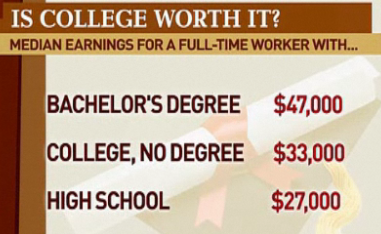
… because, if you don’t complete your four year college-level degree, you will probably still end up with the average student debt of $20,000 but only earn $4,000 a year more for your troubles!

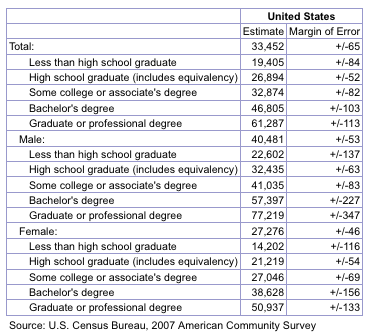
But, let’s take a closer look at what the US Census Bureau has to say about students who do complete their degrees against those who don’t:

Picture 5

OK, so for a $20k ‘investment’ (at least, if we assume the average debt left behind), the average college grad. can earn an extra $19k – $20k per year; sounds like a great deal?

It seems that we forgot to account for the extra four years of income that the high-school grad (but no college degree!) earned while you were off at the frat or sorority house!

So, let’s say that the college graduate starts (4 x $27k) + $20k behind the 8-ball … how long does it take him to catch up?

Well, if we assume that both achieve 4% yearly salary increases (starting from the same date that both are working, keeping in mind that the high-school-only grad. has already put four solid years of work in) and earns 8% on their investments (fueled by consistently saving 15% of their gross income), then we can see that it’s a ‘no brainer’:

– The College Grad would have saved $794,000 after 26 wonderfully exciting working years, and

– The High School Grad only saved $468,168 after 26 equally wonderfully exciting years working.

So, college is ‘worth’ $326k, in this admittedly highly-oversimplified example …. yippee!

But, readers of this blog aren’t thinking of spending the next 26 years working in the Quick E Mart, studiously saving 15% of their hard-earned income, just to earn 8% p.a. …

… no, they are preparing to be investors (say, real-estate and stocks) and/or entrepreneurs. Activities that high-school grads – and, even high-school drop-outs – can and certainly do in equal numbers to college grads!

You see, serious money making doesn’t discriminate on the basis of education … some of the world’s richest people have little to no formal schooling.

And, they aren’t wasting their ‘no college’ years earning $27k (and, salivating over their next 4% pay-rise) … no, they are busy reading this blog and starting their business/investment careers.

They have realized that serious wealth comes not from what you earn, but from the return that you earn on your money. So, with just the benefit of 4 years head start, they can turn a $20k per year earnings deficit into the same amount as a high-flying College Grad, by only increasing their annual return on that 15% savings from 8% to only 11.5%.

[AJC: If they can increase their return to serious real-estate investment territory of 20%, they will blow the college savings rate away by amassing nearly $3 mill. in 26 years, and if they achieve ‘entrepreneurial’ 50% p.a. returns, well they will join the ranks of the rich with more than $300 mill. to their name … really!]

Of course, if you choose to go to college – as I did, and will encourage my children to do – there’s nothing that says that you can’t also be an equally good entrepreneur and/or investor, on the side … or full-time šŸ˜‰

Safe as houses?

Picture 2Well, I did ask for it, and the first cab off the rank for the ‘diss Adrian party’ is Dan who thinks that one of my favorite posts – Contrary to Popular Opinion, Paying Off Your Mortgage Is The Dumbest Move You Can Make – is ‘ridiculous’. Seriously, thanks for opening up an important new discussion with this comment, Dan:

This is ridiculous. The author apparently believes he is untouchable and will never lose his job, get sick, or die.

You can do all the complex math you want, but the simple fact of the matter is that Risk is the biggest variable, and I don’t see it show up in your equation once.

Don’t be stupid America, and dont prescribe to a system that encourages you to continue owing people money long after you need to.

Pay off your house, free up some income, then pay off your credit cards, pay off your car, and be a happier, less stressed individual.

Hmmm …. paying off your mortgage as a ‘risk management tool’?

Before we even consider why anybody in their right mind would pay off a (say) 8% mortgage before paying off a (say) 19% credit card or car loan, let’s review the substance of my “don’t pay down your mortgage early” argument:

Look at everything that you own as a business: if it’s your own home, separate the ownership of the property in your mind fromĀ it’s use …

… for example, even if it’s your own home, treat yourself as your own tenant and figure the rent that you would otherwise had to pay when doing the sums.

Then evaluate the investment against any other investment or ā€˜business’ …

… but, if you’re still trying to get rich(er) quick(er)?

If you own a home, don’t pay it off … use the upside to help you buy more and more of these wonderful,Ā one-of-a-kind, almost-too-good-to-be-true ’businesses’ …

If you have other sources of income (businesses, investments) don’t spend it or reinvest all of it … use some of the spare cash to help you buy more and more of these wonderful,Ā one-of-a-kind, almost-too-good-to-be-true ’businesses’ …

That’s my advice to you, but only take it if you want to be rich!

But, Dan says that the ‘math’ matters not, you should consider what happens if you “lose [your] job, get sick, or die”. Well, what happens?

If you have paid out your mortgage, your money is locked in the safest bank vault imaginable … all you have to do it sell the home to access the cash. Just pray that the market is an up market and not a down market, when these events outside of your control force you to sell. Or, would YOU prefer to choose the timing? Hmmm …

Of course, you could just borrow some money against the house; but then, aren’t you now putting yourself in EXACTLY the financial situation that Dan wants you to avoid: i.e. “owing people money long after you need to”?

And, even if you still do want to use your Zero Mortgage Bank, what are the chances of the bank actually lending you (or your survivors) any money when you are jobless, sick, or dead?

Oh, and let’s say that you do happen to be unfortunate enough to “lose [your] job, get sick, or die” while you are still in the 10-15 year period when you are well ahead of the 30-year payment curve, but haven’t paid off the mortgage in full, yet? How easy will it be to refinance, or even convince your bank to hold payments for you? Even if you THINK they will, you had better be certain šŸ˜‰

What do you reckon? Dan’s on the right track? C’mon, be honest … would you feel safer paying off your mortgage early, or letting it ride?

An ad free blog!

Picture 4

Adrian J Cartwood Esq. [AJC: Euphamism for ‘Nobody Important’]

I use a tool called ad-blocker to do exactly what the name suggests: block ads from appearing in my browser. There’s no real reason for this, other than I wanted to see how it works …

… but, it’s (hopefully) well knownĀ  by now that I don’t accept advertising, promotions, or cross-links for any products or services on this blog.

I do, of course, mention books, products and services from time to time … but, only those that I genuinely use and like, and I NEVER accept payment or join affiliate programs.

The reason is simple and two-fold:

1. A multi-millionaire can hardly be credible if he writes to earn a few extra bucks per week from advertising revenue,

[AJC: Although, this reminds me of a joke that was a huge hit at Blogger Con 2007: A blogger gets on The Apprentice, and says to The Don “You know, Mr Trump, if I were you I would be richer than you”. To which Trump raised an eyebrow and responded “How so?”. The blogger, with a totally deadpan face, said: “Well, Sir … if I were you, I would still do a little blogging on the side!”. Oh, those blogger’s conventions are such a riot! šŸ™ ]

2. Even if I donated that extra few bucks to charity (I give plenty, already) YOU wouldn’t know or believe me, even if I said that’s what I was doing.

So, no solid good reasons, just the way I feel … and, others are entitled to feel totally differently … which is why I present the little owl-logo, above, just in this post, andĀ  probably won’t promote their site by placing it in my sidebar šŸ˜‰

However, what I would like to see is a ‘community service’ advertising program, where a trusted third-party places ads on your site, collects the revenue (or, maybe the spots are free community service announcements), which goes directly to a panel of trusted and worthwhile charities and/or non-profit organizations.

Anybody up to the challenge? Give me an exec. summary of your business plan!

Oops! I didn’t answer the question …

Last week, I posted the second installment on my series about real-estate development under the ‘teaser’ headline: how much money can you make developing real-estate?

But, of course, I didn’t actually answer the question!

And, that’s simply because I don’t know …

… it depends on the project, and what you are trying to achieve.

But, I DO know two things:

1. Typically, real-estate developers work on:

– a 20% to 25% profit margin on residential real-estate projects,

– a 35% profit margin on commercial real-estate developments,

– upwards of 50% profit margin on land subdivisions.

2. I also know the EXPECTED profit margin on the two projects that I’m working on.

What that expected margin on my projects will translate into is anybody’s guess, because it depends on so many RISK FACTORS – which is why real-estate development is (in my opinion) a Making Money 201 income acceleration activity, not to be taken lightly.

But, I can share Tab 3 of my spreadsheet, which shows:

– That there’s about $2,000,000 (Australia … approx. $1.8 million US dollars) of land related costs: I estimated this as $1.5 mill for the actual purchase price of the property, plus $500k allowance for taxes, closing costs, and the necessary project permits. Obviously, I will put in better estimates for some of these costs, as they come to hand.

– I’ve assumed that the bank will lend me 60% of the total project development cost of $17.9 mill. (which includes, the land component, all the costs of consultants, permits, etc., and the building costs). I’ve since spoken to the bank and they will lend closer to 80% of the total build costs, PROVIDED that I sell enough condo’s ‘off the plan’ to cover their total debt.

– Based upon the 60% that I have used in the spreadsheet, I will either need to come up with $7,160 million of my own money (i.e. the $2 mill. that I will have already spent on the land and permits, etc. PLUS the $5.160 million ‘shortfall’ in bank funding) OR find a mezzanine lender who will lend me some of this (at inflated interest rates, naturally) OR find one or more equity partners, who will put up some of the $7+ mill. shortfall in return for a good chunk of the project profits.

– In this case, I’ve assumed that we sell the condo’s in year 3 (more likely – hopefully – to be a 2 year project) and pay back the bank and this spreadsheet assumes 10% interest rate (although, that can be easily changed), leaving $10.6 million to pay back my and/or the investors’ equity and (hopefully) leave some real profits.

– I’ve assumed that we’ve had to pay some interest at ‘preferred rates’ (read: higher interest rates) on my (and the investors’) equity, which leaves a ‘real profit’ of $892k … but, don’t forget that the preferred interest is also part of our (i.e. the investors’) profits … so, they need to be added together.

– Now, I have a management partner who is a builder (but, won’t be physically building this one), who is providing time and expertise in return for 30% of the profits of the venture. He has a sweet deal: not risk (he provides NO funding and only his payment is ‘at risk’) and 30% of the upside. In my next life, I want to come back as him šŸ˜‰

– According to this spreadsheet, I make 32% on my money. Not a shabby return, and pretty much in line with the estimates that I provided above.

The good news is that the project has actually become much more profitable than the early version that I am providing here, but since it’s merely an estimate – as all budgets are – I’m not holding my breath šŸ™‚

I should point out that one of my readers has kindly provided a more sophisticated analysis of the returns that you may wish to substitute in your version of the spreadsheet, if you are going to use it; Jonathan says:

On tab “Proforma”, shouldn’t the annual return equation in cell E34 be something like =(1+E31/E5)^(1/3)-1
It looks like you have =(+E31/E5)^1/3
This drops the return from 32% down to 25%, but I do believe 25% on 2mil over three years comes to 3.9mill (2mill + 1.9mill)

Thanks, Jonathan! This tab of the spreadsheet was actually created by a consultant friend of mine who specializes in this type of thing, so I didn’t really look that closely; still, I will be keen to hear what other readers think?

How did you answer?

Picture 2

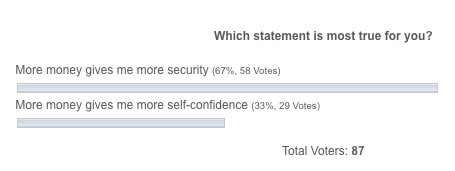
Last week, I asked the question: “does more money give you more security or more confidence?”

The results, from a reasonably representative sample of readers, was overwhemingly in favor of the statement: “more money gives me more security”.

Interestingly, this apparently says something about you …

… you see, most entrepreneurs would say that more money gives them more confidence!

But, why?!

I’m not a psychologist, so I can’t tell you, but I do think it helps to explain why entrepreneurs tend to become ‘serial entrepreneurs’ …. one success emboldens them to go for another.

We all know (by now) that once you reach your Number, you should STOP. Yet, we don’t always do that, do we?

[AJC: if you’ve been reading my recent articles on property development, you’ll know exactly what I mean šŸ˜‰ ]

Work on your business?

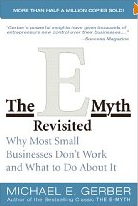
Picture 1Yesterday, I told you (yet again) about this book … the book that others claim to be “the most important business book” that they’ve ever read.

Well, I claim it to be so, too!

Let me revisit one of the key tenets of this book – indeed, a phrase that has been often (mis)used by all and sundry:

Work on your business, not in your business!

Why misused?

Because I think that most people use it, but don’t really understand what it means to really work on your business, rather than in it …

… to understand what this truly means, let me give you a personal example:

When I started my second business (the first having being ‘handed to me’ in a rather crumpled heap … but, that’s another story), I was not at all qualified to do the ‘work’ of the business, which was essentially technical in nature, yet I taught myself to handle the paralegal files that we were handling at that time because my attorney was too slow.

This became a blessing – because, it meant that I could reduce costs by insourcing a lot of the previously outsourced paralegal work which was the essential component of the business model – and a curse, because I was the person handling all files, initially.

Even when I started to hire staff, all ‘complicated’ files – or, all files over a certain $$$ value – would cross my desk, because I wanted to make sure they were “done right” … you see, I had started the business, so I wanted to believe that I was also the best technician.

But, of course, that wasn’t my job …. but, at the the time, I was blinded to the fact that every hour that I spent handling technical issues was an hour that I was NOT running my business!

Eventually, as happens in so many businesses (thank goodness!) my operations manager simply stopped his people referring those files – any files – to me; he didn’t ask, he just stopped sending them to me.

Guess what?

Our technical metrics didn’t fall in a heap … the uber-technician [AJC: obviously, only in my mind!] was not as essential as he thought he was …Ā  and, I had more time to concentrate on my real job: CEO i.e. running the business.

The business grew!

Lesson One learned: I wasn’t essential to the technical operation of the business.

But, as CEO – now, totally focused on marketing, finance, and other high-falutin’ business matters – surely, I was key to the successful day-to-day operations of the business?

Seems logical, until I signed the contract for the USA branch of the business …

… since this would be about three times the size of the Australian operation, I decided that I needed to relocate to the USA to personally manage my ‘global operations’ (well, three countries: Australia, New Zealand, and now the USA) from there.

That left me a hole to fill: I needed to appoint a replacement CEO of my Australian operations.

After a long search, I found somebody, who I appointed and trained over a period of months …. and who promptly resigned for a “better opportunity” [read: more money] just 6 weeks before I was now contractually-bound to relocate to the USA to commence operations!

Think about it: I now had only 6 weeks to find and train a CEO who could replace me in a job where I – like every owner/CEO – believed that I was totally indispensable!

How would this be possible [AJC: queue to apocalyptic visions of imminent business failure]?!

Yet, somehow, I found the ‘new guy’ and gave him all of two weeks training before I left, leaving him with:

– some last minute instructions (which he subsequently, all but ignored),

– my direct phone line in the USA (which he NEVER used), and

– my silent prayers that he wouldn’t run my life’s work into the ground too quickly.

Here is where I learned my ‘second lesson of indispensabilty’: not only did he NOT run the business into the ground, he saved a client that I had all but lost, maintained excellent relationships with my largest existing clients, signed a major strategic new contract, etc., etc. …. he proceeded to double the business over the next couple of years.

In fact, to this day, he is still successfully running the Australian operations for the new owners!

Lesson Two learned: a good business runs well under the watchful eye of it’s owner/CEO … a GREAT business runs even better without him.

You see, anybody [AJC: clearly!] with suitable training and experience can do the technical and managerial work of pretty much any business …

[AJC: if not, you don’t have a business …. you have a JOB]

… it just needs good systems to be put in place so that the business can run on ‘auto pilot’ while you – as the entrepreneur behind the business – do the ONLY job that you NEED to do:

Develop and and promote the strategic vision of the business.

Any other work that you do decide to take on is just so that you can feel busy … if that’s what makes you happy, keep doing it.

Me?

I prefer to make money šŸ˜‰