Playing the Efficient Market Theorist for a fool …

I love it when a scientific study – that cost goodness-knows-how-much – produces a result that is, well, kind’a stating the obvious …

Take this paper as an example; it finds that Warren Buffett’s success with stocks is not due to luck or taking higher risks, rather – surprise, surprise (!) – it’s due to superior stock picking skills:

The stock portfolio of Berkshire Hathaway, comprising primarily of stocks of large-cap companies, has beaten the S&P 500 index in 20 out of 24 years for the time period 1980-2003. In addition, the average annual return of Berkshire Hathaway’s stock portfolio exceeds the average annual return of the S&P 500 by 12.24% over this time period.

We examined various potential explanations for Berkshire Hathaway’s investment performance. We first explored the explanation that Berkshire Hathaway’s performance may be due to pure luck. We find that while beating the market in 20 out of 24 years is possible due to luck at a 5% significance level, incorporating the magnitude by which Berkshire beats the market makes the “luck” explanation unlikely.

After employing sophisticated adjustments for risk, we find that Berkshire’s high returns can not be explained by high risk.

Ruling out the major alternate explanations to Berkshire’s investment performance leaves us with the potential explanation that Warren Buffett is an investor with superior stock-picking skills that allows him to identify undervalued securities and thus obtain risk-adjusted positive abnormal returns.

Well, d’ah …

So, let me tell you – and, I’ll accept a $1 Mill. federal government grant to write the obvious up as a paper, if you like – that Warren Buffett makes his money essentially in two ways:

As Businesses

Contrary to popular belief that Warren Buffett is a vulture who swoops in when there is carnage all around to pick up businesses at bargain prices, Warren actually patiently waits to buy sound businesses at fair prices.

These are usually private/family businesses that need to be sold for reasons other than the soundness of the business itself … for example, the largest family business in Australia was split up to avoid squabbling by the ‘next generation’ … succession is usually the major issue facing such private/family businesses. Warren did not buy this Aussie business, but you get my point …

Warren, to the best of my knowledge, rarely bargains on the price of a business and has even been known to overpay; for example, when the Sees family wanted $30 Million for the Sees Candy business, Warren nearly walked away, thinking it was worth only $25 Million …

… Warren is glad that he bought it anyway, as the business returned Warren’s $30 Million in only a few, short years and is worth over $1 billion today.

You see, a business grows and produces continuing cashflows – even if you never sell (and, Warren NEVER sells!), so the price you pay is secondary, IF the business produces outstanding returns. That’s why Warren says:

It’s far better to buy a wonderful company at a fair price than a fair company at a wonderful price.

In Defiance

So, Warren Buffett wears two hats, with his first hat (surprisingly) being business owner … but, it’s his second hat as the World’s Greatest Stock Investor seems to be the most fascinating to most people.

Well, I’ll let you in on a ‘secret’ … there is no great secret here, at all: Warren simply makes a ton of money by proving that the so-called Efficient Market Theorists are fools … time and time again!

Given that luck and all the other explanations have been rigorously and scientifically ruled out, what the study has ‘proved’ – at great expense, I might add – is not that Warren Buffett is right …

… but, that Efficient Market Theory is wrong!

Now, THAT is a breakthrough of gargantuan proportions, and tomorrow, I’ll tell you how you can exploit it 😉

How not to be a dull boy …

When I worked I was dull and when I retired I became insufferable … it’s official!

But, there is a way out: it’s called the Work/Life Balance and we all want it, but none of us really have any idea how to get it 🙂

Which brings me back to a conversation I had with a friend of mine after showing him our new house a few nights ago (extensive renovations will be underway, soon):

My friend, a doctor – an internist, family doctor, or general practitioner as he would variously be called depending on which country you are in – confided that he originally wanted to become a surgeon.

But, he stopped his studies – after many years of trying, failing, then retrying to make the ‘cut’ when his wife suggested that he draw a pie chart of how he was spending his time.

Here’s his chart:

all-work1

Typical working student; most of his day taken up with work, then study with very little left for sleep and virtually no R&R (rest and recreation: that’s where ‘family’ comes in) …

… she then asked him to draw a similar chart of how he would LIKE his typical day to look, and this is what he drew:

no-play

It doesn’t take a genius – or a budding surgeon – to realize that what he really wanted was a BALANCED LIFE: work, sleep, family.

My friend almost immediately gave up his surgery aspirations with absolutely NO REGRETS and now runs a successful suburban practice that gives him a life where he can help people, his family, and himself in almost equal quantities.

This leads me to think: why do we live the first pie chart, if not to get to the second? Perhaps, money is not really the object, after all …

… or, maybe you need to live the first for a defined period (your Date) in order to achieve a preset amount (your Number) so that you can live the life you really need (your Life’s Purpose)?

Now I better go and take some of my own advice … 😉 [AJC: Really, I just added this sentence: I have to go for a walk to the letterbox with my wife … whoo hoo!]

A new way to look at your home …

There is a new way to look at your home, and if you do it, you will never make a financial misstep again – at least when it comes to the biggest personal purchase that you are ever likely to take …

… but, I warn you: your wife may not like it 😛

You see, we tend to describe our homes as an ‘investment’ but the reality is far different: we buy emotionally and we justify rationally.

The truth is: we [most of us] want a home … then we want a bigger one … always, just a little/lot more than we can actually afford. And, to be totally truthful … I not only succumb to this line of thinking myself, I actually encourage you to do the same!

I subscribe to the old-fashioned notion that you should buy your own home – even if it means breaking my rules to get into the home in the first place – as a way of ‘forced savings’ …

… but, once you are in your first home, I then want you to rationally examine the true current resale value of your home, and the equity that you have in it (i.e. what the home is curently worth against what you currently owe), at least ONCE EACH YEAR, to ensure:

(a) that you don’t upgrade until you can afford the payments, and

(b) that you put any excess equity to work for you.

But, these rules are only ‘proxies’ for what you should be doing, if you could be trusted to manage your money rationally, instead of emotionally …

… if you could be trusted to treat your home – at, least from a financial aspect – as a house:

You should charge yourself rent!

This is the only way to ‘prove’ that your house is an investment. It lets you know two things:

Am I living beyond my means?

To find out, simply ask yourself these two questions:

(a) How much rent could you get on your house if you rented it out? Ask a Realtor or two … scour the listings in your local paper … look it up on rent.com … do this properly!

(b) What rent can you afford to pay, according to the 25% Income Rule?

If (a) is more than (b) then you have a problem … you are living beyond your means: either increase your means (e.g. get a second job; charge your children board; etc.) or decrease your living (e.g move out; rent out a room; etc.).

Am I investing wisely?

This one is easy; if you charge yourself rent, you can see if your property is positive cashflow or negative cashflow …

You have some ‘advantages’:

– You have a great tenant

– Your tenant has a great landlord

– You get to tax deduct your mortgage

– There’s no tax to pay on the ‘rental income’ … it’s all in your head, remember? 😉

To find out if you really are investing wisely, simply ask yourself these two questions:

(a) How much return on my money (i.e. equity currently in the house) could you get if you sold the house and reinvested the equity elsewhere?

(b) What rent would you have to pay (remember that you want to take the lower of your current rent or what the 25% Income Rule allows) if you lived elsewhere?

If (a) is more than (b) then you have a problem … you are investing badly: either sell your house or see if pulling out some equity and investing helps.

If the answers don’t please you, and you are unwilling to make the necessary changes, then the 20% Equity Rule and 25% Income Rule are still there to stop you from getting into too much financial trouble … make sure you obey them! 🙂

Good deal or bad deal?

No, this is NOT another ‘Howie Mandel-style’ game show … I’m done with that series (aside from a couple of wrap-up posts, still to come)!

But, this will be my last reader Poll for a while, so I want you to sit down for 3 minutes and make a commercial decision with imperfect information:

Time for a fun ‘hypothetical’ … I’m not really asking you to invest with me [AJC: I want you to learn to invest with somebody far more capable: yourself!]

I would like you, and a number of other people, to join me in a real estate project [remember: this is hypothetical].

It will be very low risk, because it’s a very well-established commercial strip-mall in a great area, pretty much fully rented with lots of good tenants with long leases left to run and for the last 10 years has produced a reasonable – perhaps not stellar, but certainly highly respectable – profit with very low maintenance costs, tenant turnover, etc., etc.

No catches, here, really … it will be a general partnership, I will be the managing partner and you can join the group of passive investors already committed.

So, let’s look at the deal a little:

Your share of the investment will cost $100,000 and for that you get 10% of the $1,000,000 project (incl. financing/closing costs) … it’s a very inexpensive strip mall 😉

We expect reasonable capital appreciation over the life of the project (up to 10 years, although you can sell out anytime before then, and we will guarantee both a buyer and then-current market price for your share).

The property will return about $9,000 a year (net operating income per 10% share), but we think it’s best to keep aside some as a contingency against vacancies, maintenance, etc., etc.)

So, we will guarantee you (secured by the project itself) $7,500 income each year for at least the next 10 years indexed to 7.5% of the current value of the building (but, NO LESS than the $7,500 p.a. guarantee) v the $3,000 or 3% that a bank will currently give you, and which does not grow. Of course, you may have others ideas in mind for the money, but I hope you will invest with us … after all, here, your income is guaranteed!

In summary: an ultra-low-risk ‘bricks and mortar’ investment returning a MINIMUM 7.5% p.a. on your original investment (increasing in line with property value increase) … you will get your money back, just from the guaranteed distributions that the project will pay you, over 13 years and you STILL get 10% of any appreciation in the building!

Deal or no deal?

How fast is frugality?

save-v-invest

I love it when I read interesting posts on the personal finance blogs and other forums … take Mighty Bargain Hunter‘s view that frugality is the fastest way to a better bottom line:

It shouldn’t be the only way you’re improving your bottom line, but it does give results, fast.

For someone who already has their finances under good control, some money-saving activities are simply too little payback for too much time … [but] what about the people who aren’t as well off?  Maybe they’re making $40k or $50k, but have a lot less saved up than they probably should for their age.  This is the situation for which packing your lunch, buying generic, buying used, skipping Starbucks, and clipping coupons will help.

And it helps immediately.  The week you take lunch to work at $2 a day instead of hitting Subway at $5 a day, you’ve improved your bottom line by $15.  Boom.  Or brew your coffee in the morning instead of hitting Starbucks.  $10 per week.  Boom.  Instant gratification.

Building up income streams takes longer, especially the kind of income streams you want (passive ones) … higher income may be better in the long run, but that’s the long run.

Frugality is here and now.

Businesses have taken this view for a long time now … they call it cost-cutting 🙂

Usually a business that is spending its time cutting costs is a business that you should selling out of, not buying into …

… it’s current finances may begin to look great, but its future may be bloody awful (that’s why it’s busy cutting costs!).

On the other hand, a GREAT business invests in their future (sales and marketing, product development, R&D, production, etc.) while managing their costs.

So, let’s put it to the test: how fast is frugality?

Well, to find out, I put four scenarios into the Magic Excel Blender and here’s what it spat out:

Save: If you earned $100,000 a year and cut corners so that you could save 20% to stick in your mattress, at the end of 20 years, you’d have $400k stashed away.

Invest: If you only managed to save 10% a year and spent your time investing the proceeds wisely (@ 8% p.a.) you’d end up with $460k in (say) stocks.

Save + Invest: But, if you did the sensible thing and invested your savings instead of stashing it under your mattress (in other words, save 20% then invest it @ 8% … hardly rocket science), you’d end up with more than $920,000 after 20 years, and still have dividends each year to live off … a much better result for only a little extra work together with some belt-tightening.

MM101: However, if you did the really sensible thing, and built up your income (so that you can afford to reinvest the dividends), saved well (at least 20%, but only of your original level of income), and invested both the dividends and the savings wisely (@ 8% p.a.) after 20 years you’d have over $2.5 million.

Frugality may be quick (in that we can afford to pay a bill; pay down a pressing loan), but will never make us rich …

… that’s why we take a multi-faceted view to personal finance:

Making Money 101 – to ensure that our costs are under control and free up some cash to help us invest in MM201

Making Money 201 – to grow our income by investing what little cash we may have (to begin) wisely and maintaining sound MM101 ‘habits’ to ensure that we have ever-growing streams of investment income, keeping our growing personal ‘needs’ (read: expenses) in check, so that we can eventually reach our Number

Making Money 301 – to manage our Number (i.e. our nest-egg) so that it lasts as long as we do, while living the life that we have designed for ourselves, not the life that others have resigned us to.

A little perspective …

picture-1

For a bit of fun, I typed in an annual income of $220,000 into this handy little online calculator, and it shows that I’m the 107,565th richest person in the world … whoohoo!

Now, if I typed in my real annual income, I think that I could jump myself higher up that list … and, if I factored in that I get that money mainly passively, well ….

Reminds me of an interview that I saw with Guy Laliberté, founder of Cirque Du Soleil, who went from street performer (read homeless hustler) to sharing the same level of wealth as Oprah.

Now, that’s not the bit that blew me away; what did was that they were sharing something like 160th place on Forbes’ list of the richest people in the world: Oprah … Cirque Du Soleil Man … and, they ONLY get to be joint 160th (approx.) on the list??!!

Who are these other dudes between them and Bill Gates?!

So, it’s really good to be able to put things in perspective and realize that if you are earning almost ANY regular salary, you are in the Top 10% of the richest people on the planet:

The Global Rich List calculations are based on figures from the World Bank Development Research Group. To calculate the most accurate position for each individual we assume that the world’s total population is 6 billion¹ and the average worldwide annual income is $5,000².

Below is the yearly income in percentage for different income groups according to the World Bank’s figures³.

Percentage of world population Percentage of world income Yearly individual income Daily individual income
Bottom 10 percent 0.8 $400 $1,10
Bottom 20 percent 2.0 $500 $1,37
Bottom 50 percent 8.5 $850 $2,33
Bottom 75 percent 22.3 $1,487 $4,07
Bottom 85 percent 37.1 $2,182 $5,98
Top 10 percent 50.8 $25,400 $69,59
Top 5 percent 33.7 $33,700 $92,33
Top 1 percent 9.5 $47,500 $130,14


The world’s distribution of money can also be displayed as the chart below.

¹ 2003 world population Data Sheet of the Population Reference Bureau.
² Steven Mosher, president of the population research institute, CNN, October 13, 1999.
³ Milanovic, Branco. “True World Income Distribution, 1988 and 1993: First calculations based on household surveys alone”, World Bank Development Research Group, November 2000, page 30.

So, realize that UNLESS YOU ARE PLANNING TO DEVOTE SERIOUS SLABS OF YOUR TIME AND MONEY TO WORTHY CAUSES this blog and everything we are doing here is about as useful as a blog on whittling … and, probably a darn site less so, because there’s nothing inherently of artistic merit in even the best-crafted bank account.

How much does it take to feel wealthy?

The answer is “about double” 🙂

But, that’s not really a tongue in cheek question / answer, it’s actually scientifically researched and verified fact …

… let me explain.

Most people want to become rich (when we strip away the houses, cars, vacations, sex, drugs, rock and roll [AJC: Boy, I must lead a great life!]) simply to feel secure … to stop having to worry about money.

So, the definition of ‘rich’ for most people is related to how much more money that they feel that they would need in order to stop feeling financially insecure. And, that always seems to be about twice what you currently have; take a look at this report by MSN Money (if anybody can find the base source, please send me the link … I hate to quote quotes).

  • Those who earned less than $30,000 thought that a household income of $74,000 would qualify as rich.
  • Those who made $30,000 to $50,000 said an income of $100,000 would be rich.
  • And people in the top half [$50k – $100k+] of earners were more likely to say that an income of $200,000 earns you the right to the R[ich] word.

So, it seems that no matter what income level you are on, you need two (to perhaps three) times that in order to feel ‘rich’.

Perhaps, you feel that it would be different if we weren’t talking penny-ante incomes here, and jumped straight to millionaires and multi-millionaires? Surely, things would be different for them?

Well, not so … according to Robert frank, Author of Richistan, most of America’s Ultra-Wealthy still consider themselves as ‘middle class’ and would need “about twice what they already have in order to feel wealthy”.

So, this is just another reason why picking a random income or net worth $$$$ target and calling that ‘rich’ doesn’t cut the mustard … you’ll never be relaxed with your level of wealth, no matter how much you have.

No, what you need to do is:

1. Understand WHY you need the money: we call this Understanding Your Life’s Purpose

2. Understand HOW MUCH you would need so that you would be free to LIVE your Life’s Purpose: we call this Calculating Your Number

… and, when you finally reach your Number, not worrying about chasing more, because that’s about as sensible as a dog chasing it’s tail!

The definition of insanity …

“Insanity: doing the same thing over and over again and expecting different results.”  Albert Einstein

Thankfully, this blog isn’t for everybody … only those who want to get rich(er) quick(er) … I’ve proved that it can be done successfully, and I am conducting a ‘grand experiment’ at one of my other sites to prove that it’s not just luck and that others can do it, too.

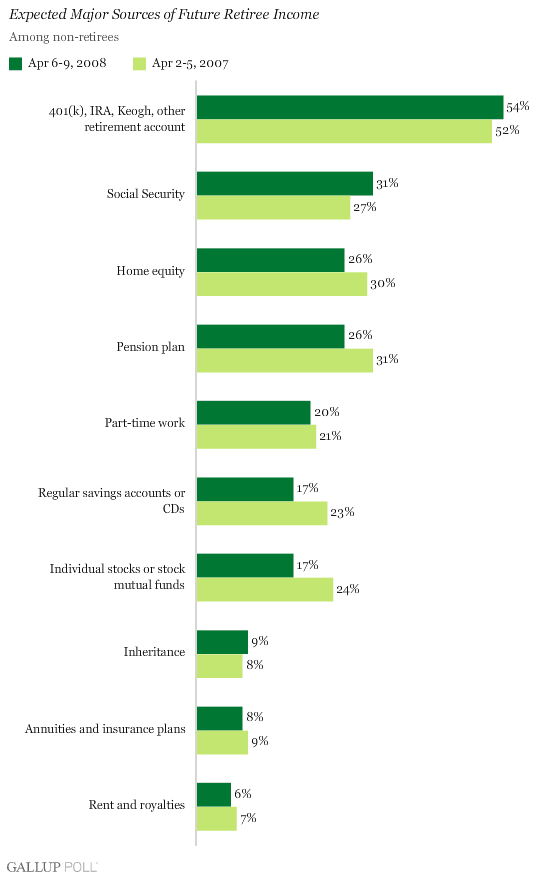
But, the vast majority are still in the ‘work for 40 years and hope to have saved enough’ mindset … and they have worries of their own, as this recent Gallup Poll showed:

Of course, recent economic woes are probably ‘skewing’ this a little … but, think about it – most aren’t retiring tomorrow, or even in the next 10 years, so markets will have plenty of time to boom and bust again for them.

No, the problem is more endemic: most people simply don’t think that they will be able to retire happy or comfortably – and certainly not wealthy – despite the ‘formidable’ array of ‘retirement weapons’ at their disposal:

So, if the majority of people are using these tools and the majority of people believe that they won’t work for them …

Whatup?!

Surely, at some level, these people know that these tools – as I have been hammering home in this blog for some months now – simply won’t do the job?!

Let’s take a look:

1. 401k’s – High fees; low returns; lousy investment products on offer:

STRIKE 1 – I have never had a 401k and I have no idea what is even in any of my tax-advantaged / retirement accounts.

2. Social Security – An unfunded program; USA in the highest level of debt in history’ what’s the chances of Social Security being around in the same form when YOU retire?:

STRIKE 2 – When my social security statement arrives I chuck it in the trash without reading it, it’s irrelevant, it won’t be around when I retire, and I had this same line of thinking BEFORE I became rich.

3. Home Equity – Please! Where do you intend to live when you retire? By the time you buy and pay changeover costs etc. if you see any spare cash, it may be just about enough to pay off your remaining credit card debt:

STRIKE 3 – I live in my home equity, don’t you?

4. Pension Plan – Do you work for Ford/GM/Chrylser? Any airline? Just about any bank?:

STRIKE 4 [AJC: 4 strikes???!!! I’m an Aussie, what do I know from baseball?] Ditto to the above, in fact, I have never subscribed to an employer-sponsored pension plan, even where I have had the choice.

… need I go on?

The point is, if you know these tools aren’t going to work for you – as the majority of Americans surveyed by Gallup seem to – yet you keep using them – as the majority of Americans do – isn’t that the very definition of ‘insanity’?

Now, that’s a question that I would love to see the Gallup Survey for!?

Merry Chrismas?!

Why am I posting a really nice Christmas video on January 25th?!!

Well, it’s simply to make a point …

… it doesn’t matter how late you start, but how well you execute that counts.

Just ask Ray Kroc (McDonalds), ‘Colonel’ Sanders (KFC), my father (who started a business at the age of 60), and (hopefully, soon) our very own Lee Martin …. old is the new young 🙂