She’s an heiress …

Madam X (provocative name) over at My Open Wallet says that she is an heiress:

Remember Great Aunt Minnie? She died peacefully a few weeks ago. I had a chance to see her one last time in May, and spoke to her on the phone a few days before her death … it was even more weird to find a thick envelope in my mail the other night, which turned out to be from Minnie’s lawyer, because I’ll inherit a share of her estate. So now I just have to see what happens once the estate is settled and divided up. I have no idea how much money it will be. I certainly don’t expect much, given I’ll only get one twelfth of her estate.

Receiving money ‘suddenly’, be it from a sad occasion such as this, or from some fortuitous circumstance such as winning a substantial prize in the lottery, can be difficult, because you probably have no plan.

And, because you have no plan, the money can go as quickly as it comes (remember poor-then-rich-then-poor Lou Eisenberg?).

I call this Found Money, and here’s how to deal with it:

If you’re lucky enough to receive such a windfall, you should spend enough to fully celebrate your good fortune (even more so if it was a result of hard work – e.g. selling your business – rather than luck).

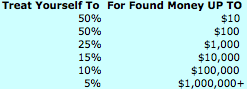
Here’s a table that will help you decide how much to save and how much to spend, depending on how much Found Money you happen to come across:


The idea is that money is for SPENDING and ONLY FOR SPENDING … but, you need to PLAN to spend some now and PLAN to spend some later (a.k.a. saving). That’s exactly what this table is designed to do.

So, if you find $10 in the street, buy yourself a fun magazine, then stick the rest in a jar.

If you happen to inherit $100,000 go ahead and upgrade your car (and/or take a vacation) – totally guilt free – then plan to invest the other $90k very wisely 😉

Disability no object …

I think that there are fewer ‘hold backs ‘ to getting what we want than we think …

Here, Lance shares his disability, but that’s NOT his hold-back … access to money is. But, I think that’s NOT his hold-back either, and it shouldn’t be yours:

I’m 32 years old and born completely deaf. I’ve worked twice as hard as my non-disabled peers to get to where I am now and am only 18 months away from being completely debt free including having my home paid off.

Meanwhile I am working full time and am trying to get a side business going that focuses on media services for the Deaf population. I strongly believe that my media business will someday replace my current income.

Now, I’m doing everything I can coming from low class family on both my side and my wife’s side to fund my way to success while watching friends from wealthier families getting much further ahead to their wealth than I am. Don’t get me wrong, it’s not a competition and I’m happy for them but I’m seeing that it takes money to make money and the road I’m taking with “self-made-funds” is taking forever. While I know my friend with a wealthy father in law wouldn’t be nearly as far as he is without his in-law’s fund I feel like in order to succeed you need to know someone wealthy, I see it all the time. My problem is I have absolutely no relatives who are wealthy, no friends with money enough to invest, or any kind of connection to people with money.

Being on the path to debt-free I really don’t want to borrow money either, I hate debt but at the same time I know it’s necessary as you call good debt. One of my next steps requires $35k – $50k, so I’m asking you where someone in my position can find that kind of money without having to save it over the next 5 years.

Now, Lance may have some advantages that some of these ‘wealthy-relatived others’ don’t have: for example, Lance is debt-free (almost)!

And, I have wealthy relatives, but would never have considered holding my hand out, anyway … some people have the ‘take gene’, but others don’t.

I don’t.

Lance could go to a bunch of non-wealthy friends and ask for a little from each … he might be surprised to find that 10 friends would be happy to cough up, say, $5k each. And, he may be able to tap into government grants to make up the difference, given his disability and the planed area for his business.

But, Lance’s best bet IMHO is to refinance his house. This is a good opportunity to lock in a very low interest rate line of funding for his business anyway by fixing at the current low home mortgage rates.

I know that this goes against Lance’s “pay off your home mortgage” mentality, but is his house any less valuable or livable because he does/doesn’t carry a mortgage?

Of course not!

If you also have a hot business idea, but have stalled for lack of money, maybe you should do the same?

But, you have to REALLY believe in your business …

Comfort kills!

Yes, that is genius …

But, what does T Harv Eker mean by ‘comfort zone’? Here’s what he says in his book:

Comfort kills! If your goal in life is to be comfortable, I guarantee two things. First, you will never be rich. Second, you will never be happy. Happiness doesn’t come from living a lukewarm life, always wondering what could have been. Happiness comes as a result of being in our natural state of growth and living up to our fullest potential.

How ‘comfortable’ you want to live is up to you … but, I can help you convert that into a number: the amount of money that you need in the bank so that you can live your desired level of comfort (or, discomfort).

Then, I can help you get there!

You DO need $12 million to retire …

Money Ning says that you don’t need $12 million to retire.

Except on Planet AJC, ‘Ning!

Money Ning says:

Can you imagine spending $11,250 per month every 30 days until you are 70? It would actually be fun for a while, but by the 24th month, I bet you’ll be tired of buying anything. And if you just leave some money left every month? Well, down goes the savings necessary.

These humongous retirement numbers may catch our attention, but they rarely speak the truth about reality. Plus, chasing a number is a never ending game, because there’s always a higher number to go after.

When I was still $30k in debt, and going nowhere fast, I calculated that I needed $5 million to ‘retire rich’:

– That was in 1998 dollars … in 2010 dollars, we’re up at around $7.5 million

– I under-estimated what I needed; and, so will you!

Right now, I ‘burn’ around $250k per year (land taxes, school fees, vacations; house upkeep; etc.) and don’t consider my spending anywhere near ‘Snoop Dog Lavish’, but it’s WAY over Money Ning’s “$11,250 per month” … and, I can’t EVER imagine spending that little per month. Really.

To that annual spend, I add my two houses (to be fair, I’m trying to get rid of the US one), and my two cars (and some associated expenses) … there’s $12 million, and I don’t live in New York!

Of course, that’s not what everybody needs … maybe not even what ANYBODY needs … but, it is (give – not take – a few million) what I decided that I needed.

But, when calculating YOUR ‘number’, don’t go for the money, do as Money Ning suggests:

Chasing a number is a never ending game, because there’s always a higher number to go after. If you want to feel rich, the more appropriate approach is to just make sure money is out of your way, out of your life decisions, and out of the list of things that you worry about.

That’s what I did … it’s hardly my fault if the answer pointed to $5 Million, nor is it my fault that I ended up cashing out for a whole lot more. And, it won’t even be my fault, if you do, too.  😉

Is greed good?

That is the question posted by Gordon Gekko (Michael Douglas) in the newly released Wall Street movie sequel which, by the way, is abysmal.

One of the pivotal moments in the movie (IMHO) is when the least-sharky of the Wall Street sharks (played incredibly badly by insipid Shia LaBeouf) asks the über-shark (played much better Josh Brolin) what his ‘walk away Number’ is.

Über-Shark answers: “More!”

If you don’t see the problem with this, then you haven’t been reading this blog.

But, my main issue with the movie, aside from the bad acting/characterization/plot-lines is the central premise:

Gordon Gekko has come out of 8 years in jail, with $100 million salted away in some Swiss Bank Account, but held in trust for his since-estranged daughter. Totally believable, so far … except that there are so many tax avoidance issues that no father would put their daughter in that much danger.

But, that’s not my issue with the plot.

The daughter indicates that she knew that there may be SOME money SOMEWHERE for her, but she didn’t care and was planning to give it all away (a plan that she eventually has a chance to execute, but we’ll come to that). Now, nobody in their right minds would give all their money away to charity: a little, some, most … maybe … but, not all!

But, that’s not my issue with the plot.

It’s in the execution of the ‘give away plan’: her fiance, and soon to be father of her child, talks her into ‘donating’ all $100 million to some new company experimenting with a new form of clean energy (lots of fancy diagrams, light beams, serious-but-kindly-and-honest-looking-scientists, high-tech-futuristic-energy-orbs, and so on).

Now, what form of young-and-brilliant-but-disillusioned (don’t forget the “brilliant” part) Wall Street type would put $100 million of his own money (well, he’s about to marry the chick, isn’t he?!), which represents about $99 million more than his entire current net worth (and, that’s only because he just received a $1.5 million bonus check), in a collapsing market into ONE INVESTMENT?

None of my readers, I hope!

And, even if he was stupid enough to bet the entire $100 million, would he bet it on a speculative company that had NEVER made a single cent in profit?

That, my friends, is financial suicide. Don’t do it, because greed is NEVER good 🙁

Beat 80% of professional fund managers!

I’m disappointed! I thought that 7million7years.com and it’s membership-site ‘cousin’ 7m7y.com were important enough to be hacked … but, they weren’t 🙁

Turns out that MANY GoDaddy-hosted WordPress sites have been similarly ‘hacked’ – with users seeing a [false] SECURITY WARNING ALERT!!! message. GoDaddy appears to be working on have fixed the issue, in the meantime, please read on for today’s un-hacked post ….

_________________________________

Shawn at Watson Inc. outlines a sensible ‘system’ – one that I have spoken about before – that beats “80%-90%” of professional fund managers [my highlights]:

Some may ask what I mean by systematic investing. Peter Lynch (Fidelity), Warren Buffett (Berkshire), and even Dave Ramsey recommend a conservative and simple approach for the typical investor: rather than trying to outsmart the markets, use benchmarks to track the markets instead. For example, the Vanguard Index 500 fund has outperformed two-thirds of all mutual funds on a rather consistent basis (Cash Flow Quadrant, 1999). Usually over 10 years, these types of index funds yield a return exceeding 80-90% of returns of the “professional” mutual fund money managers (Motley Fool, 2007). Interestingly, the average millionaire is this type of investor (The Millionaire Next Door, 1996). Although there is no 100% guarantee, this method does dramatically decrease the risk over time and provides respectable returns. Provided that one starts early enough (i.e. before mid-forties), consistent investing over time can be the key to achieving a great deal of wealth.

Now, who wouldn’t kill for a system like that?

Well, me for one … and, I’m guessing, most of you!

You see, we (7m7y readers) have a very special filter that QUALIFIES us; it’s the title of this blog: “How to make $7 million in 7 years”.

Now, there’s no reason why you CAN’T read this blog if your target is, say, $1 million in 20 years … I can’t physically stop you … but, it’s ill-advised, because most of what I say would just be ‘noise’ to you …

… just confusing ‘chatter’ that sometimes runs totally counter to what you read elsewhere.

What I say here is ‘noise’ if you really do have very modest financial goals, or no real financial goals beyond saving and trying to become debt free.

So, in my “$7 million 7 year” context, I say “so what if I can beat 80%-90% of fund managers?” because the amount that I can make simply won’t be enough to help me reach my Number … certainly not if it’s one of my main financial strategies.

Instead of worrying about the pro’s and how the vast majority are simply butchering the mutual funds that they are supposed to be wisely managing, realize that investing in the ‘market’ (e.g. by investing in a low-cost index fund as sensibly suggested by Shawn) actually LIMITS your returns to that achieved by the market: 8% over 30 years in any market, 12% in ‘average’ times, and 0% (or worse) in recent times.

Try this:

a) Plug your starting Investment Net Worth (i.e. what you could scrape together to invest) into a compound growth rate calculator

b) Also, plug in how much you think you will be able to add each year

c) Include the number of investing years that you would like to have before you finally ‘stop work’ to live off the fruits of your investments

d) Plug in any number from 1% to 12% that YOU think an Index Fund will reasonably return over the number of years that you allowed, above

e) Halve the answer that the calculator gives you to (very roughly) allow for 4% inflation, for every 20 years (or prorate, if less than 20) that you chose, above.

f) Divide your final answer by 20: on a VERY GOOD DAY, that’s roughly (in today’s dollars) what you will have to live off, each year.

If that’s good enough for you, congratulations on two counts:

1. Thanks to Shawn, you’ve just found your Ideal Investment Strategy … and, it’s easy / low risk, to boot! And,

2. You’ve also saved 2 minutes a day, because this blog – for you – is just noise …. [crackle … and, out!]

But (!), if the answer is NOT good enough for you [AJC: it sure wasn’t good enough for me! But, it just might be good enough for you – be TOTALLY honest, this could be the financial ‘tipping point’ for you] … commiserations: your life just became a whole lot harder!

If so, keep reading … I’ll do what I can to soften the blow 😉

Paying down debt IS investing …

Budgets Are Sexy [AJC: If J. Money really thinks so, I don’t want to be invited to his Stag Night!] poses an important question: “Should you invest or pay down debt?”

And, he provides these guidelines to help you decide the answer:

Whenever you have any extra money in your pocket, make sure to take care of these financial priorities, in this order, before you do anything else:

  1. Pay down any delinquent debts that could threaten your well-being or credit score, such as an overdue tax bill or legal judgment.
  2. Accumulate a financial safety net. If you don’t have at least three to six month’s worth of your living expenses saved up in an accessible emergency fund, that’s the next place your extra money should go.
  3. Pay down high-interest debt. If you have credit cards, lines of credit, or auto loans, with double-digit interest rates, attack those financial burdens next.

If you’ve accomplished the above and still have excess money left over each month, you’re in a great position. Maybe you have an extra $100 and are struggling with whether to invest it in your Roth IRA or to use it to pay down your mortgage, for example. The answer to the dilemma is simple: Determine which option is more profitable for you. To do that, you have to figure out your after-tax return for each choice.

I agree with the first bullet point: you must pay down any delinquent debts. You have to keep your head above financial water.

As to the rest, well, I think that we’re in danger of forgetting a critical point:

Paying down debt is investing!

You’re investing in your own ‘debt instruments’, where the risk is low (in fact, by paying down the debt, you’re IMPROVING your risk profile) and the return can be low / mediocre / high depending upon the AFTER TAX cost of the interest and any other fees and charges.

Your student loans and mortgage debts are probably LOW interest, hence LOW return investments.

Your car loan and credit card debts probably HIGH interest, hence HIGH return investments.

… and, you may have some personal loans or other debts that fall somewhere between the two.

So, I would modify BAS’s guidelines as follows:

  1. Pay down any delinquent debts that could threaten your well-being or credit score, such as an overdue tax bill or legal judgment.
  2. Put in place a financial safety net. Put a HELOC in place; make sure that you can tap into your retirement accounts, or keep some spare loan facilities in place in case a financial emergency arises.
  3. Pay down high-interest debt. If you have credit cards, lines of credit, or auto loans, with high double-digit interest rates, you’re probably safe in attacking those financial burdens next.
  4. Find investments that can outperform your remaining debts. If you have 1st mortgages, student loans or other loans with low single-digit interest rates, let them ride PROVIDED that you instead invest somewhere where AFTER TAX returns should be expected to outperform these remaining loans by a comfortable margin.

Once you’ve made the mental leap that paying down debt IS investing, you’re in a MUCH BETTER position to decide how best to use your money … particularly if you have optimistic financial goals 🙂

Staring down as the ground rushes up to meet you!

[click here to see movie]

I’m not a great fan of roller-coasters and thrill-rides, although I have ridden my fair share.

The most recent was at Disney World in Orlando, FL where I rode the The Disney World Rock ‘n’ Roller Coaster, mainly because I heard that it accelerated from a standing start as fast a Formula 1 race car, or something along those lines.

But, the one that scared me the most was one that I rode at our local Luna Park in my late teens … it was called The Zipper: more a thrill-ride than a coaster [AJC: I was ‘thrilled’ to find the image/movie above … imagine it at high speed and the whole arm on which the cages are moving around ALSO orbits around a central hub with the effect of ‘throwing’ each cage towards the concrete ground!], as it consisted of a number of cages spinning on an orbital arm; the effect – at certain stages of the ride – was rushing face down towards the pavement … a nice way to pick up your heart and shove it firmly into your mouth!

This effect is also one of the main reasons that I’m not enamored with most of the so-called Safe Withdrawal Rate retirement strategies that abound.

Whereas the main differentiator of these plans is usually in the % that you can ‘safely’ withdraw each year from your retirement ‘nest egg’ (usually in the 3.5% – 5% range), they are usually based on some sort of mathematical calculation that takes into account:

1. Your current age

2. The Number of years you expect to live (usually 30 or 40 years post-retirement)

3. The amount that you retired with

4. The mix of cash, stocks, and bonds that you would be most comfortable with

5. The probability that you would be most comfortable with that your money will last as long as you do (usually 75%+)

The mathematical models used then try and take these various factors into account, along with the historical performance of the cash/bond/stock markets and calculate what % of your nest-egg that you can withdraw that will – within the % accuracy that you chose – ensure that you have at least $1 left to your name on the day that you predicted that you will die.

Now, if that doesn’t sound totally idiotic to you, let’s just imagine for a moment that you CAN predict that you will die pretty close to the date that you selected for the model to work AND that you are comfortable with something less than 100% certainty that your money will last as long a you do …

… I still can’t help thinking that for the latter years – when you are pretty old and absolutely powerless to do anything other than ‘hang on for the ride’ – you will have to endure the REALITY of your bank account rapidly depleting towards that ‘perfect’ $1 remainder (or, whatever remainder you selected).

And, I can’t help but picture myself – eyes ever widening in financial terror – wondering: “will I hit Ground Zero ($)?”

I still hate thrill rides 🙁

PS I’m glad that I didn’t read about the safety issues with the earlier version of the Zipper ride – likely the same model as the one that I rode – otherwise my ‘face rushing to meet the pavement” may have turned out to be real (!):

On September 7, 1977, the Consumer Product Safety Commission issued a public warning, urging carnival-goers not to ride the Zipper after four deaths occurred due to compartment doors opening mid-ride … the same scenario was repeated in July 2006 in Hinckley, Minnesota when two teenage girls were ejected from their compartment as the door swung open.

What are your financial flashpoints?

OK, I was all set to tell JD Roth (at Get Rich Slowly) that wealth comes from your actions, not from some ‘magical millionaire mind-set’ when I clicked PLAY on this video by the author of a book that JD was reviewing on his site

… the video actually hit home!

I remember some distinct financial flashpoints that helped to set me on my financial path … for better or worse:

1. My dad waking me up in the middle of the night to go and watch our shop burning down

2. My dad telling me our (bad) financial situation

… not one event, but a series with the common theme: we were living beyond our means.

This hit home, and I resolved never to be a financial burden on anybody …. never to hold my hand out … and, so on. From a young age, I held down after school jobs, bought my own clothes, saved up for my own cars, paid for my own trips, and so on.

This is not unusual; many – most – of you probably had to do the same. And, we were not totally ‘poor’ … my dad could eventually solve most of his financial problems by going to other, wealthier relatives for hand-outs.

But, what made it a little different for me was that my dad hid all of this from my mother and my sisters … THEY believed that we lived a ‘normal’ upper-middle-class lifestyle. I actually lived in a different ‘financial house’ to the one in which they lived, even though we shared the same 4 walls!

No doubt, these experiences go a long way to explain why I am independently / self-made wealthy today, and to this day, the females in my family still live off hand-outs.

Yes, there are financial flashpoints that help to explain my ‘wealth motivation’, maybe you would like to share yours?

How to change your life …

I don’t like calling this a motivational blog; that’s not my intention at all. Above all, I want this to be a practical blog: rules and techniques that you can employ straight away.

Sometimes, though, I come across something of a motivational nature that I think I must share … in this case, twice!

I’ve shown this video before … in the context of “if he can do it, so can anyone”.

But, this time, I want you to take a really close look at it from another angle …

I want you to see the actual moment, caught on camera, of a man changing his own life!

I also want you to catch the look on the judges faces – the subtle change in demeanor – that shows that they, too, realize that they are witnessing an amazing metamorphosis.

And, I think this is the way it really happens: I think that there are moments when you step out and your life changes …

I remember a couple of such ‘moments’ in my own life:

The first was when I stepped into my father’s business and, soon after, he went on vacation. The only other employee was jealous of the nepotism thing (i.e. me joining) and promptly decided to fake a back injury and step out for a couple of weeks, himself.

That left me to do the work of three people, which I managed to fit in … between the hours of 8am and 3am. Two weeks of 20 hour days, and the business didn’t skip a beat …

The second, was when my father became terminally ill and the bank suddenly pulled our funding: no funding, no business since we were a finance company.

Somehow, during the next two weeks I managed to: restart the business with No Money Down; find a new equity partner (who actually PAID me some goodwill to buy in while providing $600k starting capital); and, a bank to put up a couple of million, totally unsecured … and, our customers were none the wiser.

There were others, but these two were the defining moments in my business life: if I could survive these – and, I did – I realized that nothing could break me.

You will have these moments in your business and/or financial life – the larger the goal, the larger the challenges that you will face … I guarantee it!

Curling up in a fetal position and sucking your thumb is NOT an option 🙂