Rapping up The Richest Man In Babylon …

I was researching a post and it occurred to me that not everybody knows about the best-selling personal finance book, The Richest Man In Babylon

… so, I found this rather ‘unusual’ summary of the book and its seven rules, which boil down to:

– Save 10% of your gross income and put it to work for you

– Reinvest the dividends (that’s how you kick in ‘compounding’ … it don’t happen automatically, bub)

– Budget your income (I’m not so sure how important this it other than to help you save the 10%)

– Own your own home

… if anybody can make head-or-tail of the other three ‘rules’ please put them in the comments šŸ™‚

Save your way to wealth?

We just spoke about saving your way to some capital to start a business and here’s Steve Olsen talking on his blog about a man that he met who managed to do just that by saving 50% of his income:

I heard a 60+ year old man say this today…

When I was 18 I made a decision. I decided I never wanted to be under financial stress. I have lived that decision my entire adult life and have never experienced financial stress. How did I do it? I saved 50% of my take home income without exception. I’ve had months I’ve made $100, and other months I’ve made $100,000. But regardless, I still saved 50% of my income. My income has fluctuated but my saving percentage hasn’t. This has enabled me to purchase several business and a large ranch without incurring debt. I hear people say ā€˜I couldn’t possibly live on 50% of my income.’ Oh! baloney, you choose not to. Sure it’s harder once you have a 400K mortgage and kids in private colleges, but you decided to live that way. You don’t need to live that way. And if you had decided when you were younger to live differently, you could have your 400K home and private college today without a dollar of debt.

I’m not trying to preach. I don’t save 50%. But I know everything this man said is true. I could have saved more, and if I had, I’d be much better off today.

First of all, I stick to my guns: you CAN’T save your way to wealth!

cash-flow-markFor example, let’s look at Mark from our 7 Millionaires … In Training! ‘ grand experiment’:

My current monthly net income after taxes is about $6,425

I haven’t tracked my expenses in detail for a while even though I’ve been using Quicken and I’m surprised to see some areas where I can easily cut down.

Current Monthly Expenses (average for the last 12 months):

  • Housing – $980
  • Gifts (gifts for family and friends, mostly family) – $925
  • Auto – $267
  • Entertainment (been to many concerts, musicals, activities and events) – $266
  • Utilities – $256
  • Dinner and Lunch outside – $228
  • Vacation (low number since I’ve used airline miles for 2 international trips) – $224
  • Charity – $191
  • Misc (Electronics, Clothes, Insurance, Cash) –Ā  $406

The total is about $3,743.

This indicates a savings of $6,425 – $3,743 = $2682

Jeff put it best:

Your ā€œliving the good lifeā€ activities account for about 43% of your monthly expenses (gifts, travel, eating out, entertainment). I’m not proposing eliminating everything, but if you cut those expenses by 1/3 – 1/2, you could increase your monthly surplus (or profit :-) ) by 20-30%. In an extreme case, eliminating them all together could boost your monthly profit [savings] by 61%.

Sure adding an extra, say, $800 p.m. can put Mark into High Income / High Saver territory, producing a HUGE $11 mill. in 25 years …

BUT:

1. That’s ā€˜only’ $4 mill. in today’s dollars and Mark has to wait 25 years to get it … Mark’s Life Purpose requires $5 million in just 10 years

2. In 10 years of frugal living Mark will ā€˜only’ have $1.25 Mill. in today’s dollars … certainly not enough to even reopen up the spending gates ;)

It seems that you really can’t ‘save your way’ to your Number – even if Mark saves 50+% of his income – unless he’s happy with the $4 Mill. in 25 years scenario (better than being broke, right?) …

… but, the secret is in what the person in Steve Olsen’s article did with the money he saved; here it is again:

My income has fluctuated but my saving percentage hasn’t. This has enabled me to purchase several business and a large ranch without incurring debt.

Now, what do you think the businesses and ranch did for his income and lifestyle?

So, the reason why I promote making Money 101 activities such as saving more, paying cash, and delaying gratification is that it allows you to build the capital required to make a lot more money later …

… you really need to be saving more to help you increase your income:

a) By building up a ā€˜war chest’ (working capital, R&D costs, etc.) for your investing activities and/or business ventures, and

b) By building up a ā€˜backup reserve’ in case things don’t work out.

As I told Mark:

Save a little now, so you can still afford to spend more later …

… but, ONLY if you are serious about your Number, otherwise spend away! Go ahead and enjoy your life as it is, you’re already ahead of 99% of those in your age group :)

What's 17 years between friends?

17Warning: This image has absolutely NOTHING to do with the post other than:

(a) it came up when I searched for “17” on Google Images (I don’t even know why?!),

(b) it’s very funny/cool, and

(c) I have absolutely NO IDEA how a boat lands on a car

… or, what a seemingly naked guy in a yellow raincoat is even doing there!?

____________________

In a recent post, we gave Chad a ‘starter kit’ to becoming a millionaire; and as Money Monk said:

There’s always a slow way and a fast way.

For me, the fast way has always held more appeal …

… but, that doesn’t mean that you can’t combine the two, as Jeff points out:

By taking into account annual contributions, your compound annual growth rate can significantly drop. For instance, if Chad starts with $10,000, his compound annual growth rate is 65.52%. If Chad could also save and invest $10,000 of his salary a year, his compound annual growth rate drops to 52.52%.

If Chad’s Date is firm, annual contributions might not change his analysis much, but if he extended his term or could increase his annual contributions, (or both)…the difference can substantial. For example, if Chad extended his date out another 17 years (and adjusted his number for inflation), his compound annual growth rate drops to 19.81%. If Chad also decided to increase his initial annual contribution to $15,000 and then continue to increase the annual contributions by 5% a year, his compound annual growth rate drops further to 16.69%.

Getting 16.69% annualized return is no cake walk, but a lot easier to get than 65.52%.

What’s an extra 17 years and a drop in living expenses by $15k a year between friends?! ;)

Seriously, Jeff’s point is absolutely valid and is the real secret:

Rather than gambling on the business or [insert speculation of choice: growth stocks and options; gold; oil; etc.; etc.] to pay off big time (i.e. deliver your Number in one neat check), you build a business for sale … in the meantime, you keep following Making Money 101 and save/invest in solid assets (e.g. income-producing real-estate and/or ā€˜value’ stocks) …

… it’s the combination of Making Money 101 and making Money 201 that delivers the extraordinary result that Chad is after.

New Reader Question about debt …

I am always pleased to receive questions and comments from readers – and, new readers in particular. For example, recently I have been in e-mail conversation with David, a new reader, who asks:

After spending half of my day reading various posts and links I have a better idea of where I need to be. Ā I do have a question – I have student loans that IĀ unfortunatelyĀ locked at a 9.9% interest rate back in the mid 90’s. Ā I still carry about 30k and I make about a $330 payment a month. Ā What is the best strategy for those? Ā I can’t refi them. Ā I can pay them off “quickly” but the money that I would be lopping off that is taken away from my nest egg and emergency funds. Ā If I pay them off on their schedule, it will cost me around $79k in the long run. What would you suggest?

While I’m not qualified to – therefore, don’t – give give direct personal advice of the financial or any other kind, I can use this question as ‘inspiration’ for this, more general, post …

This is a common problem, facing most folk these day … not specifically the student loan, but debt in general. And my response is generally the same: it depends šŸ™‚

And, the thing that it depends on is actually two things, not one:

1. Do you have ‘spare income’ or cash floating around that you COULD be applying to this loan?

If not, then you need to keep paying the loan according the schedule and doing your level best to find some additional money through increasing income (MM201) and/or better personal money management (MM101). But, if you do have some spare cash floating around then you need to ask yourself the following question …

2. Where else could you put the money that would return more than 9.9%?

This is really a simple question, so you don’t need to beat yourself up about the answer …

If you want to start a business that can return, say 50+% if it’s successful, then you may be better off keeping the loan in place – making just the required payments, for now – and putting your spare cash towards startup/working capital for your business.

But, if you are thinking (instead) of paying down your home loan, with its current interest rate of 6% (probably at least partly tax deductible) then I would suggest that you instead pay off the student loan.

And, if you had a car that you absolutely had to purchase and were thinking about financing it at, say, 11%, then I would instead suggest that you pay cash for the car and keep the student loan in place.

The decisions, to me, only become more ‘difficult’ if you have no clear idea of a better use for your money other than “Maybe investing in something one day” … in which case, I would take the ‘sure thing’ i.e. pay off the ‘student loan’ debt,

OR

The available options are so close in interest rate earned or spent e.g. should I pay down the 9.9% student loan or buy some units in an Index Fund that should return a bit over 9.9% over the next 10 or 20 years …Ā  in which case, I would again take the ‘sure thing’ i.e. pay off the ‘student loan’ debt.

Other than that, simply apply the principles in this recent post and you won’t go too far wrong …

BTW: don’t forget to compare interest earned and/or spent AFTER TAX. To me, a rough estimate (rather than paying for a consultation with your accountant UNLESS the decision is major or strategic) is probably usually good enough … but, when in doubt, work it out WITH YOUR ACCOUNTANT.

Oh and one more ‘trick’; if you have another asset that you can acquire new debt on to pay off the more expensive old debt, can/should you do it?

For example, if David has a house with ‘spare equity’ can/should David refi the house and pay off the student loan entirely. At an effective current (tax deductible) interest rate on the refi of, say, 6% (compared to a ‘locked in’ 9.9%) the answer is most likely a resounding YES, however, now we have to think about locking in and term:

The student loan is likely to be locked in to a repayment schedule that will see it paid off in just a few years, but a mortgage will probably be offered at 15 to 30 years to keep the repayment schedule low … if the purpose if simply to repay the student loan, then you should divert the money that you would be using on a monthly basis to repay the student loan to repaying the mortgage (i.e. pay off the mortgage with the original mortgage payments PLUS the former student loan payments).

Because the combined interest rate is now lower but your repayments are the same as before, you should actually be paying debt off at a slightly faster rate …

Of course, if you do have a hot new business or investment idea, then you may instead refi the house, pay off the student loan and apply any spare cash (over and above what the bank says that you HAVE to pay on the mortgage) to building that little ol’ warchest … but, this is an advanced – and more risky – Making Money 201 concept … only needed if your Number says so šŸ™‚

Avoiding a one-way ticket to misery …

broken-hammerSmart Money Daily says that winning the lottery is a “one-way ticket to misery” … and, I couldn’t agree more!

The problem, as he puts it is this:

There is something about our culture that gets people very excited about getting something for nothing. The thought of paying $1 for a lottery ticket and coming away with several million dollars is a fantasy many people can’t let go of — in fact, that’s why the lotto companies can afford to keep going in the first place.

The problem with winning so much money is that it’s a complete life change that very few people are ready for. Going from near poverty levels to wealth rarely ends well. People tend to either wind up lonely, broke, or in some other kind of trouble.

I couldn’t agree more …

I’ve read that 4 out of 5 lottery winners are worse off 5 years after winning the lottery than they were before. The problem is that you have to make your money slowly in order to learnĀ  the rules of money that allow you to keep what you have.

I am always amazed at sports and rock stars who sign multi-million dollar contracts then are broke just a few years later (remember MC Hammer?) … according to Motley Fool, it boils down to two main issues:

i) The newly rich don’t look after their own money very well

I remember receiving my first multi-million dollar check; I flew to Melbourne from the US to personally bank it – after ‘watching’ it flow through the right channels. I remember worrying that the personal bankers might have just printed up fake bank business cards and rented a fake office just to rip me off!

By the time I received my next two checks (one of them just as big at the First Big One), I just let my accountant bank them for me … it’s amazing how your mindset can change so quickly. So, it’s no great surprise that some of these people simply trust others with their money.

ii) They spend more than they earn

This is an easy one: it’s ALWAYS easy to live beyond your means, no matter how large your means are šŸ˜‰

Here’s a ‘system’ for those who receive a ‘one off’ amount … or, have a potentially limited life to their large earnings (e.g. a 5 years sports contract; a 10 year lottery payout; etc.):

1. When you sign the contract for $X per year, realize that you DON’T have 80% – 120% of $X per year to spend!

2. Instead calculate how much you will build up over the LIKELY life of the ‘contract’ and plan to save most of that (a secure/insured bank account is JUST fine for this purpose)

3. That total becomes your Number: adjust for inflation (i.e. take off 50% if it will take you 20 years to accumulate that amount … prorate for any shorter period)

4. Take 5% of that ‘accumulated’ Number and that’s the amount that you can afford to spend in any one year ‘living’ – starting now …. period!

5. To decide how much house, cars/possessions, etc. that you can afford simply apply the 20%, 5% and 25% Rules to your ‘Number’, accordingly:

– House: presume that you’re going to pay cash for this, and put no more than 20% of your expected ‘Number’ into the house; if you actually intend to buy so much house that you can’t pay cash (sucker!) then you MUST apply the 25% Income Rule,

– Cars and Other Possessions: always pay cash for these, and put no more than 5% of your expected ‘Number’ into them … since you will most likely enjoy spending, spread the 5% over the number of years that you expect to achieve your Number.

Of course there is still risk in this, but you are a [Insert Lucky S.O.B. Reason ofĀ  Choice: Lottery Winner; Rock/Movie/Sports Star; Slip’n’Fall Insurance Payout Recipient; etc.; etc.] so, you probably won’t be able to fully contain your spending until after you actually see how much money you are GUARANTEED to end up with, so this ‘system’ is at least designed to keep your spending as ‘realistic’ as we can without sacrificing your Rock Star Image (or, whatever ‘image’ you are trying to project) too much šŸ˜‰

Still, to be safe yet keep up pretenses, simply rent the house (that’s where the 25% Rule comes in; i.e. don’t spend more than 25% of your after-tax yearly earnings on rent and other direct housing expenses) and cars until you’re pretty sure that you will actually achieve your Number … or, be prepared to downsize pretty quick if something happens (e.g. sport injury).

Oh, and forget the blood-sucking entourage!

I hope that this post becomes VERY helpful to you, one day soon šŸ˜›

7million7years in the 'news' again!

picture-11Kimberly Palmer wrote an excellent piece for US News (and, reprinted by Yahoo News!) called 10 Secrets of Millionaires’ Money Management and the first cab off the rank is 7million7years!

I’ll let you click on the link to read the article in its entirety.

In the meantime, I thought that I should share with you my response to Kimberly’s contribution request which said:

I’m writing a story on “secrets of millionaires” and would love to include some of your thoughts — could you please share two to three of the strategies that worked for you, perhaps things you’ve written about on your blog before?

Hmmm …

Two or three strategies that could be counted as a ‘secret’ to becoming a millionaire?

The strategies are easy (Kimberly included one of mine in her finished piece), but there’s nothing ‘secret’ about making money and/or amassing serious wealth, as my eventual response to Kimberly showed:

Here we go:

1. The Number One secret of being a millionaire is not an obvious one, but it’s the absolute key: you need to know your Number i.e. how much is enough FOR YOU.

For most Gen-X and Gen-Y’ers, retiring with a couple of million when they are 65 won’t be anywhere near enough to maintain even an average lifestyle because that little pup called inflation is constantly nipping at your heels as you try to run towards building your own retirement nest-egg. You need to be aiming for a MINIMUM of $3 million+ in 5 to 10 years to even be considered a ‘bare bones millionaire’ these days.

2. The second secret is also counter-intuitive but equally powerful: when you get to your Number STOP and live your Life, you deserve it.

For example, if you have a business and somebody offers you enough money to meet your needs for the rest of your life, then – as long as the offer values the business reasonably – TAKE IT. Don’t get greedier šŸ˜‰ by rejecting the offer looking for more. And, don’t be tempted to start again – lighting doesn’t often strike twice and who knows when the next recession (or other disaster affecting your business e.g. fire, departure of a number of key employees, etc.) will hit?

3. The final secret is to learn the lessons of money early and stick to them.

For example, know how much capital to have invested in your own home, in your cars and in your other possessions, learn how much you can safely borrow, learn how to live within your means, and learn how to delay gratification; these are the habits that you need to maintain on the way up, so that you can keep your millions when you get there. If lotto winners can spend their winnings in just 5 years and end up broke and athletes and celebrities such as MC Hammer, Elton John, and Evander Holyfield can spend their huge fortunes, your paltry few millions can easily disappear much faster than it arrived.

See? This is pretty much it … the rest is just “filler” šŸ˜‰

The even greater Power of 10-1-1-1-1

Yesterday’s post was about Suzy Welch’s “life transforming idea” (her words, not mine) about the Power of 10-10-10, which I believe can be applied to financial decisions as well.

Now, here’s an even better idea:

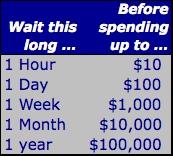
How do you know WHEN something is a ‘major financial decision’ worthy of asking Suzy’s Three Big Questions?

Simple, use this table:

If you’re on a low-to-average income, or still well-entrenched in Making Money 101, then you may want to replace each ‘$1..’ with a ‘$3..’ but, if you’re super well-off, then you just start adding zero’s to the dollar amounts to suit!

But, the ‘default table’, as presented above, is a pretty good place to start …

So, next time you’re walking past a store and see that little $99 ‘number’ on sale that you simply “HAVE to have … and, look … it’s ONLY $99! [squeal]” pull out this little table – that you’ve laminated [ AJC: don’t worry, you’ll wait at least 10 minutes in line at Kinko’s to give yourself plenty of time to decide if the cost of laminating is worth it :)) ] – from your pocket and check to see that you really need to come back in 24 hours to complete the transaction …

… chances are you won’t.

Think about even the small expenses that you may be tracking, if you keep a budget; take a glance down the list for even one or two random days and see how many you would have not bought (or bought less of, or fewer of, or the cheaper one of, etc.) had you taken even 10 minutes ‘time out’?

Is this being frugal [AJC: shock/horror … 7million7years on a frugality drive?] – perhaps, overly so? I don’t think so, because you can still make the purchases that you want to make … it’s just that you may change your mind IF you:

(a) allow a little time out, and

(b) ask yourself Suzy’s 10-10-10 questions.

Instead, you may just end up suffering a little less buyer’s remorse

Does this work?

imagesWell, when the ML Mercedes first came out, I simply HAD to have one of those [squeal] little SUV’s that drives like a car … after some self-imposed ‘time out’, I decided that I really didn’t need the car right now.

Sure enough, the burning desire to buy the car – right then and there – dissipated to the point that I forgot about it; sure enough, a year later the opportunity fell in my lap to buy a factory executive-driven vehicle (genuine … I bought it directly from Mercedes Benz head office), virtually no miles on it, for $11k off the best dealer price that I could get.

Oh, and last week I was hungry … but, after 10 minutes of waiting decided I was even more hungry, so I bought more šŸ˜›

Give it a try and let me know how 10-1-1-1-1 works for you … use the Contact Me form on the About page or just drop me a line at AJC at 7million7years.com, I love hearing from readers (but, not spammers) …

The Power of 10-10-10

10-10-10Suzy Welch, in her new book of the same name, calls 10-10-10 “a life-transforming idea” …

… I don’t know about ‘life-transforming’ but, it’s definitely a simple-yet-powerful decision-making process.

Suzy says:

I call it 10-10-10.

Here’s how it works. Every time I find myself in a situation where there appears to be no solution that will make everyone happy, I ask myself three questions:

What are the consequences of my decision in 10 minutes?

In 10 months?

And in 10 years?

The answers usually tell me what I need to know not only to make the most reasoned move but to explain my choice to the family members, friends, or coworkers who will feel its impact.

I can definitely see how these questions could apply to personal finance: before you make your next major financial decision, take some time out to ask yourself how that decision to [insert financial decision of choice: buy, sell, finance, change, etc.] could affect your life in 10 minutes / 10 months / 10 years.

Chances are that you will change your mind šŸ™‚

Tomorrow, I’ll show you an even more powerful idea that will go hand-in-hand with 10-10-10 to “totally transform” your personal spending habits …

Cash Cascade your car?

community7I often get comments from new readers asking where to start: so, I start from the premise that living frugally and working for 20 to 40 more years to retire on the equivalent of $15,000 today isn’t what you had in mind? If it is, then this blog isn’t for you šŸ™‚

OK, so you’re still reading … great! In that case, the place to start is to work out what you want from your life and how much it will cost you to get it; here is a site that shows you how to work all of that out: http://www.shareyournumber.com/ Visit it (and, join the Community) … not only is this site totally free, I promise that it will be truly Life Changing.

Once you confirm that you do need to make $7 million in 7 years or $3 million in 10 years (or anywhere in between) then you’ll probably want some ‘quick start tips’; well, let’s start with your greatest expense: your house. This post – if you follow all the backlinks – will tell you all you need to know to make sure that your house actually HELPS you get rich(er) quick(er) instead of poorer: http://7million7years.com/2009/01/12/how-much-house-can-you-afford/.

And, if you’re struggling with questions around debt, then this post will totally change the way that you think about ‘good debt and bad debt’: http://7million7years.com/2009/03/25/debt-snowball-debt-shmowball-as-long-as-youre-rich/.

If you’re still with us after that, then sign up for e-mail updates and trawl through the site to see what you can find, just like this guy did …

_______________________

waterfall_over_carI’m glad that some people still rummage through my older posts, as the principles of money don’t age (reference the Richest Man In Babylon, for example) …

… so, I was pleased to have this opportunity to renew this discussion when John commented on this post about cars:

I know it has been over a year since you published this but I was wondering if you could comment on a few calculations I did after reading this post. My disagreement is mostly with the Finance Vs Cash option. The buying a used car part I totally get.

Let’s say I wanted to buy a car with an MSRP of 30,000. If I put 10% money down and get a loan of 27000 for 5 years at let’s say 5% APR. At the end of 5 years I will end up paying 33,571 for the car. If I had paid in cash I would have paid 30,000 for he car. The depreciation on the car would be the same in both cases. So I ended up paying 3,571 more for the car by choosing to finance it instead of paying cash.

But here’s the thing, by financing the car, I also ended up with 27,000 of cash which I can invest elsewhere. To recover the extra 3,571 that I’ll have to pay on interest for the loan, all I need to do is to put this 27,000 in an investment that can give me an APY of 2.52% only, which is not very difficult to find at all.

This suggests that buying with cash, even for a depreciating asset, does not make all that sense. Am I missing something here?

John is basically putting forward the idea of applying Cash Cascade principles to your car … and, given the parameters that he has set, John is absolutely right: it would be better to finance your car and invest the cash elsewhere …

… at least, in principle.

However, in practice, I’m not so sure that the Cash Cascade actually would suggest that you DO finance the car.

Here’s why:

Reason # 1 : It’s unlikely that you will see 5% APR on a auto loan

5% APR car loans are not unheard of, but they are relatively rare; MSN Money cites the current national averages for auto loans as:

National Averages: Low – 3.99% Average – 6.18% High – 10.49%

So, while auto loans as low as roughly 4% (an internet only ‘special’) are available, most are in the 6% – 10% range; and, don’t forget to factor in any added fees!

Of course, you MAY be able to take a 5% HELOC on your house to raise the cash for the car, but I wouldn’t recommend a short-term loan (i.e. a HELOC) for a long-term use (i.e. financing your car over 2 to 5 years) because the bank can change the terms – or even cancel your HELOC – whenever they feel like it. Then you might be stuck with getting a more conventional loan at a higher rate (there goes your 5% loan!).

On the other hand, a refi may do the trick … but, you need to watch both the 25% Income Rule and the closing/refi costs, which are likely to push you well over the 5% if amortized over the expected life of the car loan (you’d be crazy not to have a 2 to 5 year loan payback expectation).

Reason # 2 : It’s likely that you can beat a 5% APR auto loan

This seems to contradict Reason # 1, but doesn’t …

… you see, if you do find a 5% APR loan, it will most likely be offered by an auto dealer. However, the chances are that it comes with a catch: the car isn’t discounted as much as it could be!

A low (or even zero) APR loan is a very common manufacturer / importer / dealer incentive … but, they do a deal with their finance company (often manufacturer-owned, like GMAC) whereby they pay the differential interest rate for you and up front. Back to the catch: they load the price of the car to offset the pre-paid interest component. Sneaky, huh?

Reason # 3 : Even if you can’t beat the 5% APR auto loan you’d better have the cash ready

But, let’s assume that you go to the Pentagon Federal Credit Union for the only 4% APR rate that I could find that wasn’t loaded with fees, and they do give you the loan …

… you had better have the cash ready to buy an investment reasonably quickly.

If you don’t have already have the cash saved up then you should be prepared to save up until you have the lump-sum cash then decide if you want the car only or both the car and the investment. No point borrowing money for the car and trying to save up for an investment … unless, you really, really, really need the car right now! šŸ™‚

… oh, and if you’ve read all the way to here, then you might want see what my 7 Millionaires … In Training! are up to; kind of like American Idol Meets The Apprentice …except it’s online šŸ™‚