A young man's fancy turns to spring …

Picture 1Just as a young man’s fancy turns to you-know-what when spring is in the air, this not-so-young investor’s fancy turns to real-estate as soon as he arrives back in the home country.

But, I am 5 years out of touch as to values; not to mention, I have grown accustomed to values in ‘per square feet’ and Australia is all metric: ‘per square meter’ rules the day …

… what to do, what to do?

Take a look at the scanned image; it’s really my hand-writing; I submit this near-illegible, piece of potential embarrassment for two reasons:

a) Bad handwriting is a sign of intelligence – ever looked at an old-fashioned, handwritten doctor’s prescription? And,

b) It proves that I really do this stuff that I’m telling you about. It works!

You see, the funny squiggles on the scanned image told me all that I needed to know about commercial real-estate values in the Melbourne inner-city suburb of South Melbourne [AJC: unlike many major US cities, the ‘south side’ of Melbourne is not dangerous … it’s ‘chic’] in less than half an hour, here’s how:

Assessing Rental Values

I visited an on-line commercial real-estate site [AJC: this won’t work for residential; but, it will work for larger multifamily, as well as offices, warehouses, etc.]; in the US I use loopnet.com and in Australia I use sites like realestate.com.au

I then scrolled through listings of my target property types (in this case, offices) in the area of my choice (in this case, South Melbourne) and listed Properties for Rent – two columns:

Column A: size of building (i.e. rentable area);

Column B: annual rent

I then entered the same figures into a spreadsheet and graphed the two columns as a line chart; here’s the actual one that I produced for South Melbourne:

Picture 1

This simple graph shows the size of the properties that I was looking at along the bottom (Column A along the X-axis) and the annual rent being offered up the side (Column B up the Y-axis) … and, it tells me an awful lot:

– The smaller the property, the larger the (relative) rent

– The average rent is $249 and the median is $306 (both easy to calculate using the built-in tools in the spreadsheet)

But, you can really see what is happening on a graph like this – something that you would probably miss entirely if you were just scrolling through listings – there seems to be two separate rental markets: one around the $200 per square meter price point, and another one around $300 psm.

Now, if I was really looking to rent (I’m not; I’m a buyer), and if I was looking to rent a space around the 500 square meter size range, I’d be asking to inspect the three properties around the $200 per square meter price point first, then I’d start working my way up. I might also look at a couple around $300 to see if there is a quality difference … I’m betting ‘no’.

Assessing Purchase Values

Using the same on-line commercial real-estate site, I then scrolled through the ‘for sale’ listings of my target property type and again listed Properties for Sale as two columns:

Column A: size of building (i.e. rentable area);

Column B: sale price

As before. I entered the same figures into a spreadsheet and graphed the two columns as a line chart (again, for South Melbourne):

Picture 2

This graph – similar to the first – shows the size of the properties that I was looking at along the bottom (Column A along the X-axis) and the sale price being asked up the side (Column B up the Y-axis) … even though there’s usually fewer ‘for sale’ than ‘for rent’ listings, it tells me even more:

– The smaller the property, the larger the (relative) sale price

– The average sale price being asked is $4,600 per square meter (sounds like a lot – and, it is … prices are high in Melbourne – but you can just divide by about 11 to see the price per square foot) easy to calculate using the built-in tools in the spreadsheet).

More importantly, at least for the smaller properties on offer, there are two distinct price points: $6,000 psm and $3k – $4k psm … now, you can divide the list into Class A office space and Class B/C if you have enough listings, because that will probably explain such a large difference. And, there’s nothing like a quick ‘drive by’ or two to confirm.

Since I’m looking for 400 square meters, for a co-working project that I am looking at, this is telling me pretty quickly that if i can find a decent office in that size range for $1+ million, I might be onto a bargain  … and, that’s something that I just love 🙂

Oh, by comparing the average rents to the average sale price (and confirming with a few listings where both a rental price and sale price are offered – which happens more often than you may think), I get a quick indication of current cap. rates: around 6.2% in Melbourne … I must have rocks in my head even thinking about investing here!

At the very least, by doing this exercise, I have very quickly and easily laid the groundwork for a sensible discussion with a local Realtor …

BTW: If the properties in your area vary by class (eg Class A, B, C) and by types of leases offered (eg Triple Net for some, but not for others) then you may want to graph these separately … but, start on one graph and see what that shows you.

How do you eat an elephant?

One_PercentWe all know the Richest Man In Babylon and the Automatic Millionaire approach to getting rich (very slowly, and if we ignore inflation … you wish!): simply save 10% to 15% of your gross salary …. and wait.

But, that sage advice is doled out like just something that you can easily do …

… but, there’s a couple of problems:

1. It’s not so easy to save that much if you’ve got a stay-at-home spouse, three hungry kids, a car loan and a mortgage to ‘feed’; I mean, not everybody started reading personal finance blogs in their diapers [AJC: that’s when they start writing them! 😉 ], and

2. It’s not enough: inflation, financial crisis, work crisis, home crisis, etc. all ‘eat’ into your savings and decimate your Save 15% Until You Die Or Retire Whichever Is Worse plans.

Fortunately, I have a solution to both problems:

We solve the first problem by remembering that ago old adage / riddle:

elephant_eatingQ: How do you eat an elephant?

A: One bite at a time!

It’s the same with savings: set your target at 15% of your gross salary, then make a start by saving just 1% more than you are saving today. If you’re currently saving nothing, then I guess you’re now saving 1% … infinitely more than before 😉

As often as you can, but no less than monthly, increase that savings amount by 1%. Repeat until you reach 15%.

In Australia, we have $1 and $2 coins; I just automatically throw these in the center console of my car. Last time I checked, there was $50 or $60 in there … if I were poor, I guess I would trundle off the the bank and deposit that in savings account, until I had accumulated enough to add to my 401k.

You probably won’t even miss the ‘lost’ spending money …

Then we can solve the second problem by saving even more; here’s how, and you won’t even feel it, I promise:

You only save more when you are allowed to spend more!

It’s a trick that I taught my children: when they get money (any money: an allowance, a gift, find it on the street, etc.) half goes into Spending and the other half into Savings.

So, too, does it go for you: anytime that you get any additional money [insert ‘found money’ methods of choice: a pay increase, a second job, a windfall, loose change that you save out of your pockets, a gift, a manufacturer’s cash rebate, tax refund check, etc., etc.] you Spend half and you Save half.

Over time, you will find that your rate of savings goes up tremendously … and – almost – painlessly (because you get to spend the other half)!

Of course, there is a third solution: simply contrive to earn more money from businesses and/or investments such that your savings won’t make any difference to you …

… but, I encourage you to try my “eat the elephant” Making Money 101 strategies as well because the money that you have saved will help you to fund these ventures  – with enough left over to ensure that you have a safety net of some sort in case your plans don’t work out; and, even if things don’t work out the way you expected, if you followed those basic guidelines, you’ll probably find that you’re still better off than 90% of your neighbors 🙂

What to do when you are upside-down on your mortgage …

upside-down-houseRyan – one of our Millionaires … In Training! – is upside down on his mortgage; if you can’t afford the payments (and, I have some guidelines to help you decide when that point has been reached), then I would generally suggest that no matter whether you are right-side up, upside down, or sideways, that you should get out!

But, Ryan is a high-income earner and high-saver already so he has decided to … well … I’ll let him tell you:

If I could wave a magic wand, I would not be upside-down on my mortgage, but that will correct itself over time as we are not planning on moving soon. While we could short sell the house and rent, we will not likely do that. We are emotionally tied to the house and would not, in my opinion have much upside with a rental because we would have to either float the note on our mortgage or pay the taxes on the difference on a short sale, all to pay MAYBE $1000/month less and not have the mortgage interest to write off come april 15th. An appreciation of our home of around 5%/year, starting in 2010, [should help by] bringing us back to an equity position around 2012.

A home performs two functions: housing and investment.

Like most dual-purpose things, owning your own home is probably a poor compromise on both …

… in my experience, you can usually rent a better house than you can afford to buy AND can usually find much better returning investments.

Yet, I recommend that one does own their own home, for a number of reasons:

1. Often it can turn out to be a person’s only investment,

2. It is a ’safety net’ in case all else goes wrong,

3. You have continuity of tenure (the ‘landlord’ won’t kick you out, as long as you keep up with the payments)

4. Over time, you may build up equity that you can ‘release’ to kick-start other investing activities.

For me, it was always 3. (and, the associated ‘emotional attachment’ that comes with calling your house your ‘home’) that held the most sway as I always expected to make my ‘fortune’ elsewhere. And, I have never actually used the equity for investing (except for my brief HELOC-fueled stock speculation experiment of 2007/2008).

So, I would suggest that you ask yourself the following TWO questions:

i) Can afford the payments? If so,

ii) If I were to invest in a house right now, given my current net worth, is this the house that I would invest in ?

If the answer to both questions is YES, then stay. If the answer is NO, then sell/move … be it into a rental or to purchase another (provided that the changeover costs/hassles are worth it).

This is a question that we all need to ask ourselves at least once per year (or, whenever the market and/or our financial position changes), as – in effect – we are ‘buying’ our house every year (by missing the opportunity of selling and putting the money to work elsewhere).

Given the size of our ‘investment’, we should never take the rent/own – buy/sell decision for granted 🙂

Does technical analysis even work?

Rick is skeptical about the value of technical analysis:

I would be very skeptical that technical analysis works- here is a link discussing the controversy:
http://en.wikipedia.org/wiki/Technical_analysis#Empirical_evidence
I’ve never heard of anyone getting very rich from technical analysis. Plus neither Peter Lynch nor Warren Buffett believes in it.
A web site that tells you when to buy/sell stocks strikes me as too good to be true. Let’s say that you had a stock purchasing system that WORKED- would you
A Make it available to the world on a website/write a book and make $1M
B Keep it secret, start your own hedge fund and make $1B.
I’m guessing A wouldn’t be too likely… Also if you did have a system that really worked then making it widely known will cause the system to be useless. Why? For every transaction there must be a buyer and seller. If many potential sellers see a “buy” signal at the current prince they will demand a higher price to sell driving the price up. Similarly, if many potential buyers see a “sell” signal at the current prince they will demand a lower price to buy forcing the price down. The final result is that the pool of believers in the system will force the actual price to agree with the system’s prediction of a fair price.

Rick might be a little surprised to know – given my recent posts, apparently condoning technical analysis a lá Phil Town – that I tend to agree with him!

Firstly, keep in mind that I am on record as stating that I am not the ‘go to’ guy on any specific form of investment (perhaps some on business, less on real-estate, even less on stocks, and so on) … my ‘expertise’ (more like ‘passion’) is in the overall strategy of wealth-building, and showing how these individual pieces fall into place.

Also, I am a ‘value guy’ … I love to sniff out a bargain – be it a business, property, or stock – and pounce, and am a fan of Phil Town’s valuation methods (although, I will point out my ‘issues’ with his methodology in a future post).

And, I agree in principle that if you COULD:

a) Identify a stock that was under-priced, and

b) Avoid the market dips by selling out (then rebuying)

… you would increase your returns and – MUCH more importantly – avoid holding onto an under-priced ENRON … one that you thought was cheap but some disaster strikes that the ‘big Boys’ get wind of early.

In principle, that is 😉

Look:

1. There have been successful traders, but none that I know of with longevity; it’s a speculation / business … so, if you are prepared to take the chance on the big run up – then sell off – PERHAPS, just perhaps, you can make it big? Jesse Livermore did it 4 times (before putting a gun to his own head when he crashed for the 4th time).

2. Phil Town suggests that the ‘big guys’ (the huge mutual funds) put so much money in/out of the market that they have to make their move over a number of weeks to avoid the sudden price movement that you suggest. IF this is true and IF you can use technical signals to tell you when the run up/down is occurring, then Phil says that the smaller investor can use these signals to move instantly (in 8 seconds, v the ‘big guys’ 6 weeks).

… and, I have certainly used Phil’s methods to suffer ‘only’ a 15% loss when the rest of the market soured by 50+% (and, you need to remember that I have been actively trading since the crash UNTIL it bottomed and have been in cash since for reasons unrelated to the market), so my personal experience is that the ‘3 indicators’ ARE useful.

The catch is, I don’t know why, because they are all PRICE indicators, not VOLUME … in fact, volume only tells you of an increase in activity, there can be no net buying/selling because there are two parties in every trade (the ‘hint’, I guess, is in the price … it goes up/down according to market sentiment).

So, I am a fan of ‘value investing’ (if you can find the right way to reliably value a stock and can then find one that is way under priced … I believe that this happens often enough to make it useful) and am experimenting with the technical indicators to get in/out, but am – like you – skeptical, but not complaining while I am getting positive results …

… but, please DON’T read this post, I am planning to start my own hedge fund 😉

This week’s Carnival of Personal Finance is out; we’re buried in their list somewhere ….

To MLM or not to MLM? That is the question …

Robert Kiyosaki (of Rich Dad, Poor Dad fame) is fabled to have ridden to success on the coat-tails of the ‘network marketing’ (a.k.a. MLM) community, who are said to have distributed his books to ‘downlines’ by the millions … or, so the story goes.

But, it is true that RK is a fan of MLM, as this video proves; the (justifiable, in my opinion) reasons that he gives is for the business education that it gives you …

… and, I agree. My only issue with MLM is that you are putting your future in the hands of the MLM company: you build a huge profitable business generating millions of dollars a year in passive income (as my wife’s old school chum does!), but what happens if they change the rules or, worse, close their doors or shut down the MLM distribution arm of their business?

But, I do think that if you simply substitute the words: “part time business” – better yet, “part time online business” into Robert Kiyosaki’s video, then you will have all of the benefits of MLM in a much more ‘new millennium’ platform.

It could be:

1. An information products site,

2. A web 2.0 (i.e. the “next FaceBook”) business,

3. An eBay business,

4. ??????

Of course, there are still risks: for example, you could build a massive e-Bay business and have your account suspended on a ‘technicality’ (as happened to my son a few months ago); risks abound but if you start small, cheap and see what develops, you will at least gain the #1 objective that TK mentions: a business education 🙂

The mythical stock market guarantee …

In a recent post I spoke about various products that purport to ‘guarantee’ your returns in the stock market … in the current environment, it’s totally understandable that investors would be looking for such guarantees. But, you pay for them …

… instead, I suggested:

You can provide yourself a similar – or better – result at far less cost: buy a low-cost Index Fund and wait 30 years to cash it out; I can virtually ‘guarantee‘ an 8.5% minimum return :)

Rufus, though, took me to task, citing the Japanese stock market:

Here’s a prediction for you….In about 5 years the NIKKEI index will show you to be completely full of it even at your 30 year timeframe. If you had picked up the NIKKEI 225 in 1990 you’d now be down 75% just on your principal. Fun! If you had picked it up in 1985, you’d be about even today, which is still an absolutely massive loss against inflation. Your entire premise has a market survivor bias built into it to which you are blind. There simply are no guarantees.

Firstly, Rufus is right … there are NO GUARANTEES in life .. especially when it comes to the stock market.

BUT, what I offered was a ‘virtual guarantee’:

It is simply based upon the fact that the past 75 years of the Dow Jones have seen NO 30 year periods (including buying in the day before the biggest stock market crash in history) of returns less than 8.5%.

I’m not sure whether Japan could claim anything remotely approaching the same track record, nor are/were its fundamentals the same as the USA.

From a practical standpoint, I can only tell you this:

1. I invest using history as a guide to setting my benchmarks, but I always buy on value: i.e. do the stocks, RE, businesses look cheap at the moment, and

2. I invest in markets where, if things turn drastically sour, then everybody else is likely to be in the same boat … and, by everybody, that means the whole world.

If I’m going to be peeling potatoes, then so is everybody else … hence my major stock market investments are always in the USA.

Rufus, of course, ONE DAY, there will be a 30 year period where this does not hold true for the USA either, but by then I’ll be learning to speak Mandarin Chinese ;)

Bunker Strategy For Surviving A 12 to 24 Month Recession

Nobody_Knows_YouThe blogoshpere is alive with posts that trumpet that Suze Orman has changed her financial advice .. some of it inspired by this excellent article from Yahoo Finance News:

Personal finance gurus usually treat credit card debt as the plague and urge consumers to pay it off–ASAP. But this week, Queen of Personal Finance Suze Orman announced on The Oprah Winfrey Show that the old advice is wrong. The recession has made job loss so prevalent, she says, that consumers now need to make creating an emergency fund with eight months worth of expenses their top priority.

Now, I also happened to be watching that Oprah show [AJC: I can blame my wife … she watches religiously … can I help it that I am sometimes also standing withing ‘eye shot’ of the TV 😉 ] where Suze said:

If you have an unpaid credit card balance [and] not much saved up in emergency savings, I need you to listen up. My advice has changed. I want you to only pay the minimum due on your credit card balance, and instead, make it your top priority to build as much of an emergency cash fund as you can.

Now, I think that Trent at The Simple Dollar hosted the best discussion on Suze’s comments, and I suggest that read both Trent’s post and all of the comments before you read on; Trent said:

In this environment, making the decision to jump from debt repayment to emergency fund building is about two years overdue.

I propose a different solution.

First of all, ignore a huge, long-term goal like an eight month emergency fund. Instead, if you’re worried about the downturn, focus on three key things through the rest of this year (and thus, likely, through the bottom of the downturn):

One, apply some realistic frugality in your life.

Two, acquire no new debt.

Three, build up your emergency fund a little now, but be prepared to reduce it in 2010.

I agree with Trent, asking people to save up to 80% of their salary for the next 12 months is way too much too late 🙂

And, I agree with Trent’s basic ‘bunker mentality’ of tightening the belt, but I am actually going to advocate a totally opposite three-step strategy, and here it is … 7million7years’ Patented Bunker Strategy For Surviving A 12 to 24 Month Recession:

One, ramp up your Making Money 101 strategies …. during recessionary times, double them if you can (i.e. save 20% – 30% of your income; save 100% of any ‘found money’).

Two, acquire some critical new debt.

Three, use that new debt to build up your emergency fund a lot for now, but be prepared to dramatically reduce it when the recession turns.

Question: Who of sound mind acquires new debt in a recession?

Answer: Anybody who wants to survive!

Look, if you didn’t start storing nuts for this recessionary winter in 2005 / 2006 then you probably have NIL chance of building a large enough emergency fund to tide you over if you do lose your job now or soon … worse, if you do lose your job, it could take months to find another one in the current market.

So, what to do?

Simple, look for where you already have nuts stored: for many of you, it will be in your house.

IF you still have equity in your house, simply refinance out as much as you can up to Suze Orman’s 8 months emergency fund limit (however much that may be for you) PLUS a sufficient ‘buffer’ to make 12 – 24 months of mortgage payments. Now may also be a good time to consolidate your credit cards and other higher interest loans into the same loan (not normally a strategy that I would recommend … but, this is an unusual plan that we are executing) …

… and, fix the interest rate (so long as the loan conditions allow you to pay off as much extra as you like when you like!).

Why?

Well, you now have peace of mind … for only the price of 12 to 24 month’s interest on your mortgage, perhaps a very small price to pay for surviving the deepest recession that you will likely see in your lifetime.

If you don’t lose your job, you can pay back the loan whenever you feel that things are somewhat coming back to normal (i.e. jobless rates are dropping again), and if you do lose your job, you have the cash buffer to help you survive.

Sure, this is a drastic strategy, which will cost you some unecessary interest and lost investing opportunity as you borrow money at 6+% just to have it sitting in the bank at 1.9% if you are lucky, so I am aiming this strategy only at those who:

1. Believe Suze Orman, but have no hope of meeting her criteria at this late stage, or

2. Believe that their job is at reasonable risk.

For a person on a gross income of $50,000 a year, with a current mortgage of $250,000 (a lot of house!), this rather unique ‘insurance policy’ would cost you less than $100 a week … a lot of money, sure, but small change if it helps you survive the Second Great Depression (well, at least  the worst recession since the Great Depression).

If so, this is counter-intuitively probably your best chance of protecting your home and family and riding the storm … but, if you don’t get a new job within a few months then you are probably slightly closer to foreclosure.

Or, are you?

You have 12 to 24 months protection (by way of the 8 months living expenses plus interest payments buffer), whereas without doing this you have whatever you can scrape up. Compare that with the alternative: what would you do if you lost your job next month and you didn’t put this plan in place? How could/would you survive?

Your honest answer dictates whether this admittedly ‘unusual plan’ is for you …

… if it is; if you do have the spare equity; and, if you do meet the two criteria listed above, now is the time to execute this plan. If you wait:

a. You won’t be able to refi if you have lost your job, and

b. A HELOC won’t save you, as the bank will probably pull it.

So, refinance your home now and put the spare cash into another bank instead!

Of course, if you don’t have the ‘spare equity’ in your house … cross your fingers 🙂

We're not there yet, but …

ugly-dog… who knows?

Inflation may just rear its ugly head, as Modern Gal suggests:

My bet is that the long-term successful investors (like Warren Buffet) see the next big cyclical turn as being the threat of global inflation.  And by this, I mean not inflation as in 3-4%, but I mean a change in cycle to having structurally higher inflation for a number of years.  While nominal wages have (mostly) risen, real wages have not kept up with inflation for many workers.  This is the problem called the money illusion.  In other words, because your paychecks are growing larger over time, you think that you think of this as a raise or cost of living increase.  In fact, if the cost of living outpaces your raises, you have in effect gotten poorer, or your salary has lost real value.

I don’t normally talk about things that you can’t do today – and, the things that I do talk about often need to be adjusted for which part of the Making Money Cycle you are in – but, I will make a couple of suggestions and you can bookmark this post in case inflation does hit before I get a chance to write a follow up post 🙂

Firstly, what is high inflation?

To me, ‘high’ and ‘low’ are pretty meaningless terms in an inflationary context, but Modern gal suggests “let’s say inflation crept up to 5% a year … not many people are expecting a shift to a very high inflation rate, like 10%.”, which seems like a pretty reasonable range to work with, if you ask me.

Modern Gal then suggests that inflation-adjusted securities such as TIPS are sensible high-inflation strategies …

… but, here is what I think, IF you think inflation is heading up and you are in this stage of the Making Money Cycle:

Making Money 101

No great change here; get your spending under control; avoid consumer debt (although, strangely enough, it’s actually slightly BETTER for you if inflation rises AFTER you accrue the debt because your payments stay fixed – unless interest rates also rise – but, your income rises due to ‘cost of living increases’); and save money … but, if this is all you do, that inflation will eat up a lot of the benefit; as Modern Gal says:

Let’s say you have $100,000 in savings today, but you want to hold off spending until retirement.  If you decide to put your savings under a mattress (meaning you earned zero interest or dividends), in 25 years time, at a 3% inflation rate, your $100k would be the equivalent of about $48k in the future.  But let’s say inflation crept up to 5% a year, a rate that was not unusual a decade ago. Under this scenario, your $100k should be thought of as less than $30k in 25 years time.  And, if we end up with double digit inflation at 10%, the 100k adjusted for buying power in today’s dollars looks like a measly $9230.

The key Making Money 101 change (although, this is a strategy that I also recommend in the current low inflation / low interest rate environment) is to lock in your interest rate on your own home, ideally before the high inflation (which can often trigger higher interest rates) kicks in.

Making Money 201

Here, we want to take advantage of inflation which tends to push the prices of things up: the higher the rate of inflation, the more prices go up …

… so, the trick is to buy something that will rise in price with (or over) inflation BUT pay for it in current-day dollars.

What can do THAT???

Well, real-estate can, particularly in the USA where you can leverage an unusual quirk of the lending industry: you see, you can buy real-estate that will go up in value as surely as your can spell I N F L A T I O N …

… and, you can buy it with the Bank’s money and lock that ‘price’ in for up to 30 years (on some residential property).

So, that $535 payment (at 5.75% fixed interest for 30 years) STAYS at $535 even as the $100,000 property doubles in value to $200,000 over time … and, the higher the inflation rate, the quicker the property doubles … no matter what happens, your payments stay the same.

Obviously, if spending $535 p.m. was ‘good value’ when the property was $100k, it must be twice as good value when the property reaches $200k!

So, if you know that high inflation is increasing your property portfolio more rapidly, why wouldn’t you buy as much as you can get your hands on if:

a) Current interest rates seems low, and

b) If you felt that a period of higher inflation was coming?

Making Money 301

We are obviously not looking to acquire more debt, here, but there’s no reason to pay off debt either IF:

1. The interest rate has been locked in at levels lower than current interest rates, and

2. You can’t put the money to work for you in ‘safe’ investments elsewhere, and

3. The properties produce enough ‘spare’ (after mortgage interest, costs, and provisions against future vacancies and repairs/maintenance) cash-flow to satisfy your daily needs.

If the property meets these criteria then it’s probably reasonable to assume that your income (i.e. rents) will keep pace with inflation, as probably will your capital (i.e. the building itself).

Of course, if you haven’t already bought the property by the time that you stop work [AJC: a MUCH better word than ‘retire’ for us 49-years-young-stopper-workerers 😉 ], then I would advise that you look at these alternatives:

i) Real-estate (this time, bought with very high deposit / very low borrowings … if any), and/or

ii) TIPS – Treasury Inflation Protected Securities … although, you will have ideally bought these while inflation was still low(er) as competition for these may have pushed prices up / yields down, and/or

iii) Dare I say it: dividend stocks (or, any portfolio of stocks that you are happy to sell down a portion of each year to create your own ‘dividend’

…. but, avoid cash, or cash-equivalents (CD’s, non-inflation-protected bonds, etc.) as inflation will almost literally gobble these up!

Insure your future?

If you’re on the road to your Number – let’s say it’s $2 Million by the time you are 35 – and that milestone is well before your retirement accounts vest, you have a real trade-off to make:

1. Put that money that you would have otherwise invested in a 401k/IRA/etc. to work for you now to help you get to your Number, or

2. Keep socking money into your retirement account as a ‘safety net’ in case you fail.

The ideal strategy is actually 2., as you should always ‘insure your future’ …

And, some would say that you should keep socking that money away until you have something concrete to use your money for and then you can always pull your money out of your retirement account if you need to.

But, there’s the issue of taxes and penalties on early withdrawal, right?

Speaking of Motley Fool’s mastery of the sensational headline, I thought that I had found an easy solution for you when I saw this headline on their site: Tap Your IRAs to Retire Early. Unfortunately, it was only a ‘funnel’ into a pretty boring article that tells you that you can withdraw a couple of percent of your IRA each year, earlier than your standard retirement age.

Not much use to an aspiring multi-millionaire!

If you do what I suggest:

1. Implement sound MM101 strategies (save 15% of your gross income via 401k/IRA’s/etc.), as well as 50% of any ‘found money’ (lottery winnings. tax refund checks, inheritances, etc.)

2. Pay cash for your cars, don’t acquire credit card debt, buy your own home, obey the 25%/20%/5% rules

3. Increase your income (and save 50% of any such increase) through a second job etc.

… then you will probably have the ‘capital’ saved as cash (or in ‘spare equity’ in your own home) to start the types of businesses that I suggest that you start (eg low cost – perhaps internet – businesses) or to slowly start investing in real-estate without needing to ‘tap’ your 401k.

This is the ideal … but, if your business should be growing and you need the funds to expand further, then you may be left with some unsavory alternatives:

1. Hock the house, cars, children

2. Find a partner to invest in your business

3. Raid your retirement accounts

I’d probably go for 1., then 2., then 3., or maybe 3., then 1. then 2. – or maybe I’d put the partner second (never first) – but, I’m not sure. It all depends on circumstances … which we’ll have to explore further in future posts.

In the meantime, which would you choose?

I hate budgeting … so, I’ve only ever tracked my expenses once!

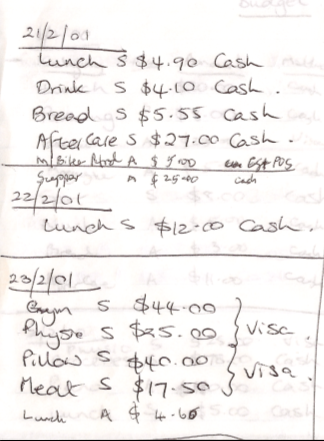
No Budget BudgetThat’s why I was so  excited a number of years ago (very early on in my Financial Re-birthing Process] to come across John Burley’s ‘No Budget Budget’.

For those who don’t know him, John Burley is a financial spruiker (originally, on the subject of ‘wraps’ for real-estate … something that I have never tried myself, so something that I can’t really comment on); after hearing him speak, I tracked down one of his courses that covered basic financial improvement “in 31 Days” …

… I don’t think I ever got past Day 1 or Day 2, but I’m really glad that I tried his ‘no budget budget’. It’s the ONLY personal budget that I have ever tried (and, don’t even get me started on the subject of business budgeting!).

Basically, the process consists of writing down every single dime that you spend (cash, check, credit) for a month. That’s it!

When I was cleaning out the house for ‘our big move’ recently, I found the actual budget that I had put together … it spans all of 3 pages (part of page 1 is scanned and reproduced here); a small ‘price’ to pay for financial freedom 🙂

Here’s how it works:

1. Grab a blank sheet of paper and a pen (actually, a little pocket notepad and pencil is ideal … but I kept a folded sheet of paper in my pocket and my wife kept a little notebook and pencil in her purse and every night she would tear the page out that she used and give it to me to add to my sheet).

2. EVERY DAY FOR EXACTLY ONE MONTH [AJC: you don’t have to start on the first day of the month; any day – like TODAY – will do] I wrote on that sheet of paper:

– The Date (each day I started a new section on the piece of paper … when you try this, you should be able to fit a week or so on each sheet)

– What we bought (e.g. lunch; drink; bread; newspaper) … we did this for every single purchase!

– Who bought it (A for me; S for my wife; I guess we would also need to add Ad and Ta for our children if we were starting this No Budget Budget now)

– How much it cost (inc. taxes etc)

– How we paid …. we used a simple system eg Cash, Visa, Check

That’s it; one month …

Also, we added a new ‘last day’ of the month, so that we could write in 1/12 of any annual expenses (eg insurance) whether paid for in that month or not.

You can see that we did this in Australia 9 years ago [AJC: the date 1st Feb, 2000 is written as 1.2.00 in Australia]

You can also see that we were mainly a ‘cash society’ back then as only the haircut (mine) was paid by Visa [AJC: at $28 back then, I must have had WAY more hair than I do now] …

So, we simply kept a log of all of our spending for each day, in exactly the same way that we did for Feb 1 for the whole month … of course, Feb is a dumb month to choose, because it’s the shortest.

I can’t find the summary page, but I recall it being something like $1,000 a month that we were spending then.

That tells you what you’re spending … now, compare that to what you’re earning (after tax):

Annual income twenty pounds, annual expenditure nineteen six, result happiness. Annual income twenty pounds, annual expenditure twenty pound ought and six, result misery.
Charles Dickens, David Copperfield, 1849
English novelist (1812 – 1870)

This worked for us, and we never bothered doing it again; didn’t see the need … now, tell me about your experiences with Budgets (or No Budgets) 🙂