I am woman … hear me roar!

Congratulations to the Final 30 for our 7 Millionaires … In Training! ‘grand experiment’; visit 7m7y.com to see who ‘made the cut’ …

____________________________________________________

Well, to set the record straight, as those who watched my first live show last night will know, I am definitely not a woman … but, those were the lyrics to the famous Helen Reddy song …

… and, I was amazed at the sheer number – and the relative proportion – of women of all ages who applied for my 7 Millionaires … In Training! project.

One of them was Debbie, who received a ‘good luck’ comment from ‘Janet’ … I followed the back-link and found a great site that specializes in helping women succeed on-line!

Well, that just blew me away, so I simply had to write to Janet Beckers (it turns out that she’s a fellow Aussie, bless her soul) and ask about the Power of Women Phenomena (I just made that up!):

Why is it that so many women are applying to become one of my 7 Millionaires … In Training! and what has changed (either in perception or reality) in recent years to make these women so ambitious and, well, so capable as entrepreneurs? Also, why does the Internet seemingly hold so much attraction for women and where can they go for help?

You know Adrian, I’m not surprised that most of your applicants are women. I would also be willing to bet some of your 7 million dollars that if you had offered this opportunity 2 years ago the ratio would have been very different. There have been dramatic changes in the last few years. In fact I would go so far as to say that we are experiencing a new era in Internet business and women are the pioneers. I can see 2 reasons for this. Let me share them with you:)

Visible Role Models

There have always been incredibly ambitious and successful women on the Internet. But they have traditionally flown below the radar. I think this is for a couple of reasons.

Firstly Internet marketing styles are traditionally quite sexist though not usually intentional. So successful women have been excluded by the boys club and gone unnoticed.

Secondly, they are so busy managing the many other roles a woman has, they just get on and make money instead of promoting themselves as “gurus”.

This is one of the reasons I launched Wonderful Web Women. I was searching for role models I could relate to. I couldn’t really relate to the men on stage at Internet Marketing conferences because their reality was so different to mine and that of other women who attended. When I launched, my male colleagues recommended I make it a short term project because I wouldn’t find enough successful women. I’ve been booked solid every week for a year interviewing successful women and never see it ending.

Women are so much more visible now and that gives other women (like Debbie) the confidence to push themselves beyond their boundaries.

Social Networking

Women are natural networkers. We thrive in an environment that lets us create relationships, share and create a community. The recent changes in the Internet, called Web 2.0 means there are so many ways for women to communicate with each other. We are the most effective users of blogs, forums, membership sites, facebook etc. In fact, even in the open mastermind session we hold every week after our live tele-interview, the women on the call form Joint Ventures on the spot. It is not unusual for a woman in the US to arrange to communicate and do business with a woman in Australia who she has only met on our conference calls. It is rare to see men do this.

Relationships and Joint Ventures are the best way I know to create a lasting Internet business and women have the networks in place now to know they are supported by a community of other women who wish them well. A romantic ideal but very true.

Why is the Internet attractive to women?

Well, apart from the wonderful way we can use our relationship skills, the Internet holds the same attraction for women as it does for men – except more. The Internet offers the attraction of a flexible lifestyle, the freedom to choose your hours. Women do balance so many more roles and expectations than men. An Internet business means women don’t have to choose between career and being at home with the kids. You can have both. For example, I run a successful Internet business yet I never miss a school event, sporting event or performance of my 2 children. They never rely on before and after school care and they know that Mum or Dad will be home every afternoon to hear the stories of their day. I still work hard, but when I choose to. How good is that?

So where can women get help?

At Wonderful Web Women of course! Not only do we have fantastic resources and interviews with amazing women we also have an incredibly supportive community of women from around the world. My hope is that women who join us will find at least one successful woman who really “clicks” with them. Someone who they can relate to and think “she’s not that different to me and she did it. So can I”. Our members range in age from 12 to 80 years so it is never to early or too young to become the person you want to be.

Well, there you have it … why women could be the new powerhouse on the web. This was my first guest post, and I couldn’t think of a better subject for it! Nor a better person to be writing it … thanks, Janet!

Note: Janet Beckers and The Wonderful Web Team can be found at:

www.NichePartners.biz
www.WonderfulWebWomen.com
www.WonderfulWebIdeas.com
www.WonderfulWebSeminars.com
http://wonderfulweb …..you get the idea!

Who wants to retire in their 20's, anyway?

Join AJC’s Live Video Chat on Thursday @ 8pm CST … 7 Millionaires … In Training LIVE Results Show: Final 30 announced live tomorrow (!)

________________________

Yesterday we talked about starting young, not just as it applies to saving, but as it applies to accelerating your retirement plan.

Maybe you couldn’t find your WHY?

After all, who wants to think about retirement when they are still in their 20’s or even 30’s? Most are still thinking about their job!

Yet, as yesterday’s post showed, there are some good reasons for starting early. And, who wouldn’t want to retire early if their goals matched these from a recent survey of GenXfinance‘s readers:

How Do You Envision Your Ideal Retirement? 

Being a ‘Gen X’ PF site, we can probably assume that most of the respondents were younger than, say, me. But, it’s even more interesting to notice how each of the first three categories (where the majority of the votes fell) require MONEY and/or TIME:

1. Extensive Travel

Think about it, you can escape money to a greater of lesser degree if you are willing to travel frugally, work at least during some of your stopovers (haven’t you noticed how all the ‘servers’ in restaurants in vacations areas are young foreigners?) …

… but, you can’t escape the time element: this means that you have to be ‘retired’ from your day job.

2. Not going to work; just taking things one day at a time

Obviously, this means that you are retired from your day job … but, two things happen when this occurs:

i) Your income goes DOWN

ii) Your spending goes UP

For those who subscribe to the “75% of current income in retirement” theory, I ask this: have you ever tried spending time doing anything BESIDES WORKING that doesn’t COST money?

Think about it … it stopped me from cashing out when I was offered $4 mill. a few years before I eventually did cash out (for a helluva lot more!).

3. Doing volunteer or charity work

All [charity] work and no play makes Jack a dull boy … this is really 2. plus you are spending some of your time (perhaps a lot) giving back. This is a good thing … as well as the great work you are doing, you are spending less time … well … spending!

4. Other

If you scroll down the comments attached to GenXfinance’s post, you will see that most of the ‘other’-folk either mean not retiring at all (like the ‘pursuing a second career’ option) or involve a similar outflow of money and/or a similar savings-account-draining, non-income-earning amount of time.

But, they are all things that you will probably want to start whilst still young enough to enjoy them …

… which means starting to build a pretty damn large nest-egg pretty damn soon!

Let me know what (and how much by when) ‘retirement’ means to you?

Age is NO obstacle!

Applications for my 7 Millionaires … In Training! ‘grand experiment’ are now closed. I will be announcing the Final 30 Applicants this Thursday at 8pm CST on my Live Chat Show … if you want to follow along, I will also be announcing the next Millionaire Challenge! This will help me decide the Final 15 … now for today’s post:

It seems that blogging and personal finance is a ‘young man’s game’ …

… not so!

At least, not according to Lee, who was yesterday’s Featured Applicant for my new 7 Millionaires … In Training! ‘experiment’.

You can read Lee’s story on the 7m7y site, but I wanted to share the following with you:

Lee is a ‘tad’ older than me 🙂 and is an e-mailer, emoticon’er, and … a blogger. Go Lee!

Whether Lee joins our program from the front-lines or the side-lines, he will succeed because age is NO impediment.

Here are two related stories:

1. There’s an old ‘urban myth’ that says that a retired ‘colonel’ with no money and no prospects at the age of 70 left for a journey across the USA, living out of his car! All he had was an old family recipe for chicken that he wanted to ‘licence’ to restaurants. 1,000 restaurants and 2 years later, all he had was a trunk-full of “no, thanks!”.

Then restaurant number 1,001 said “yes!” … and, that’s how Colonel Sanders came to launch Kentucky Fried Chicken (now, KFC) …  or so the story goes!

His actual story is a little less ‘dramatic’, but I really feel epitomises the path that people like Lee need to (and, can) take:  ‘The Colonel’ actually started at the age of 40, cooking chicken dishes for people who stopped at his little gas-station in Kentucky. 

At the time (he wasn’t a ‘Colonel’ yet) he did not have a restaurant, so he served customers in his apartment at the gas station!

Eventually, his local popularity grew, and Sanders moved to a motel/restaurant that seated 142 people where he just worked as the cook. Over the next nine years, he perfected his method of cooking chicken. Furthermore, he pioneered the use of a pressure-fryer that allowed the chicken to be cooked much faster than by pan-frying.

He was given the honorary title “Kentucky Colonel” in 1935 by the Kentucky State Governor. Ever the ‘salesman’, Sanders started to call himself “Colonel”, even dressing in the stereotypical “Southern gentleman” outfit that we are now used to seeing; he was the consumate marketer!

After the construction of a major highway bypassing his town reduced the restaurant’s business, Sanders had to leave so he took to franchising Kentucky Fried Chicken restaurants, starting at age 65, using $105.00 from his first Social Security check to fund visits to potential franchisees.

To me, that’s the real story: a 65 year-old fry-cook funding a franchise from Social Security!

2. The second story is a little more personal … highlighting the moment when I can remember being most proud of my own father.

It was my 30th Birthday and my father was at my Surprise Party (I am so thick, I didn’t notice all the cars on the street, the late arrivals hiding behind the trees, or even the balloons when I walked in … boy, was I surprised!) happy as a Dad can be.

The next day he told me that it was on the day of my party that he had been fired from his job – what made it worse was that he had been ‘stabbed in the back’: it was a finance company that he helped start for a ‘friend’, who (once my father had done all the hard work to get the company up and running with a solid book of business) reneg’ed on their deal to pay my father a 33% profit share.

Just two weeks later, at the age of 60, my father had found an ‘angel’ for seed funding and a bank for the major funding and was off and running … a feat that I was (fortunately) able to repeat just a few, short years later (and, unfortunately that I HAD to repeat … but, that’s another story).

Lee, age is NEVER an obstacle …

The Myth of Diversification

Important Announcement: Applications for my 7 Millionaires … In Training! ‘grand experiment’ CLOSE TONIGHT (June 2) at Midnight CST !!! This is your last chance to throw your hat in the ring …

I have been just itching to write this post … it falls straight into the category of ‘uncommon wisdom’ and will probably be jumped on by every Personal Finance author and self-appointed ‘finance guru’ out there.

All I can say is …

… bring it on, baby!

If you’ve read my posts on the only three ways to invest in stocks and the follow-up post that quoted some of Warren Buffet’s views on Index Funds vs direct stock investments, you’ll have some idea where this is heading.

But, if you’re just reading 7million7years for the first time, here it is in a nutshell:

1. Diversification is only suitable as a mid-term saving strategy – it automatically limits you to mediocre returns: The Market – Costs = All You Get … period!

Now, saving money this way, and compounding over time (a loooooonnnnnngggggg time) will put you way ahead of the typical American Spend-All-You-Earn-Then-Some Consumer ….

Just don’t confuse it with investing or wealth-building: it simply can’t, won’t, will never make you rich … nor will it make you wealthy …. nor will it even make you well-off ….

… because as long as you run, the dog of inflation is nipping at your heels!

However, it WILL stop you from being poor, broke and you may even be able to retire before 70, on the equivalent of $30k or $40k a year – not in today’s dollars, but in the inflation-ravaged dollars of the day that you retire!

But, if that’s all you need, then relax, that’s all that you need to do 🙂 But, if you need more then …

2. Concentration puts all of your eggs into one (well, a very few) baskets – it automatically gets you above average returns … if you get it right!

Investing implies taking some risk … it means choosing a vehicle (stocks, business, real-estate) … it means selecting one or a very few, well-chosen targets … it means putting your all into those well-selected targets and actively managing them for above-average market returns … until you get close to retirement.

Now, I could wax lyrical on this subject all day, every day … but, why trust me when you hardly know me and you can simply go to a source that everybody knows and can respect … Warren Buffet, who says:

I have 2 views on diversification. If you are a professional and have confidence, then I would advocate lots of concentration. For everyone else, if it’s not your game, participate in total diversification. The economy will do fine over time. Make sure you don’t buy at the wrong price or the wrong time. That’s what most people should do, buy a cheap index fund and slowly dollar cost average into it. If you try to be just a little bit smart, spending an hour a week investing, you’re liable to be really dumb.

If it’s your game, diversification doesn’t make sense. It’s crazy to put money into your 20th choice rather than your 1st choice. “Lebron James” analogy. If you have Lebron James on your team, don’t take him out of the game just to make room for someone else. If you have a harem of 40 women, you never really get to know any of them well.

Charlie and I operated mostly with 5 positions. If I were running 50, 100, 200 million, I would have 80% in 5 positions, with 25% for the largest. In 1964 I found a position I was willing to go heavier into, up to 40%. I told investors they could pull their money out. None did. The position was American Express after the Salad Oil Scandal. In 1951 I put the bulk of my net worth into GEICO. Later in 1998, LTCM was in trouble. With the spread between the on-the-run versus off-the-run 30 year Treasury bonds, I would have been willing to put 75% of my portfolio into it. There were various times I would have gone up to 75%, even in the past few years. If it’s your game and you really know your business, you can load up.

Over the past 50-60 years, Charlie and I have never permanently lost more than 2% of our personal worth on a position. We’ve suffered quotational loss, 50% movements. That’s why you should never borrow money. We don’t want to get into situations where anyone can pull the rug out from under our feet.

In stocks, it’s the only place where when things go on sale, people get unhappy. If I like a business, then it makes sense to buy more at 20 than at 30. If McDonalds reduces the price of hamburgers, I think it’s great. [W. E. B. 2/15/08 ]

So Warren Buffett seems to be suggesting that the average investor should be diversifying … not true. He is saying that unless you educate yourself, you should be ‘saving’ not ‘investing’ … but, here is what the difference between the two strategies means to you financially:

 i) Warren Buffet-style Portfolio Concentrationhas produced 21% returns compounded annually since warren Buffett took the reins of Berkshire-Hathaway 44 years ago. This is how he became the world’s richest man, and created many other multi-millionaires in his wake.

ii) Common Wisdom Portfolio Diversificationas measured by an index such as the Dow Jones Industrial Average (DJIA) averages out to just 5.3% compounded annually, even though the DJIA appeared to “surge” from 66 to 11,497 during the 20th century.

When you subtract 4% average inflation from each of these sets of returns, which do you think has ANY CHANCE of making you rich? 

But, it’s true that it is far better to be earning $30k – $40k (albeit in ‘future dollars’) in retirement than being flat-broke … so you need to build a safety net before you take on the additional risk that concentration implies.

Here’s how:

1. Create two buckets of money: your long-term savings, and your risk-capital.

You should first create your long-term savings bucket, as your fall-back … this means, max’ing your 401k; being consumer-debt-free; buying your own home and building up sufficient equity to satisfy the 20% Rule; and holding some money in reserve (this could be a 3 – 6 month emergency fund, or extra equity in your home that you are prepared to release in an emergency).

2. Maintain your long-term savings with the first 10% of your current gross salary, but using excess savings (i.e. any additional money no longer required to pay off debt now that you are debt-free); 50% of future pay-rises or other ‘found money’;  50% of any second income (e.g. from a part-time business) all to fund your risk-capital account.

3. Educate yourself on the investments that you will specialize in … then do your homework on the specific investments that you want to make and seek professional advice before stepping (not jumping) in.

4. If you fail … fall back to Step 2. then try and learn from your mistakes … but do try again/smarter.

Which path will you take?

Ali Baba and the … rabbit?

7 Millionaires ... In Training!

Last 24 hours to apply!!!!

Recently, I sent out a Casting Call for what I call my Grand Experiment … a real attempt to create 7 Millionaires in just 7 Years! If you haven’t applied yet, you still have time … 24 hours to be precise (applications close Midnight CST, June 2, 2008).

Now might be a great time to sign up for regular e-mail updates – that way, when something does happen, well you’ll be amongst the first to know! You can sign up by clicking here:

Subscribe to 7 Millionaires … In Training! by Email

Read on for today’s post ….

_________________________________________________________________________________

OK, I admit it … I learned as much from Bugs Bunny as anybody … even about money!

Don’t believe me, watch this latest installment from my Videos-on-Sundays series and tell me the ‘money moral’ (!):

http://youtube.com/watch?v=1oOEjssp2pE

AJC.


My biggest mistake?

A new tool to drive traffic to your page: if you haven’t seen Pinyo‘s new site, yet, click here now … I am predicting that it will become THE place to see what late breaking personal finance stories and blogs are hot right now!

I’m not really sure how it works, so I just submitted 3 or 4 of my posts to see what happens … I hope that you will visit PF Buzz, find them, and give each post the rating that it deserves 😉 It’s just an experiment … we’ll see how well it works … in the meantime, here’s today’s post …

I’m often asked what my biggest semi-financial mistakes were … and, I can point to some doozies:

1. I was offered the opportunity to head up a regional business unit promoting one of the first ever PC’s in the market … I said “no thanks … the future’s in mainframes!”

2. I sold 5 ounces of gold (losing money on the transaction) about a week before the 1980’s boom that took gold from $350 and oz. to over $1,800 an oz.!

3. I constantly choose to enter the markets just at the end of a major bull-run … because that’s when I happen to be cashed up.

But, my biggest financial mistake? That’s easy … not getting ‘religion’ early …

Explanation: we all know the benefit of SAVING early:

The following graph shows three investors, each of whom invests $1,000 a year until age 65. However, one begins at age 25, investing a total of $40,000; one at age 35, investing a total of $30,000; and one at age 45, investing a total of $20,000. Each earns 7 percent per year and, for purposes of this illustration, the effects of taxes and inflation are ignored.

The Power of Compounding

Source: Investment Company Institute

And, you already know my view on this: big deal … for each $1,000 invested the start-early guy saves $215k by the time he is 65 … or $2.15m if he can scrape up $10k each year from the age of 25.

That will provide the equivalent of about $30k a year (today) in retirement living (then) …. big deal.

No, I’m talking about the equivalent compounding power of starting to boost your income early … so that you can pump far more than $10k a year into your ‘retirement investments’ …

… imagine what you would get OUT if you could pump $100k a year IN?

The key is to get religion early … the ‘religion’ that I am talking about is the massive why that leads to the massive action that leads to massive amounts of money.

I can easily divide my financial life into two distinct parts:

1. Pre-Why: Until 1998 I plodded along with my little business slowly trying to grow it. I worked hard, but had no particular goal other than to try and eke out a living. My results were unspectacular, to say the least.

2. Post-Why: In 1998, I read the E-Myth Revisited by Michael Gerber; in it he recommended thinking about what I wanted my life to be like when I was ‘done’ and to think about how much money that would take (and by when).

I now had a massive ‘why’ and an ‘oh shit’ amount of money required to support it!

That’s what kicked off my $7 Million Dollar Journey.

So, what was my ‘big mistake’???

There was NOTHING that I did in that 7 years that I COULDN’T have done in the preceding 7 years, or in the 7 years before then!

If I had ‘got religion’ early, I may have reached my goal early … that little ‘financial mistake’ makes every other financial mistake that I could have made, did make, and probably will still make … pale into insignificance.

Which brings me to a comment made by Blogrdoc to a recent post, in which he says:

I seek business success primarily as a challenge and because I want more in life. Not more money, but more impact on others and being able to have fun.

When you’re a 9-5 corporate stiff like me, it’s so easy to just let life ‘happen’. For me, the motivation to get off my ass and try something different from my 9-5 is the tough part.

That was me, pre-1998 … but, 7 years post-1998, I went from there ($30k in debt) to $7 million cash in the bank … fully retired a couple of years later at the age of 49.

Mistake? Hell, yeah …

… I could have just as easily have retired in the same financial position at age 39 or 29!

At the very least, I would have had a helluva buffer against failure: Shoot for 29 … missed? Oh, well … shoot for 39 …

So, when you are still in your 20’s or even 30’s, I suggest that you try and ‘get religion’ early. Here’s how Blogrdoc might do it:

1. He could look for the real meaning in “I want more in life. Not more money, but more impact on others and being able to have fun”.

What would it mean to Blogrdoc … his FAMILY … hell, the WORLD ! … for him to have this?

What about your WHY?

Would it mean enough to you to really need it?

Would it mean enough to you that you would feel that your life was a failure if you didn’t have it? Would it be enough of a need to carry you through the 1st, 2nd, and 100th obstacle that will get in your way?

If not, stop now!

You will never have the emotional strength to crash you through the invetiable HUGE obstacles that will get in the way of you and (say) $7 million: you won’t get rich and you will ‘die’ trying …

But, If so … great … you have the WHY!!!

2. The, you should  think about HOW MUCH in today’s income (as if you did it today) you will need to live the life that gives you your WHY (think about costs like travel, housing, cars, donations, etc.); also, decide if you need to quit work entirely to do it … the difference is how much PASSIVE INCOME that you need.

Remember: even if you do decide that you can still work, you may need to rerun these numbers for when you stop work entirely as well … sort of a pre-quit and post-quit plan.

3. Think about WHEN you need this to all happen by (not want it to happen by, NEED it to happen by); DOUBLE the amount of income that you calculated in Step 2. for every 20 years until the WHEN (you can prorate, eg add 50% for 10 years and so on … it wll be close enough).

Multiply by 20, 25 or 40 depening on how conservative you are and how much of a buffer you need (remember, once you stop ‘earning’, what you have in savings and investments has to last your whole life, therefore, I use 40 .. perhaps, excessively conservative) … that’s your Number.

3. Oh shit?

Great!

Now, you have the WHY that leads to the WHEREFORE that leads to the MONEY  …

… and, you just may get there 10 or 20 years before I did 🙂

What the Quality of Life Index means to you …

First LIVE show aired last night … thanks to all of those who joined us (!) … a few technical glitches … the host wasn’t exactly Jay Leno [I don’t have as many cars as Jay, either] … some great question and fantastic chatting. Same time next week, all?

Now, for today’s post

Today, I am reviewing – and adding to – an important concept recently introduced by mymoneyblog … a way of comparing wealth without resorting to meaningless concepts like Net Worth.

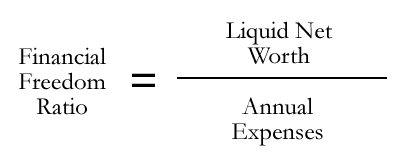
It’s a ratio that mymoneyblog has dubbed the Financial Freedom Ratio:

If someone tells you that they have a net worth of $1,000,000, you might be impressed. But what if they spent $150,000 per year? If they stopped working, the money wouldn’t last very long. However, if they only spent $15,000 per year, they might already be set for life. In other words, your income doesn’t matter. Your expenses do. It may be assumed that the two are related, but that is not necessarily true. We all have the power to disconnect the two.

I’m sure somebody somewhere has already coined this term, but until told otherwise I will call it the Financial Freedom Ratio (FFR):

Liquid Net Worth divided by Annual Expenses

By liquid, I simply mean you can sell it for cash while not affecting your expenses. (Don’t count your car if you need it for work).

I like the FFR because it is a way to compare two people who may be on different financial paths; I mean, who is better off?

The doctor who earns $250k per year (net) but spends $260k a year on mortgages, cars, vacations?

OR

The veterinarian who earns $150k per year (net) but spends $110K and has paid off their house?

But, there is a problem, as mymoneyblog also points out:

For example, if you had $200,000 but only spent $20,000 per year you would have the FFR value of 10 as someone with $1,000,000 but spent $100,000 per year. This also calls into focus how important spending patterns are when talking about financial freedom.

You see, Ratios are dimensionless … they lose scale. Therefore, with the FFR a ‘hobo’ COULD conceivably have a better FFR than a multimillionaire!

For example: my FFR is 40 (purely based upon cash in the bank) – but, that doesn’t mean anything to you, until I also tell you one of the Scaling Numbers (either ‘liquid net worth’ OR ‘annual spending’ will do).

If we want to keep these numbers secret (the great benefit of the FFR), then we simply need to add some sort of Quality of Life Index:

Quality of LIfe Index

As long as the QLI is greater than 1, then I agree that the FFR is a great way to share ‘financial positions’ WITHOUT disclosing how much we actually have in the bank!

It is also a great way to determine if your are on track to your ideal retirement, rather than just settling for the personal finance blogger’s curse: you will save, and save, and save until you can retire on your current paltry salary …

… the QLI forces you to assess what you really need to be able to spend in retirement and then it, together with the FFR, doesn’t let you retire until you can get there!

The only problem?

It doesn’t tell you how to do it! So, you tell me … how will you do it??? 

What does it mean to be wealthy?

7million7years live tomorrow (!) and 7million7years in the press:

Two of my favorite sites are TickerHound (the Investment Q&A Community) and the Tycoon Report (Daily Investing Newsletter); and, they’re both free! 

Also, 7million7years got two mentions when these sites got together here 🙂

Now for today’s post …

Trent at the Simple Dollar rekindled this debate  by asking “How Much Money Is ‘Walk Away From It All’ Money?”

I’ll let you read Trent’s post yourself, but, what often interests me most are some of the questions and comments left by readers to my posts and those on other blogs.

For example, I am often asked what my definition of wealth is; I can tell you what it ISN’T:

I DON’T like the simple numerical definitions of wealth that researchers and academics like to trot out e.g. $170,000 income per year; or $1,000,000 in assets not including primary residence; or even the often quoted Millionaire Next Door formula:

Multiply your age times your realized pretax annual household income from all sources except inheritances. Divide by ten. This, less any inherited wealth, is what your net worth should be.

To me, these are just meaningless numbers.

Then there are the passive-income-covers-current-income approaches to wealth [AJC: you may recall that Robert Kiyosaki  claimed $100k p.a. passive income as = wealth for him in Rich Dad, Poor Dad]; “KC” left this example in her comment to Trent’s post:

I’ve always said “wealthy” people are folks who don’t have to work and can live off their savings, pension, social security check, dividends, and any other non-work related payments. That is an age dependant term. My 90 year old grandmother is wealthy by those standards – but I’d hardly call her style of living wealthy – but she is able to live comfortably off her savings cause her budget is so small – no car, paid for house, minimal food & utility needs.

I disagree with this definition of wealth, because of exactly that scenario: the ‘cash poor’ person who accepts a certain level of lifestyle because that is what they can afford. They have one benefit: they can maintain this lifestyle WITHOUT WORKING therefore some would consider them wealthy. But, to me, they are still just getting by …

… which is interesting, because KC then when on to show the contrast:

My in-laws are wealthy – they both have pensions and health benefits, but retired early (55’ish) due to a sizable inheritance and wisely saving money when they were younger despite knowing they’d come into an inheritance. I would describe their lifestyle as wealthy – European travel, upscale cars, very nice paid-for home.

 This lifestyle has all the trappings of wealth … but, to me ‘trappings’ do NOT equal wealth. So, KC what would I consider wealthy?

Simple, it’s the definition that you provided, with an additional – but critical- twist:

It’s having the regular passive income to cover your ideal lifestyle not just your current lifestyle!

Your ideal lifestyle is the one that you measure by what you DO not what you HAVE …

… the DO part is about legacy: what, if anything, do you want to be remembered for?

The financial part of this is then simple. Just ask yourself: how much will it COST (time and/or money) and by WHEN do you need it?

When KC did the numbers she came up with the following:

But for me (a 35 yr old) to be wealthy by the no work standard would easily take 3 million. I arrived at that number by saying what amount times 8% would allow me to maintain my lifestyle on the principal generated? I chose $3 million cause in a few years I’d need that extra money due to inflation. At $3 million I could very easily pay off my home and live VERY comfortably off the 8% interest. That would make me and my husband independently wealthy. Oh well, I’m only about 2.8 million away from my goal – sigh…

Firstly, good on KC for ‘getting’ that you need a hell of a lot more than $3,000,000 AND for figuring inflation into the equation. But, here are some things that she needs to correct:

1. Firstly, she needs to work out her annual passive income requirements – it looks like she’s counting on $3 Million LESS ‘inflation allowance’ LESS Paying off current home.

2. I’m guessing that amounts to something like $150,000 a year that she’s aiming at – a healthy income, but nowhere near ‘reasonably rich’ (that would take about $350,000 – $500,000 a year income: big house, First Class flights, 5 Star Hotels, a couple of fancy cars, private schools). But, let’s assume that she has modest retirement spending requirements: she doesn’t say WHY she needs it, or HOW much … but, we do know that she needs to replace 100% of her time with money as she doesn’t intend to work at all.

3. Before retirement, KC may be able to count on a 12%+ annual compound return (over a 20 – 30 year period) on her ACTIVE investments (forget 401k’s, managed funds, index funds, etc. … to get 12+% she’ll need real-estate and direct investments in stocks), but in retirement, she will want to wind that back to, say 8% on her PASSIVE investments (now she can buy those Index Funds, if she likes).

Why 8%: because that’s the largest return that the stock market has ‘guaranteed’ over any 30 year period, in the last 100 years (the figure drops to just 4% over any 20 year period, and 0% over any 10 year period). And, then we really should deduct mutual fund and middle-man fees …

4. But, to counter for inflation and up/down market swings, KC will need to wind back her withdrawals to somewhere between 2.5% and 5% of her portfolio … 8% is right out of the question! Why? You have to reinvest at least the expected amount of inflation; KC will need a payrise if she wants to keep up with rising prices …

5. That means somewhere between $3 Mill. and $6 Mill. is the ‘Number’ for KC, or she’ll have to be content with taking ‘just’ $75,000 a year in retirement (at least, it will be indexed for inflation) … just remember, if she takes 20 years to get to that $3 Mill. it will be just like retiring on $35,000 a year today. Whilst $75k seems like a lot to most, it ain’t ‘rich’.

Maybe KC was a little optimistic in saying: “At $3 million I could very easily pay off my home and live VERY comfortably off the 8% interest”?

Do you need to shift your financial goalposts a little, as well?

Is Money's only 7 Investments that you need wrong?

ANNOUNCEMENT: To kick off the final stages of the 7 Millionaires … In Training! project selection process, AJC is going LIVE – this Thursday @ 8pm CST !!!

___________________________________________________________

Last month Money Magazine published an article listing the only 7 investments you need – and Kevin at No Debt Plan wrote a follow-up piece that summarized the options nicely:

That’s right, this Thursday @ 8pm CST 7million7years is coming to a web-cam near you! All you need to participate is a PC with sound and broadband connection – AJC has the web-cam!!

Click here for more details: http://7million7years.com/liveshould be a ton of fun!

Now, for today’s post …


CNN Money thinks you only need 7 investments:

  1. A blue chip US-stock fund (track the S&P 500 index) (Fidelity Spartan 500 Index, FSMKX)
  2. A blue chip foreign-stock fund (track the international stock index) (Vanguard Total International Stock Index, VGTSX)
  3. A small company fund (T. Rowe Price New Horizons, PRNHX)
  4. A value fund (Vanguard Value Index, VIVAX)
  5. A high-quality bond fund (Vanguard Total Bond Market, VBMFX)
  6. An inflation-protected bond fund (Vanguard Inflation Protected Securities, VIPSX)
  7. A money-market fund (Fidelity Cash Reserves, FDRXX)

And, I was happy when I saw that Kevin’s article disagreed, saying:

I think that is four to six too many for the average investor … I think Money’s intentions were good here and I don’t have anything personal against the funds they mentioned. (Well, except the Fidelity S&P 500 fund. $10,000 minimum investment? Are you kidding?) I sincerely think seven funds is too much. You end up sharing a lot of the same stocks in many instances.

But, I disagreed for a totally different reason … Money is trying to have you invest in EVERYTHING … and, trying to invest in everything simply doesn’t work for all the reasons that Kevin of No Debt Plan mentions in his post (go read it!).

But, I disagree with Money on this one simply because I hate, hate, hate funds … any, but mostly the ones with fees e.g. Target Funds … which, No Debt Plan tells me can also be bought quite cheaply, if you shop wisely, so maybe I hate them not just for the fees 😉

I mainly hate them, because investing directly in a few select investments is a strategy of the rich and those who want to BECOME rich. Of course, diversifying a little may be a better way to stay rich … I’m still deciding on this one, and will let you know when I pop up for air.

So far, I’m still on the side of not diversifying …

Of course, not everybody wants to be rich (and, I recently found out that some of them still read this blog!), so for them I agree with Money strategy – but, drop the bonds and most of the other funds … just Funds #1 and #2 will do.

I’ve mentioned on this site before that Warren Buffett agrees 100%:

In fact, I was just at his Annual General Meeting in Omaha where he said that IF you don’t want to take the time to learn about investing directly then you should just dollar-cost-average into a broad piece of “American Business” … which he went on to clarify as meaning Fund # 1 (except he specifically named Vanguard for its very low costs, but I know that Fidelity fund is pretty cheap, too).

Here is what Kevin had to say (via e-mail) when he saw my comments on his post:

I believe in diversification for the average joe out there. I just think the 7 funds they picked was stupid especially because it takes more than $24,000 to get started with all of the minimum investments (if you wanted an equally weighted portfolio).

The target fund expense ratio is not bad at all 0.21% for the 2050 fund by Vanguard. Sure it isn’t 0.07% but it also isn’t 1%. For instant diversification starting out… I’ll take it.

I’ve read Buffet’s comments as well. Thinks the average investor should be indexing and I agree. Kind of a set it and forget it deal.

That’s where Kevin’s view and mine part company … we’re on the same page except that I think the ‘average joe’ should aim to get rich and not be indexing/diversifying at all … 

In fact, I was surprised to hear at his Annual General Meeting that Warren Buffett (and Charlie Munger, his partner also agreed) said that he would put 80% of his wealth into ONE investment – surprised because Warren owns 76 businesses and lots of other investments!
But, the reason he later said is that he grew bigger than his investments, so he had to keep buying more.
So, it’s very simple:
1. If you want to be poor, but slightly less poor than you otherwise might be: diversify into American Business a.k.a. buy one, two, or even all seven of Money’s recommendations (just choose the ones with the lowest fees) and wait 20 or 30 years. Actually, not all seven … if you can wait 2 decades, why buy bonds?
2. If you want to get rich, don’t diversify … choose a very few investment, choose them very wisely, and manage them very well! If you can do that you just may very well end up rich … 
Let me leave you with the words of a very wise man, business man, inventor, and famous author:

Behold, the fool saith, `Put not all thine eggs in the one basket’–which is but a manner of saying, `Scatter your money and your attention’; but the wise man saith, `Put all your eggs in the one basket and–watch that basket!

The Tragedy of Pudd’nhead Wilson, Chapter 15.
Mark Twain(Samuel Langhorne Clemens) [1835-1910].

PS Keep this post handy, you’ll need Mark Twain’s real name (including middle name for extra bonus points) to win at Trivial Pursuit … after all, you’ll have lots of spare time to play when you’re retired 7 years from now 😉
 

Give me the skinny on MLMs

Disclaimer: 7million7years does NOT participate in any MLM either as owner, member, participant, or promoter … so there!

I wrote a post last month about a rumor that Warren Buffett had bought half a dozen Multi-Level Marketing (MLM) companies. He didn’t … I’m almost, absolutely positive about that. He may have bought one (at least, according to one of our commenters) but I couldn’t even find any independent verification of that.

But, if he did …

… why MLM‘s?

Well, they are one of the many ways that people use to try and build additional income streams … and building additional income streams are one of the key Making Money 201 steps to building wealth (since, you can’t just save your way to wealth).

Now, before I tell you more about MLM’s let me share the following:

MLM’s don’t work for me … I don’t have the personality for them: you need to be able to ‘mine’ from within your circle of friends and acquaintances; you need to be able to also ‘cold call’; but, most importantly you need to be really, really persistent.

I’m none of those things (though, I have learned to cold call … yuk … and, am a little more persistent than I used to be), but …

… it’s this third characteristic that (if well controlled) can help you in ANY endeavor!

Having said that, MLM can be an astoundingly good business model for the operators.

And, if you join because you use and love the product (not just because you can propogate membership), for the members, as well. [AJC: if you choose a highly reputable one]

Think about it this way:

i) If you love the products and will use them anyway, then you get to buy at ‘wholesale’ prices.

Well, not quite … and you usually have membership fees and ‘starter kits’ to buy. But, if you have compared prices and believe that you will buy enough to justify any ‘upfront fees’ then why not buy in?

ii) If you love the products, some of your friends might as well.

Why shouldn’t you subtly recommend them to your friends? If you used a product that you loved but didn’t sell it, wouldn’t you still recommend that product to your friends and family without hesitation? And, if you owned a store in the local mall, wouldn’t you want your friends and family – and wouldn’t they be happy to – shop there?

So, why not sell to your friends – how convenient for them!

Just don’t commit the sin of trying to cajole your friends and family into either buying more or joining just so that you can make more money … keep the attitude of trying to serve them, not have them serve you and your interests –  even if they appear to be happy to do so [AJC: I assure you, they are just being polite].

iii) Now, here is where it gets tricky: if you love the product and it makes you money, why shouldn’t you introduce other people – even your friends and family – to the same opportunity?

In principle, no reason not to: just remember that your friends and family will be ‘expecting’ this move from you [AJC: with rolled eyes … and a sigh or two].

Here is where I failed: I just can’t bring myself to involve friends or family in my ‘deals’ … I don’t like the idea of anybody thinking that I am profiting from them.

But, that’s just me. In truth, most people are looking for an opportunity to ‘get ahead’, just like you … and MAY respond well to an offer to “find out more”.

Just don’t commit the Three Great MLM Sins:

1. Don’t drag your friends/family along to some ‘secret meeting’ – “I can’t tell you what I’m involved in, but if you just come along I think you will thank me later”. That’s just plain tacky … be upfront.

2. Don’t plead/cajole/cry to get your friends/family ‘into’ your meeting/s – MLM’s are a direct-selling business pure and simple; don’t confuse the motivational stuff that goes on [AJC: necessary, because MLM can be a HARD business to grow fast] with how YOU should act.

3. Don’t be persistent with your friends/family – Now doesn’t this conflict with what I just said: “most importantly you need to be really, really persistent”?!

Yes, be really, really persistent with anything you truly believe in – including your beloved MLM – just don’t expect your friends/family to be the same … be persistent with the business, not the person.

In other words, it MAY be OK to politely, subtly ask a friend/family member who has expressed: (a) some liking for the product, and/or (b) some desire for a new opportunity … ONCE.

Anything more is simply out of bounds!

To me, the same rules apply to anybody that you meet: ask them once (OK, if not a friend or family member, go ahead and ask them twice … after all, you don’t want your new MLM Family to laugh at you, right?) … but, twice is enough!

Oh, and don’t do what my multi-millionaire friend does (who joined an MLM after becoming rich) …

4. Don’t plaster your brand new BMW with tacky vinyl stickers that say: “Want to lose weight now? Ask me how!” …. just … don’t 🙂