Insure your future?

If you’re on the road to your Number – let’s say it’s $2 Million by the time you are 35 – and that milestone is well before your retirement accounts vest, you have a real trade-off to make:

1. Put that money that you would have otherwise invested in a 401k/IRA/etc. to work for you now to help you get to your Number, or

2. Keep socking money into your retirement account as a ‘safety net’ in case you fail.

The ideal strategy is actually 2., as you should always ‘insure your future’ …

And, some would say that you should keep socking that money away until you have something concrete to use your money for and then you can always pull your money out of your retirement account if you need to.

But, there’s the issue of taxes and penalties on early withdrawal, right?

Speaking of Motley Fool’s mastery of the sensational headline, I thought that I had found an easy solution for you when I saw this headline on their site: Tap Your IRAs to Retire Early. Unfortunately, it was only a ‘funnel’ into a pretty boring article that tells you that you can withdraw a couple of percent of your IRA each year, earlier than your standard retirement age.

Not much use to an aspiring multi-millionaire!

If you do what I suggest:

1. Implement sound MM101 strategies (save 15% of your gross income via 401k/IRA’s/etc.), as well as 50% of any ‘found money’ (lottery winnings. tax refund checks, inheritances, etc.)

2. Pay cash for your cars, don’t acquire credit card debt, buy your own home, obey the 25%/20%/5% rules

3. Increase your income (and save 50% of any such increase) through a second job etc.

… then you will probably have the ‘capital’ saved as cash (or in ‘spare equity’ in your own home) to start the types of businesses that I suggest that you start (eg low cost – perhaps internet – businesses) or to slowly start investing in real-estate without needing to ‘tap’ your 401k.

This is the ideal … but, if your business should be growing and you need the funds to expand further, then you may be left with some unsavory alternatives:

1. Hock the house, cars, children

2. Find a partner to invest in your business

3. Raid your retirement accounts

I’d probably go for 1., then 2., then 3., or maybe 3., then 1. then 2. – or maybe I’d put the partner second (never first) – but, I’m not sure. It all depends on circumstances … which we’ll have to explore further in future posts.

In the meantime, which would you choose?

I hate budgeting … so, I’ve only ever tracked my expenses once!

No Budget BudgetThat’s why I was so  excited a number of years ago (very early on in my Financial Re-birthing Process] to come across John Burley’s ‘No Budget Budget’.

For those who don’t know him, John Burley is a financial spruiker (originally, on the subject of ‘wraps’ for real-estate … something that I have never tried myself, so something that I can’t really comment on); after hearing him speak, I tracked down one of his courses that covered basic financial improvement “in 31 Days” …

… I don’t think I ever got past Day 1 or Day 2, but I’m really glad that I tried his ‘no budget budget’. It’s the ONLY personal budget that I have ever tried (and, don’t even get me started on the subject of business budgeting!).

Basically, the process consists of writing down every single dime that you spend (cash, check, credit) for a month. That’s it!

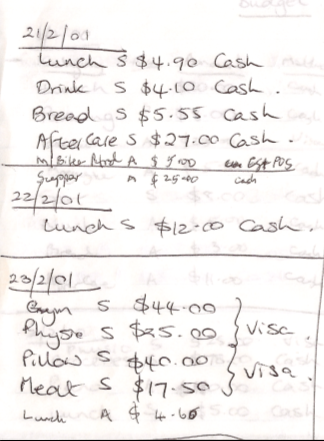
When I was cleaning out the house for ‘our big move’ recently, I found the actual budget that I had put together … it spans all of 3 pages (part of page 1 is scanned and reproduced here); a small ‘price’ to pay for financial freedom 🙂

Here’s how it works:

1. Grab a blank sheet of paper and a pen (actually, a little pocket notepad and pencil is ideal … but I kept a folded sheet of paper in my pocket and my wife kept a little notebook and pencil in her purse and every night she would tear the page out that she used and give it to me to add to my sheet).

2. EVERY DAY FOR EXACTLY ONE MONTH [AJC: you don’t have to start on the first day of the month; any day – like TODAY – will do] I wrote on that sheet of paper:

– The Date (each day I started a new section on the piece of paper … when you try this, you should be able to fit a week or so on each sheet)

– What we bought (e.g. lunch; drink; bread; newspaper) … we did this for every single purchase!

– Who bought it (A for me; S for my wife; I guess we would also need to add Ad and Ta for our children if we were starting this No Budget Budget now)

– How much it cost (inc. taxes etc)

– How we paid …. we used a simple system eg Cash, Visa, Check

That’s it; one month …

Also, we added a new ‘last day’ of the month, so that we could write in 1/12 of any annual expenses (eg insurance) whether paid for in that month or not.

You can see that we did this in Australia 9 years ago [AJC: the date 1st Feb, 2000 is written as 1.2.00 in Australia]

You can also see that we were mainly a ‘cash society’ back then as only the haircut (mine) was paid by Visa [AJC: at $28 back then, I must have had WAY more hair than I do now] …

So, we simply kept a log of all of our spending for each day, in exactly the same way that we did for Feb 1 for the whole month … of course, Feb is a dumb month to choose, because it’s the shortest.

I can’t find the summary page, but I recall it being something like $1,000 a month that we were spending then.

That tells you what you’re spending … now, compare that to what you’re earning (after tax):

Annual income twenty pounds, annual expenditure nineteen six, result happiness. Annual income twenty pounds, annual expenditure twenty pound ought and six, result misery.
Charles Dickens, David Copperfield, 1849
English novelist (1812 – 1870)

This worked for us, and we never bothered doing it again; didn’t see the need … now, tell me about your experiences with Budgets (or No Budgets) 🙂

Rapping up The Richest Man In Babylon …

I was researching a post and it occurred to me that not everybody knows about the best-selling personal finance book, The Richest Man In Babylon

… so, I found this rather ‘unusual’ summary of the book and its seven rules, which boil down to:

– Save 10% of your gross income and put it to work for you

– Reinvest the dividends (that’s how you kick in ‘compounding’ … it don’t happen automatically, bub)

– Budget your income (I’m not so sure how important this it other than to help you save the 10%)

– Own your own home

… if anybody can make head-or-tail of the other three ‘rules’ please put them in the comments 🙂

Save your way to wealth?

We just spoke about saving your way to some capital to start a business and here’s Steve Olsen talking on his blog about a man that he met who managed to do just that by saving 50% of his income:

I heard a 60+ year old man say this today…

When I was 18 I made a decision. I decided I never wanted to be under financial stress. I have lived that decision my entire adult life and have never experienced financial stress. How did I do it? I saved 50% of my take home income without exception. I’ve had months I’ve made $100, and other months I’ve made $100,000. But regardless, I still saved 50% of my income. My income has fluctuated but my saving percentage hasn’t. This has enabled me to purchase several business and a large ranch without incurring debt. I hear people say ‘I couldn’t possibly live on 50% of my income.’ Oh! baloney, you choose not to. Sure it’s harder once you have a 400K mortgage and kids in private colleges, but you decided to live that way. You don’t need to live that way. And if you had decided when you were younger to live differently, you could have your 400K home and private college today without a dollar of debt.

I’m not trying to preach. I don’t save 50%. But I know everything this man said is true. I could have saved more, and if I had, I’d be much better off today.

First of all, I stick to my guns: you CAN’T save your way to wealth!

cash-flow-markFor example, let’s look at Mark from our 7 Millionaires … In Training! ‘ grand experiment’:

My current monthly net income after taxes is about $6,425

I haven’t tracked my expenses in detail for a while even though I’ve been using Quicken and I’m surprised to see some areas where I can easily cut down.

Current Monthly Expenses (average for the last 12 months):

  • Housing – $980
  • Gifts (gifts for family and friends, mostly family) – $925
  • Auto – $267
  • Entertainment (been to many concerts, musicals, activities and events) – $266
  • Utilities – $256
  • Dinner and Lunch outside – $228
  • Vacation (low number since I’ve used airline miles for 2 international trips) – $224
  • Charity – $191
  • Misc (Electronics, Clothes, Insurance, Cash) –  $406

The total is about $3,743.

This indicates a savings of $6,425 – $3,743 = $2682

Jeff put it best:

Your “living the good life” activities account for about 43% of your monthly expenses (gifts, travel, eating out, entertainment). I’m not proposing eliminating everything, but if you cut those expenses by 1/3 – 1/2, you could increase your monthly surplus (or profit :-) ) by 20-30%. In an extreme case, eliminating them all together could boost your monthly profit [savings] by 61%.

Sure adding an extra, say, $800 p.m. can put Mark into High Income / High Saver territory, producing a HUGE $11 mill. in 25 years …

BUT:

1. That’s ‘only’ $4 mill. in today’s dollars and Mark has to wait 25 years to get it … Mark’s Life Purpose requires $5 million in just 10 years

2. In 10 years of frugal living Mark will ‘only’ have $1.25 Mill. in today’s dollars … certainly not enough to even reopen up the spending gates ;)

It seems that you really can’t ‘save your way’ to your Number – even if Mark saves 50+% of his income – unless he’s happy with the $4 Mill. in 25 years scenario (better than being broke, right?) …

… but, the secret is in what the person in Steve Olsen’s article did with the money he saved; here it is again:

My income has fluctuated but my saving percentage hasn’t. This has enabled me to purchase several business and a large ranch without incurring debt.

Now, what do you think the businesses and ranch did for his income and lifestyle?

So, the reason why I promote making Money 101 activities such as saving more, paying cash, and delaying gratification is that it allows you to build the capital required to make a lot more money later …

you really need to be saving more to help you increase your income:

a) By building up a ‘war chest’ (working capital, R&D costs, etc.) for your investing activities and/or business ventures, and

b) By building up a ‘backup reserve’ in case things don’t work out.

As I told Mark:

Save a little now, so you can still afford to spend more later …

… but, ONLY if you are serious about your Number, otherwise spend away! Go ahead and enjoy your life as it is, you’re already ahead of 99% of those in your age group :)

What's 17 years between friends?

17Warning: This image has absolutely NOTHING to do with the post other than:

(a) it came up when I searched for “17” on Google Images (I don’t even know why?!),

(b) it’s very funny/cool, and

(c) I have absolutely NO IDEA how a boat lands on a car

… or, what a seemingly naked guy in a yellow raincoat is even doing there!?

____________________

In a recent post, we gave Chad a ‘starter kit’ to becoming a millionaire; and as Money Monk said:

There’s always a slow way and a fast way.

For me, the fast way has always held more appeal …

… but, that doesn’t mean that you can’t combine the two, as Jeff points out:

By taking into account annual contributions, your compound annual growth rate can significantly drop. For instance, if Chad starts with $10,000, his compound annual growth rate is 65.52%. If Chad could also save and invest $10,000 of his salary a year, his compound annual growth rate drops to 52.52%.

If Chad’s Date is firm, annual contributions might not change his analysis much, but if he extended his term or could increase his annual contributions, (or both)…the difference can substantial. For example, if Chad extended his date out another 17 years (and adjusted his number for inflation), his compound annual growth rate drops to 19.81%. If Chad also decided to increase his initial annual contribution to $15,000 and then continue to increase the annual contributions by 5% a year, his compound annual growth rate drops further to 16.69%.

Getting 16.69% annualized return is no cake walk, but a lot easier to get than 65.52%.

What’s an extra 17 years and a drop in living expenses by $15k a year between friends?! ;)

Seriously, Jeff’s point is absolutely valid and is the real secret:

Rather than gambling on the business or [insert speculation of choice: growth stocks and options; gold; oil; etc.; etc.] to pay off big time (i.e. deliver your Number in one neat check), you build a business for sale … in the meantime, you keep following Making Money 101 and save/invest in solid assets (e.g. income-producing real-estate and/or ‘value’ stocks) …

… it’s the combination of Making Money 101 and making Money 201 that delivers the extraordinary result that Chad is after.

Is your partner worth $5 million?

picture-12I guess by now you know my true feelings about partnerships, but you may have other ideas …

… after all, your intended partner may be the Yin to your Yang … she may be the finance whiz while you run rings around operations … or he may just be your buddy since you shared a dorm together.

All I can say is: I hope that whatever your partner brings to the table, that they are also bringing The Big Idea.

You see, if you are the one with The Big Idea and you choose to share it with a partner because you [insert too scared to go it alone reason of choice: need more capital; need finance/operations/marketing skills; need somebody with a level head; need somebody to burn the midnight oil with; need somebody to hold hands with; etc.; etc.], then you are effectively paying your partner $5 million for the privilege!

By now you’re thinking that I’ve gone entirely off my rocker, so let me explain:

Let’s say that you have worked your way through all of the exercises and you believe your Number to be, say, $10 Million in just 10 years … where are you going to get it from?

Well, The Big Idea of course!

You’ve had this great idea and you will build a business around it and you will sell it for $10,000,000 in 10 years and …

… ooops!

You forgot that you invited a partner to join you … and when you sell, they are going to get half: $5,000,000.

That’s $500k a year for 10 years PLUS whatever salary that they took for those 10 years PLUS whatever perks that they got (e.g. trips, cars, laptops, phones, etc., etc.) PLUS 50% of any profits.

And, now you’re only half-way towards your Number!

Was your partnership worth it? Or, could you have hired people when you needed them for far less cost? I’m venturing that the answer is ‘yes’.

Another way to look at it is: will I be able to sell my business in 10 years for $20 million, so that my half still gets me to my $10 million 10 years Number? Or $30 million, if I decide to have 2 partners 😉

So, the question that you need to ask before considering going into business with somebody else is: am I more likely to get to my Number with or without this person?

And, I’m guessing that unless you’re a total doofus who just happens to have The Big Idea and not much else going for them, the answer will be “NO, I can get to 100% of my goal without this person, MUCH easier than getting to 200% of that same goal with them”.

So, what if you don’t have The Big Idea, but the guy who happens to have it asks you to go into business with him?

That, my friend, also depends on whether you are more likely to get to your Number with or without this person … and, their Big Idea?!

New Reader Question about debt …

I am always pleased to receive questions and comments from readers – and, new readers in particular. For example, recently I have been in e-mail conversation with David, a new reader, who asks:

After spending half of my day reading various posts and links I have a better idea of where I need to be.  I do have a question – I have student loans that I unfortunately locked at a 9.9% interest rate back in the mid 90’s.  I still carry about 30k and I make about a $330 payment a month.  What is the best strategy for those?  I can’t refi them.  I can pay them off “quickly” but the money that I would be lopping off that is taken away from my nest egg and emergency funds.  If I pay them off on their schedule, it will cost me around $79k in the long run. What would you suggest?

While I’m not qualified to – therefore, don’t – give give direct personal advice of the financial or any other kind, I can use this question as ‘inspiration’ for this, more general, post …

This is a common problem, facing most folk these day … not specifically the student loan, but debt in general. And my response is generally the same: it depends 🙂

And, the thing that it depends on is actually two things, not one:

1. Do you have ‘spare income’ or cash floating around that you COULD be applying to this loan?

If not, then you need to keep paying the loan according the schedule and doing your level best to find some additional money through increasing income (MM201) and/or better personal money management (MM101). But, if you do have some spare cash floating around then you need to ask yourself the following question …

2. Where else could you put the money that would return more than 9.9%?

This is really a simple question, so you don’t need to beat yourself up about the answer …

If you want to start a business that can return, say 50+% if it’s successful, then you may be better off keeping the loan in place – making just the required payments, for now – and putting your spare cash towards startup/working capital for your business.

But, if you are thinking (instead) of paying down your home loan, with its current interest rate of 6% (probably at least partly tax deductible) then I would suggest that you instead pay off the student loan.

And, if you had a car that you absolutely had to purchase and were thinking about financing it at, say, 11%, then I would instead suggest that you pay cash for the car and keep the student loan in place.

The decisions, to me, only become more ‘difficult’ if you have no clear idea of a better use for your money other than “Maybe investing in something one day” … in which case, I would take the ‘sure thing’ i.e. pay off the ‘student loan’ debt,

OR

The available options are so close in interest rate earned or spent e.g. should I pay down the 9.9% student loan or buy some units in an Index Fund that should return a bit over 9.9% over the next 10 or 20 years …  in which case, I would again take the ‘sure thing’ i.e. pay off the ‘student loan’ debt.

Other than that, simply apply the principles in this recent post and you won’t go too far wrong …

BTW: don’t forget to compare interest earned and/or spent AFTER TAX. To me, a rough estimate (rather than paying for a consultation with your accountant UNLESS the decision is major or strategic) is probably usually good enough … but, when in doubt, work it out WITH YOUR ACCOUNTANT.

Oh and one more ‘trick’; if you have another asset that you can acquire new debt on to pay off the more expensive old debt, can/should you do it?

For example, if David has a house with ‘spare equity’ can/should David refi the house and pay off the student loan entirely. At an effective current (tax deductible) interest rate on the refi of, say, 6% (compared to a ‘locked in’ 9.9%) the answer is most likely a resounding YES, however, now we have to think about locking in and term:

The student loan is likely to be locked in to a repayment schedule that will see it paid off in just a few years, but a mortgage will probably be offered at 15 to 30 years to keep the repayment schedule low … if the purpose if simply to repay the student loan, then you should divert the money that you would be using on a monthly basis to repay the student loan to repaying the mortgage (i.e. pay off the mortgage with the original mortgage payments PLUS the former student loan payments).

Because the combined interest rate is now lower but your repayments are the same as before, you should actually be paying debt off at a slightly faster rate …

Of course, if you do have a hot new business or investment idea, then you may instead refi the house, pay off the student loan and apply any spare cash (over and above what the bank says that you HAVE to pay on the mortgage) to building that little ol’ warchest … but, this is an advanced – and more risky – Making Money 201 concept … only needed if your Number says so 🙂

Avoiding a one-way ticket to misery …

broken-hammerSmart Money Daily says that winning the lottery is a “one-way ticket to misery” … and, I couldn’t agree more!

The problem, as he puts it is this:

There is something about our culture that gets people very excited about getting something for nothing. The thought of paying $1 for a lottery ticket and coming away with several million dollars is a fantasy many people can’t let go of — in fact, that’s why the lotto companies can afford to keep going in the first place.

The problem with winning so much money is that it’s a complete life change that very few people are ready for. Going from near poverty levels to wealth rarely ends well. People tend to either wind up lonely, broke, or in some other kind of trouble.

I couldn’t agree more …

I’ve read that 4 out of 5 lottery winners are worse off 5 years after winning the lottery than they were before. The problem is that you have to make your money slowly in order to learn  the rules of money that allow you to keep what you have.

I am always amazed at sports and rock stars who sign multi-million dollar contracts then are broke just a few years later (remember MC Hammer?) … according to Motley Fool, it boils down to two main issues:

i) The newly rich don’t look after their own money very well

I remember receiving my first multi-million dollar check; I flew to Melbourne from the US to personally bank it – after ‘watching’ it flow through the right channels. I remember worrying that the personal bankers might have just printed up fake bank business cards and rented a fake office just to rip me off!

By the time I received my next two checks (one of them just as big at the First Big One), I just let my accountant bank them for me … it’s amazing how your mindset can change so quickly. So, it’s no great surprise that some of these people simply trust others with their money.

ii) They spend more than they earn

This is an easy one: it’s ALWAYS easy to live beyond your means, no matter how large your means are 😉

Here’s a ‘system’ for those who receive a ‘one off’ amount … or, have a potentially limited life to their large earnings (e.g. a 5 years sports contract; a 10 year lottery payout; etc.):

1. When you sign the contract for $X per year, realize that you DON’T have 80% – 120% of $X per year to spend!

2. Instead calculate how much you will build up over the LIKELY life of the ‘contract’ and plan to save most of that (a secure/insured bank account is JUST fine for this purpose)

3. That total becomes your Number: adjust for inflation (i.e. take off 50% if it will take you 20 years to accumulate that amount … prorate for any shorter period)

4. Take 5% of that ‘accumulated’ Number and that’s the amount that you can afford to spend in any one year ‘living’ – starting now …. period!

5. To decide how much house, cars/possessions, etc. that you can afford simply apply the 20%, 5% and 25% Rules to your ‘Number’, accordingly:

– House: presume that you’re going to pay cash for this, and put no more than 20% of your expected ‘Number’ into the house; if you actually intend to buy so much house that you can’t pay cash (sucker!) then you MUST apply the 25% Income Rule,

– Cars and Other Possessions: always pay cash for these, and put no more than 5% of your expected ‘Number’ into them … since you will most likely enjoy spending, spread the 5% over the number of years that you expect to achieve your Number.

Of course there is still risk in this, but you are a [Insert Lucky S.O.B. Reason of  Choice: Lottery Winner; Rock/Movie/Sports Star; Slip’n’Fall Insurance Payout Recipient; etc.; etc.] so, you probably won’t be able to fully contain your spending until after you actually see how much money you are GUARANTEED to end up with, so this ‘system’ is at least designed to keep your spending as ‘realistic’ as we can without sacrificing your Rock Star Image (or, whatever ‘image’ you are trying to project) too much 😉

Still, to be safe yet keep up pretenses, simply rent the house (that’s where the 25% Rule comes in; i.e. don’t spend more than 25% of your after-tax yearly earnings on rent and other direct housing expenses) and cars until you’re pretty sure that you will actually achieve your Number … or, be prepared to downsize pretty quick if something happens (e.g. sport injury).

Oh, and forget the blood-sucking entourage!

I hope that this post becomes VERY helpful to you, one day soon 😛

7million7years in the 'news' again!

picture-11Kimberly Palmer wrote an excellent piece for US News (and, reprinted by Yahoo News!) called 10 Secrets of Millionaires’ Money Management and the first cab off the rank is 7million7years!

I’ll let you click on the link to read the article in its entirety.

In the meantime, I thought that I should share with you my response to Kimberly’s contribution request which said:

I’m writing a story on “secrets of millionaires” and would love to include some of your thoughts — could you please share two to three of the strategies that worked for you, perhaps things you’ve written about on your blog before?

Hmmm …

Two or three strategies that could be counted as a ‘secret’ to becoming a millionaire?

The strategies are easy (Kimberly included one of mine in her finished piece), but there’s nothing ‘secret’ about making money and/or amassing serious wealth, as my eventual response to Kimberly showed:

Here we go:

1. The Number One secret of being a millionaire is not an obvious one, but it’s the absolute key: you need to know your Number i.e. how much is enough FOR YOU.

For most Gen-X and Gen-Y’ers, retiring with a couple of million when they are 65 won’t be anywhere near enough to maintain even an average lifestyle because that little pup called inflation is constantly nipping at your heels as you try to run towards building your own retirement nest-egg. You need to be aiming for a MINIMUM of $3 million+ in 5 to 10 years to even be considered a ‘bare bones millionaire’ these days.

2. The second secret is also counter-intuitive but equally powerful: when you get to your Number STOP and live your Life, you deserve it.

For example, if you have a business and somebody offers you enough money to meet your needs for the rest of your life, then – as long as the offer values the business reasonably – TAKE IT. Don’t get greedier 😉 by rejecting the offer looking for more. And, don’t be tempted to start again – lighting doesn’t often strike twice and who knows when the next recession (or other disaster affecting your business e.g. fire, departure of a number of key employees, etc.) will hit?

3. The final secret is to learn the lessons of money early and stick to them.

For example, know how much capital to have invested in your own home, in your cars and in your other possessions, learn how much you can safely borrow, learn how to live within your means, and learn how to delay gratification; these are the habits that you need to maintain on the way up, so that you can keep your millions when you get there. If lotto winners can spend their winnings in just 5 years and end up broke and athletes and celebrities such as MC Hammer, Elton John, and Evander Holyfield can spend their huge fortunes, your paltry few millions can easily disappear much faster than it arrived.

See? This is pretty much it … the rest is just “filler” 😉

Can't think of a side-business to start?

cute-cuddly-toy1Everybody wants to be an entrepreneur, or so it seems; but, where to start?

If you can’t think of a side business to start, Trent at The Simple Dollar gives you a ‘kick-start’ with this list of 50 Side Businesses You Can Start On Your Own

… you can click the link and browse through all of his ideas, but here is a sampling:

What follows is a list of 50 of those ideas that I’ve collected over the last year or so. Each of these ideas is very simple to start, and most can be done as a sole proprietorship at first (meaning you don’t have to file any legal documents to get started, though you will want to do that if it starts to take off). Most of these can be done at home in your spare time in your spare space, too.

Ready? See if there are any ideas below that fit you well. If you find an idea, seek out a guide on how to get started in that area.

Blogging If you enjoy writing, find a topic you’re passionate about and start a blog on the topic. All you need is a computer, some time, and some energy to consistently write.

Candle making Candle making is a great little craft to learn. You can often easily sell the candles at local shops and also through websites like Etsy.com.

Event coordinator Events like family reunions and large parties are often full of busywork that many people simply don’t want to tackle. That can be the perfect place for you to step in and take charge of the planning and coordination.

Jewelry making If you have a good eye for detail work and a lot of patience, homemade jewelry can be quite profitable. As with other items on this list, there are many opportunities to sell such items through local gift shops or at sites like etsy.

Pet walking Many busy people leave their pets home all day, but realize that those pets really could use a vigorous walk (and an opportunity to relieve themselves) during the day. Pet walking is a great opportunity for exercise, fresh air, and some pocket money if you have free time during each day.

Scrapbook making Many people dream of having beautiful scrapbooks. They collect all the materials they want in the scrapbooks but never follow through on the actual creation. You can step in here – take their ideas and materials and assemble a scrapbook for them.

Virtual assistant Many ultra-busy professionals appreciate having someone who can check and answer their email, organize task lists for them, update their calendars, and so on, with minimal interaction. The best part is that you can provide this service from home with a good internet connection.

I’m betting the readers have many, many more ideas along these same lines.

I’m also betting that my readers have many, many more ideas along these lines … and, each is a potentially GREAT Making Money 201 idea that can:

– Produce a little extra income

– Boost your savings rate (remember, you WILL save at least 50% of this extra money, right?)

– Help you build up some capital for future businesses investments (putting the 50%+ savings to its highest/best use)

BUT … did you spot the problem?

Almost all of these business ideas (and, I mean Trent’s full list, not just the random few that I have sampled above) seem to have one – I feel – major flaw:

They (almost) all rely on the fruits of your personal labor.

And, it’s easy to understand why: you have a skill – perhaps learned on your job or via a hobby – and you naturally apply that to a business: you start making some cute little cuddly toys for your kids, then friends, then the school fete, and before you know it … you’re in the Cute Cuddly Toy Business!

Even though you are in the business of making PRODUCTS (i.e. Cute Cuddly Toys), you are really in the SERVICE business, because it is all tied to YOUR ability to keep making Cute Cuddly Toys.

The problem is that these businesses are hard to expand past … well … YOU. And, any business based on Y O U is actually just another J O B.

Sure, you can expand by hiring people to do what you do, but then:

– Will you be able to find / train sufficient people to manage growth?

– Will you be happy with their quality?

– Will you be able to manage people (they get sick; ‘forget’ to turn up; have temper-tantrums; etc.; etc.)?

– Will YOU be around (will you get sick; have family conflicts; etc.; etc.)?

There is a simple solution:

Turn these service-based businesses into product-based businesses; here’s how:

1. Start with your service-based business, but keep it small as you will probably shut it down pretty soon

2. Video yourself doing what it is that you do (including how you buy/sell/make) … every step, sequentially … and, explain what you are doing as you go along

=> you are creating a series of short instructional videos 🙂

3. Write down the same steps that you followed in the videos … every step, sequentially … and, explain what you are doing as you go along

=> you are creating a series of short instructional manuals 🙂

4. Write down a list of materials required and places to get them

=> you are creating a Buyer’s Directory 🙂

5. Package the lot up!

=> you are creating a course in [insert part-time business of choice] 🙂

6. Buy a web-site-building package such as Bebiz and/or Site Build It! and sell your course (and/or materials required to make Cute Cuddly Toys) online!

=> you are creating an internet-based business 🙂

Can you see what you have done?

You have turned your ongoing personal labor (i.e. making the Cute Cuddly Toys) into once-off personal labor (i.e. developing a course on how to make/sell Cute Cuddly Toys), and then selling those toys online … once the course is complete and the web-site is set up, you can outsource most of the manual work of the business (fulfilling/shipping orders) to someone else when you get too big (or too sick) to fulfill them yourself.

Not to mention, you can make a lot more money; for example this guy who turned his hobby of wire-sculpture jewellery-making into a $600k per year online business.