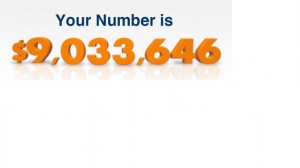
How to excite a millionaire …


It really doesn’t take much to excite me, as evidenced by this commercial that I just came across …

… given my obvious passion on the subject of Numbers (as opposed to mere ‘numbers’) you won’t be surprised to hear that I jumped straight onto ING’s web-site to see what their take on this whole ‘Number-thing’ was:

ING Your Number - 1

It’s a neat calculator that – in 4 or 5 simple ‘plug-in-the-numbers’ – gives you Your Number … or, does it?

You be the judge:

ING Your Number - 2

…. now, I might just be a touch pedantic, but isn’t the $7 million dollar question: “how much income do you need in retirement?”.

In other words, isn’t the whole point of such a tool to help you come up with this number, rather than asking you to pluck it out of ‘thin air’ [AJC: like I just did with the $250k figure that I randomly plugged in]?!

And, without it, isn’t this just some sort of glorified calculator? 🙂

BTW: According to ING, my Number is:

ING Your Number - 3

… guess I’m $2 Million short; can anyone lend me some 😛

Work backwards to move forwards …

work backwardsIn Monday’s post, I took a look how Scott – a young family man and doctor – could use his Number/Date to help him evaluate whether to buy his business partner out now or simply wait 30 months, when his partner retires from their medical practice.

Without the ‘filter’ of his Number/Date, this would be a very difficult decision, with so many risk/reward variables … 

… but, it’s actually a very simple decision: 

Which is the most comfortable (i.e. lowest risk, ‘feel right’) alternative that seems most likely to ‘guarantee’ that your Number/Date – this most critical of life goals – can be achieved? 

This is such an important concept that I want to share another example, this time from Trey and Juliana a young couple just starting out on their financial journey together: 

Two nights ago I got Trey to work on a life’s purpose. Last night we brainstormed money making ideas: Trey really wants to open a thrift store and we know a perfect location right near the college. Kind of like a Buffalo Exchange, that offers cool music, buying and selling jeans and ultra cool clothing items, shoes , hats and such as well as art and records.

 Then we thought of our life purpose and though about making it a Non Profit and helping abused children in some way.

 The thought occurred that perhaps as a nonprofit it might be possible to get lower rent, tax breaks, donations and other benefits while helping children. Perhaps we could choose a local children’s or battered woman’s shelter to benefit from our thrift store. There is a lot of research and we will need cash up front.

 [Trey is also an artist and has developed] a whole line of B**** B*** Gang which he came up with, (Little cartoon boys) … I think he should license them and sell them. He though of making a comic strip online or illustrating kids books.

 I think this would be a better idea than the thrift store because a store ties one down to one spot. However, Trey is really into the thrift store idea.

 Another idea is blogging for cash. Perhaps starting 3 separate blogs about separate things such as economical recipes, the battle of the bulge ( weight loss) and one about saving money. I know it would take a while to get subscribers however it does not tie one down the way a store does. I know that this will be time consuming and I will need to do much research as to how one gets paid.

 Trey might open a thrift store and I might start a blog or three. It is all about multiple streams of income. I bet I could write children’s books. What if I wrote books and a portion of the proceeds went to fund parenting classes.

For some people, the well of ideas runs dry, but for other – like Juliana [AJC: and me !] – the ideas flow so thick and fast it’s hard to decide where to start …

 … so, we often put the shutters up and don’t start at all!

 If this is you, I want to share a novel concept: It’s always a good idea to work BACKWARDS …

 … here are the steps, as they might apply to Trey and Juliana:

 Step 1. Find your Life’s Purpose – They’ve already done this. Check!

 Step 2. Choose your Lifestyle – I showed Trey and Julian where to find some great ‘sample lifestyles’ here (click on the links inside that post to see some sample lifestyles at different $$$$ levels).

 The idea here is to choose the type of lifestyle that they hope their business/es to fund one day … this will help them immensely (as we’ll see shortly) in choosing the right business!

 Step 3. Account for Inflation – This is actually quite easy! Simply double your chosen ‘lifestyle’ amount for every 20 years before you intend to ‘retire’ (i.e. to start living it). If you only intend to wait 10 years, then just add 50% to your annual lifestyle amount.

 Step 4. Find your Number – Multiply your final ‘inflated’ lifestyle number by 20: THAT’S your Number!

I left Trey and Juliana some further guidelines on their Life’s Purpose post at the Share Your Number community site.

 Step 5. Work Backwards – Now’s the time to decide which opportunities can be sold by their Date for at least the amount of their Number.

 Let’s assume their Number is large (right now, it’s $50 Million, but my suspicion is that they will revise this well-downward once they complete the above steps against the filter of their Life’s Purpose).

 If it remains a large Number, a blog is unlikely – on its own – to get them there, unless their name is John Chow whose blogs generate about $1,000,000 a year (then again, he does own Technorati.com!).

 So, I would advise Trey and Juliana to look at ideas that can expand exponentially, with relatively low capital requirements … here’s a couple of ideas:

 Trey’s idea of licensing a cartoon series might have great potential: he could generate interest by starting online (here’s where Juliana’a blog idea CAN help), then hope to get picked up by one of the traditional avenues (e.g. syndication in the news and/or become the next ‘South Park’ cartoon series) supported by product sales and licensing … and, a LOT of luck!

 Alternatively, as Debbie suggested, if they can:

 a)    Successfully create their first Thrift Store and operate it profitably, and

b)    Find a unique angle, so that it stands out from similar businesses (not just in this location), and

c)     Document all of their operating procedures, such that any ‘dummy’ could run the business just as successfully as they can

 … then, they may just have a business that can be franchised.

 By working backwards, Trey and Juliana – with a little help of a pencil/paper/calculator or spreadsheet – can decide which of these opportunities is really worth pursuing!

After all, if it can’t help you to reach your Number/Date, why bother? 😉

Can you eat a car?

I’m rapidly becoming the ‘Dear Amy’ of personal finance blogs (don’t let this stop you, I actually love receiving these types of e-mails!); Tam asks:

I am working to pay off my expensive debt which should be paid off in the next six to eight months. However, my dilemma is I LOVE cars. I want to finance (w/ a sizable down payment) a new car after my debt is paid off. I’m trying to talk myself out of it because I know I should be putting that money toward my financial goals but I just keep saying that if I can get this car, then I won’t want anything else and will be satisfied. Deep down, I know this is not true because three years later, they’ll be another new car that I will want. What can I do to stop myself from buying this new car (Nissan 370Z Roadster)?

 Man, what can I say?!

I could point Tam to the post that said not to buy a new car, or to the one that said not to finance, or even to the one that said not to spend more than 5% of your net worth on ‘stuff’ (including your car). 

I’m guessing that any one of these would be reason enough not to buy the car … instead, I just offered Tam the following advice:

Don’t!

Can you eat a car? 😉

Your Craig’s List Ad …

Scott has placed an ad on Craigs List:

WANTED: A very successfully run healthcare practice, specializing in spinal rehabilitation, exercise, massage therapy as well as other holistic services such as nutritional advice and expertise. Professionally run to the highest of clinical standards with a well-trained, goal-oriented staff, necessary equipment and supplies. Low monthly overhead, time-proven practice and business design system already in place, extremely high cash-flow and yearly profit margins, ongoing community marketing programs in place, all in a state and local community that harbors terrific heath insurance coverage for these services. Totally turn-key, fully developed business design, everything from new employee training techniques, to patient marketing, to patient scheduling, to treatment programs and proven care systems are all in place and can be duplicated, expanded upon and repeated in additional clinic ventures and startups time and again. The commercial property that the clinic resides in may also be purchased in addition to the business at reasonably assessed property value and additional rents may be collected by adjoining business that resides in the same building, once building is purchased.

Now, this isn’t a real ad, and Scott didn’t really place it, you see he has a dilemma and is trying to solve it right here.

Let me bring you up to date … … Scott is a doctor – living on a beautiful country estate with his young family (and, a couple of horses!); his savings ethic is an inspiration (Scott saves around 50% of his reasonably high salary).

Now, Scott is a partner in his small medical practice (one that specializes in non-traditional forms of healing, even though Scott and his partner are qualified medical doctors) and he has wonderful altruistic dreams of one day being able to spend the bulk of his time helping the underprivileged in the US and overseas to receive the highest quality medical care that he can offer.

For Scott, this means eventually putting his practice on ‘autopilot’ so that he can:

(a) bring in more ‘pro bono’ patients (as many as he can handle without the practice going broke!), and

(b) take extended periods off to travel to 3rd world countries dispensing his unique brand of medical assistance.

Scott’s worked out that he needs around $4,000,000 in 8 to 10 years, and then he should be able to implement his plan.

The good news is that Scott’s partner is set to hand him 100% of the medical practice in 30 months time (Scott’s only ‘investment’ is the work that he puts in between now and then) …

… this, along with Scott’s aggressive savings-and-frugality-strategy should put Scott smack on target in 8.5 years! Scott’s dilemma is:

1. Should he just stay the course, and trust everything to work out … worst case: work for another few years, if some of his assumptions should prove incorrect?

2. Should Scott buy his partner out now (he’s guessing that it would cost him $200k), which would free him up to open up a second (or even third and fourth) practice now?

Should Scott take the ‘safe road’ to his Number and maybe make it, or should he high-gear onto the aggressive path to his Number and scoot right on past it?

We won’t solve Scott’s problem here, that’s the purpose of the Spotlight post that I have just placed on the 7 Millionaires … In Training! site, and I encourage you to read that post and follow (better yet, contribute to) the comments …

… but, I want to demonstrate yet another use for your Number, here:

[AJC: Buy your New Improved Number here! You can wash dishes with it, ride horses with it, tune your car’s engine with it … but, wait! There’s more … if you buy your Number today, we’ll even throw in an aggressive Date and a FREE set of steak knives! Yes, your Number is the chamois for all occasions 😛 ]

You see, the usual filter for business and investment decisions is:

1. Risk – what is the risk profile of the various investment alternatives in front of you? What is your ‘appetite’ for risk? And,

2. Reward – what is the expected return of the various investment alternatives in front of you?

Choose the investment alternative that provides the greatest return, yet meets your risk profile.

But, I want to throw up an alternative filter:

a) Which of the various investment alternatives available will guarantee that you meet your investment goals; in the case, the ultimate test is its ability to achieve your Number by your Date?

b) Then find the lowest risk alternative that AT LEAST gets you there.

So, that is the message that I delivered to Scott:

If your current strategy (i.e. wait 30 months for the practice to be given to you, free and clear) can get you to your Number even after you run some ‘likely case’ and ‘worst’ case scenarios around the various investment returns (Scott also requires some RE and stock investments to achieve his Number) then why would you do anything else?

But, if it’s reasonably possible that you’ll fall short – unless EVERYTHING goes right, and, if delaying your Date is not an acceptable alternative – then, in my opinion, Scott has no choice:

He has to run the numbers around buying out his partner, and see where that takes him!

I’m keen to find out what happens, how about you?

Nasty Mr Inflation – Part II

Nasty_ManLast time, we looked at dealing with inflation before we retire (a.k.a. Life After Work), to see that $40k a year of current needs means that you need to be able to generate somewhere between $100k and $125k per year, IF you want to retire in 30 years.

Even if we manage to build up the $2.8 million nest egg that Pinyo talks about (or the $1.8 million one that the following reader talks about), we have a problem, illustrated by the comment by Elaine on Pinyo’s post:

I don’t see interest included in the calculations here. Even at 4%, *just the annual interest* on 1.8 million will cover your annual needs. Not that that’s a bad thing, you’ll still have 1.8 mil left when you die. If you plan to use up all your money in retirement the necessary amount would be quite a bit lower.

Elaine has ‘forgotten’ about inflation; this doesn’t stop just because you retire!

You earn 4% on your money and before you get to spend any of it, Mr Inflation ’spends’ 3.5% for you … I asked Elaine if she can live off just 0.5% of $1.8 Million?

When you retire, if you have your money just sitting in the bank, inflation will simply kill you, financially-speaking.

On the other hand, if Elaine buys a $1.8 mill. rental property (paying 100% cash, forgetting closing costs) the property will increase in value WITH inflation, as will the rents … an inflation-proof retirement (or, she can buy TIPS, inflation-protected government bonds … etc., etc.)

Finally Revealed! The MOST important Making Money 101 lesson of them all …

old lightI was just rereading last week’s post where I said that I believed delayed gratification to be the most important Making Money 101 tool of them all.

And, as I said, I truly believed this to be the secret of my financial success …

… until this very morning!

Let me backtrack a little: we delayed gratification (MM101), built up our business income (MM201) and socked money away in passive investments (to prepare for MM301) and we finally made it.

We then started to really live our ‘new life’ as multi-millionaires: we acquired the houses, the cars, the paintings, the vacations, the technology …

[AJC: feel sorry for us, yet? 😉 ]

… but, today we did something just as important (since we are stripping and renovating entirely the new house, which is actually an old house, built in the 1940’s and last renovated some 20 years ago):

We sold some second hand light-fittings for almost $200!

No, you didn’t misread: the new multi-millionaires didn’t just say to the builders “it’s a soon-to-be $6 mill house, so throw the junk away … or, take what you want” … they sold some stuff for $200 😛

Just in case you still don’t see the irony, here was the process:

1. We went to the house and decided what we wanted to sell: a few light fittings; some old built-in shelving (total hoped-for sales price circa $700)

2. We photographed everything that we wanted to sell

3. My wife and son listed each item on eBay (about 5 or 6 separate auctions)

4. My wife dealt with the two ‘winners’ (only two of the items actually sold first time around: both were light fittings)

5. I met the winners separately at the house and helped them remove the light fittings

6. I ‘upsold’ both: one with a heated-towel rail and extra light fitting for an additional $9, and the other for an additional $50 of lights

7. My wife and son are busy relisting the shelving and unsold lights as I am writing this … Round 2. Ding!

So, I spent a whole morning – plus all of the lead-up work – ‘earning’ exactly $140 …

in some circles (millionaire circles, that is) that would be regarded as sick 😉

But, that’s when it hit me: it was not delayed gratification that set the grounds for our later financial success …

… that’s a result, not a cause.

And, it wasn’t saving 15% – 50% of our income, or putting money into a 401k, and so on … they are all results, not causes.

It was the respect that we had and still have for money as a tool to help us live our Life’s Purpose that caused us to do all of these things …

… read that again, carefully: I didn’t say ‘love’ or ‘need’ or ‘desire’ or ‘greed’ … I said respect.

If we want the money to live our Life’s Purpose, we have to respect money as one of the tools (just one, not even the most important) to help us achieve that. Just as a hunting nomad would respect his hunting weapons, a farmer his plot of land, a charter pilot his aircraft, and so on: we respect the money that feeds us and fuels our needs.

This means that we don’t squander it needlessly, we save it when necessary, and we spend it when it doesn’t make sense not to … that’s Making Money 101, and it just hit me like a sledgehammer between the eyes: delayed gratification is the tool, but gaining a healthy respect for money is the lesson that we all need to learn.

I won’t forget this lesson … will you?

Debt as a hedge against inflation?

debt_snowball_or_debt_avala

Flexo (at Consumerism Commentary) wrote an interesting piece on debt reduction; in promoting his Debt Avalanche over the Dave Ramsey’s Debt Snowball, Flexo said:

One major problem I have with the snowball approach is that your largest balance may be significantly more expensive than your smallest balance. Today it is not difficult to find a default interest rate on a credit card north of 30%. There is no way in good conscience I could recommend holding off on eliminating a debt this expensive in favor of paying off a small balance with a 7.9% interest rate. The same goes for payday loans, whose fees can border on usurious if interpreted as interest rates.

I agree totally, but then reminded Flexo that there is a third method – one that I humbly invented – called The Cash Cascade which encourages you to consider what you will do AFTER you have paid off your debt … and, perhaps do some of that instead!

Flexo sent me an e-mail and asked me to to “describe at least a summary of [my] method in the comment”, which I did as follows:

We are all familiar with the concept of ‘good debt’ and ‘bad debt’, but most don’t realize that this is only a way of avoiding getting INTO (bad) debt … once we have acquired the debt, then we need to start thinking of debt simply as ‘cheap debt’ or ‘expensive debt’. The Debt Avalanche is clearly ideally suited to attacking the ‘expensive debt’ first.

However, there is another part to this: our ultimate financial goal is usually not to become ‘debt free’ (although, that may be a tactic that some would choose … not me!), rather to achieve financial independence, or wealth, or [insert your life-supporting goal, here], and often a part of the strategy will be to acquire SOME debt in order to get there while you are still young enough to enjoy life e.g. you might decide to take out a mortgage on an investment property, or a margin loan on stocks, or a small business start-up loan, etc.

Clearly, it would make NO sense to delay investing just so that you can pay off relatively cheap debt (e.g. student loan, mortgage, etc.) i.e. just to take out more expensive debt later (e.g. the small business loan) … instead, leave the cheaper loan in place and “pay off’ the more expensive loan by not taking it out in the first place!

Once you think about debt and investment as ‘cheap’ v ‘expensive’, it becomes easier to apply the principles of the Debt Avalanche to both debts AND investments 🙂

Not sure if my thought process was very clear, but it certainly stimulated an unbelievably clear comment, from another reader – Kitty – who said:

I would like to second 7million7years in that keeping fixed low interest debt around instead of repaying could be a valid investment strategy. One thing to keep in mind always is the possibility of future inflation and/or higher interest rates – a reasonable expectation nowadays.

If your debt is at 4.5% now, it may seem like higher than you can get on a normal CD. But what about 5 years from now? During the early 80s where you could get double digit returns on normal bank CDs people who had 30-year fixed mortgages at 9% were feeling very lucky… Long term fixed low interest debt is as much a hedge against inflation as buying commodities or TIPs. In fact I have a couple of multi-millionaire friends who took a mortgage on their vacation home when they could’ve paid for it in cash.

I don’t know if I would finance my vacation home – unless, I had something MUCH better to do with the money – but: “long term fixed low interest debt is as much a hedge against inflation as buying commodities or TIPs” …

… using debt as a Making Money 301 tool? Brilliant, Kitty!!

I only wish that I had thought of it, first 🙂

Playing the ‘System’

This post first appeared on my personal blog at Share Your Number, but I thought it was worth repeating here …

_____________________

MoneyNing acts surprised when he found out that “Steal-$50-Billion-From-Charity” Bernie Madoff’s wife gets to keep her house:

Out of all the coverage of the Bernard Madoff fraud, the one headline that really puzzled me was the point in time when they were negotiating a house that the lawyers claim belonged to Madoff’s wife. It would seem to me that every asset the family owns came from the ponzi scheme, especially since the coupled was married for more than 50 years. However, the court ruled that Ruth (the wife) can keep the house when his husband destroyed so many people’s homes.

How is that fair?

Well, it’s not fair … but, it’s the law and every person going into business SHOULD take advantage of the protection from liability (but, not criminal liability, as in Bernie’s case … I’m talking about commercial liability, when things simply go wrong in your business) that the law provides … in fact, the laws in Australia – as an example – make it very simple:

1. Put ALL of your personal (non-business) assets into your wife’s name … in the event of a divorce it makes NO difference how your assets are structured.

2. Put ALL of your business (non-personal) assets into a company name (e.g. equivalent of an LLC, S-, or C-corp) … that’s all that you can lose if your business/investments go broke

3. Sign as many personal guarantees as you need to (in YOUR name only) because you should have a ZERO net worth … no need to declare bankruptcy because nobody will bother you when they find out that there’s nothing to get and you then make a ‘generous’ offer to pay, say, 10 cents in the dollar.

[AJC: It’s true; I have a ZERO personal Net Worth … well HAD … I’ve recently broken my own rule because the house is now 50% in my name … not even sure why I did that?! ]

Scummy, but it works 😉

That old chestnut …

7 Millionaires … In Training! featured on iReport.com … click here to read more!

_________________

My Money Blog gives me the excuse to revisit that old chestnut – a favorite of mine, since it is so emotive and is bound to piss off Ramseyphiles, saying:

I’ve been thinking more about whether I should commit some additional funds to pay down the principal on my mortgage and reduce my interest paid.

I like this opening sentence, because it clearly provides the financial motivation to pay off your mortgage early: to reduce your interest paid.

Since interest doesn’t gain you anything, why not pay it off as early as possible?

Simple: because you still need to decide what to do with the mortgage payments that you USED to make, once you stop making them?

If you want to get rich(er) quick(er) you’ll probably put them into some sort of investment that earns you at least an 8.5% long-term return … and, if you REALLY want to get rich(er) quick(er) you might even borrow money so that you buy an even higher performing investment (e.g. ‘start a business’ funds, investment property, margin loan on stocks, etc.) …

… you’re being smart!

But, if you are going to do that later, why not start earlier, when you have more time to:

a) allow compounding to really ‘kick in’, and

b) recover if things should go awry?

Your answer, of course, will be: “because I have a mortgage to pay” …

… when it should be: “you’re right, otherwise I won’t have a retirement”!

We would normally leave things there, but My Money Blog finished his article with a nice suggested strategy when deciding if to pay your mortgage early:

My idea is to simply look at the current yield of a comparable U.S. Treasury bond and compare it to my mortgage interest rate. If my mortgage interest rate is a lot higher than the bond rate, then I should pay extra towards the mortgage. Otherwise, if the Treasury rate is higher, then I should invest in bonds or bank accounts directly instead. If it’s close, stick with liquidity.

My Money Blog seems to have the right idea: compare the AFTER TAX mortgage savings with what you can earn elsewhere, but comparing to the cash / bond rate is too conservative for most people.

Look, you’re in this for the long-term (eg do you have 20+ years left before you plan to retire?), so put your money where you can get the best 20+ year return; this is the order:

Businesses

Real-Estate

Individual Stocks

Index Funds

Bonds

CD’s

Cash

Start as close to the top as you feel comfortable handling eg

You may have no interest/aptitude in either real-estate, businesses, or even learning about how to value companies/stocks, so you may simply buy a low cost Index Fund and wait 20+ years for your return …

… but, no matter which you pick (unless, you are wading down at the Bonds, Cd, Cash end) – and, you have 20+ years to ‘play with’ – it’s really no contest 😉

What makes you wealthy may not KEEP you wealthy …

It may be OK to choose an activity that some would consider ‘gambling’ to make your money: trading stocks and options; trading options; flipping real-estate …

… or, in this case, it’s Phil Ivey who many consider to be the ‘Tiger Woods of Poker’ a.k.a. The World’s Greatest Poker Player.

But, listen closely, in the 10 seconds from 5:00 you will hear the likely source of his eventual demise – Phil Ivey’s Financial Archilles Heel.

If this is you, seek help now … if you want to reach your Number by your Date, you may need to take a few chances to make your money, but once it’s in your hands you don’t want to risk just throwing away a penny of it!