A little perspective …

picture-1

For a bit of fun, I typed in an annual income of $220,000 into this handy little online calculator, and it shows that I’m the 107,565th richest person in the world … whoohoo!

Now, if I typed in my real annual income, I think that I could jump myself higher up that list … and, if I factored in that I get that money mainly passively, well ….

Reminds me of an interview that I saw with Guy Laliberté, founder of Cirque Du Soleil, who went from street performer (read homeless hustler) to sharing the same level of wealth as Oprah.

Now, that’s not the bit that blew me away; what did was that they were sharing something like 160th place on Forbes’ list of the richest people in the world: Oprah … Cirque Du Soleil Man … and, they ONLY get to be joint 160th (approx.) on the list??!!

Who are these other dudes between them and Bill Gates?!

So, it’s really good to be able to put things in perspective and realize that if you are earning almost ANY regular salary, you are in the Top 10% of the richest people on the planet:

The Global Rich List calculations are based on figures from the World Bank Development Research Group. To calculate the most accurate position for each individual we assume that the world’s total population is 6 billion¹ and the average worldwide annual income is $5,000².

Below is the yearly income in percentage for different income groups according to the World Bank’s figures³.

Percentage of world population Percentage of world income Yearly individual income Daily individual income
Bottom 10 percent 0.8 $400 $1,10
Bottom 20 percent 2.0 $500 $1,37
Bottom 50 percent 8.5 $850 $2,33
Bottom 75 percent 22.3 $1,487 $4,07
Bottom 85 percent 37.1 $2,182 $5,98
Top 10 percent 50.8 $25,400 $69,59
Top 5 percent 33.7 $33,700 $92,33
Top 1 percent 9.5 $47,500 $130,14


The world’s distribution of money can also be displayed as the chart below.

¹ 2003 world population Data Sheet of the Population Reference Bureau.
² Steven Mosher, president of the population research institute, CNN, October 13, 1999.
³ Milanovic, Branco. “True World Income Distribution, 1988 and 1993: First calculations based on household surveys alone”, World Bank Development Research Group, November 2000, page 30.

So, realize that UNLESS YOU ARE PLANNING TO DEVOTE SERIOUS SLABS OF YOUR TIME AND MONEY TO WORTHY CAUSES this blog and everything we are doing here is about as useful as a blog on whittling … and, probably a darn site less so, because there’s nothing inherently of artistic merit in even the best-crafted bank account.

How much does it take to feel wealthy?

The answer is “about double” 🙂

But, that’s not really a tongue in cheek question / answer, it’s actually scientifically researched and verified fact …

… let me explain.

Most people want to become rich (when we strip away the houses, cars, vacations, sex, drugs, rock and roll [AJC: Boy, I must lead a great life!]) simply to feel secure … to stop having to worry about money.

So, the definition of ‘rich’ for most people is related to how much more money that they feel that they would need in order to stop feeling financially insecure. And, that always seems to be about twice what you currently have; take a look at this report by MSN Money (if anybody can find the base source, please send me the link … I hate to quote quotes).

  • Those who earned less than $30,000 thought that a household income of $74,000 would qualify as rich.
  • Those who made $30,000 to $50,000 said an income of $100,000 would be rich.
  • And people in the top half [$50k – $100k+] of earners were more likely to say that an income of $200,000 earns you the right to the R[ich] word.

So, it seems that no matter what income level you are on, you need two (to perhaps three) times that in order to feel ‘rich’.

Perhaps, you feel that it would be different if we weren’t talking penny-ante incomes here, and jumped straight to millionaires and multi-millionaires? Surely, things would be different for them?

Well, not so … according to Robert frank, Author of Richistan, most of America’s Ultra-Wealthy still consider themselves as ‘middle class’ and would need “about twice what they already have in order to feel wealthy”.

So, this is just another reason why picking a random income or net worth $$$$ target and calling that ‘rich’ doesn’t cut the mustard … you’ll never be relaxed with your level of wealth, no matter how much you have.

No, what you need to do is:

1. Understand WHY you need the money: we call this Understanding Your Life’s Purpose

2. Understand HOW MUCH you would need so that you would be free to LIVE your Life’s Purpose: we call this Calculating Your Number

… and, when you finally reach your Number, not worrying about chasing more, because that’s about as sensible as a dog chasing it’s tail!

The definition of insanity …

“Insanity: doing the same thing over and over again and expecting different results.”  Albert Einstein

Thankfully, this blog isn’t for everybody … only those who want to get rich(er) quick(er) … I’ve proved that it can be done successfully, and I am conducting a ‘grand experiment’ at one of my other sites to prove that it’s not just luck and that others can do it, too.

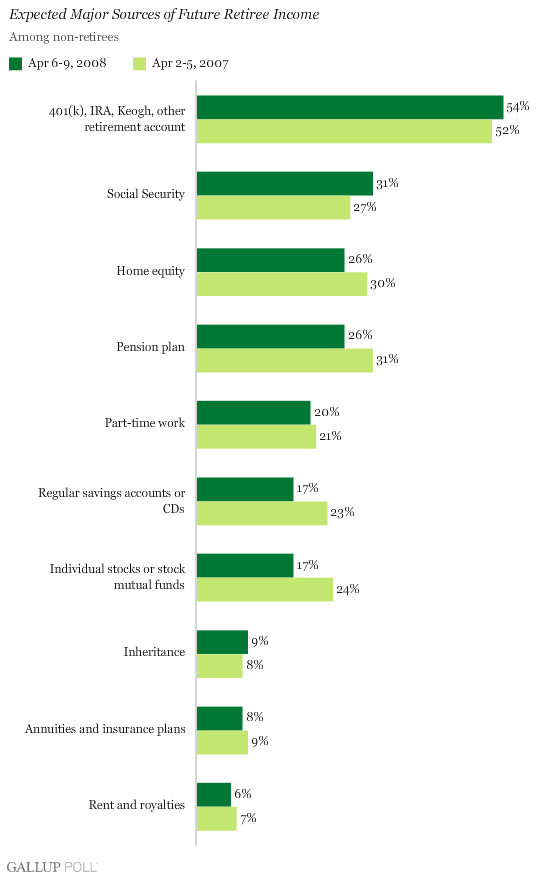
But, the vast majority are still in the ‘work for 40 years and hope to have saved enough’ mindset … and they have worries of their own, as this recent Gallup Poll showed:

Of course, recent economic woes are probably ‘skewing’ this a little … but, think about it – most aren’t retiring tomorrow, or even in the next 10 years, so markets will have plenty of time to boom and bust again for them.

No, the problem is more endemic: most people simply don’t think that they will be able to retire happy or comfortably – and certainly not wealthy – despite the ‘formidable’ array of ‘retirement weapons’ at their disposal:

So, if the majority of people are using these tools and the majority of people believe that they won’t work for them …

Whatup?!

Surely, at some level, these people know that these tools – as I have been hammering home in this blog for some months now – simply won’t do the job?!

Let’s take a look:

1. 401k’s – High fees; low returns; lousy investment products on offer:

STRIKE 1 – I have never had a 401k and I have no idea what is even in any of my tax-advantaged / retirement accounts.

2. Social Security – An unfunded program; USA in the highest level of debt in history’ what’s the chances of Social Security being around in the same form when YOU retire?:

STRIKE 2 – When my social security statement arrives I chuck it in the trash without reading it, it’s irrelevant, it won’t be around when I retire, and I had this same line of thinking BEFORE I became rich.

3. Home Equity – Please! Where do you intend to live when you retire? By the time you buy and pay changeover costs etc. if you see any spare cash, it may be just about enough to pay off your remaining credit card debt:

STRIKE 3 – I live in my home equity, don’t you?

4. Pension Plan – Do you work for Ford/GM/Chrylser? Any airline? Just about any bank?:

STRIKE 4 [AJC: 4 strikes???!!! I’m an Aussie, what do I know from baseball?] Ditto to the above, in fact, I have never subscribed to an employer-sponsored pension plan, even where I have had the choice.

… need I go on?

The point is, if you know these tools aren’t going to work for you – as the majority of Americans surveyed by Gallup seem to – yet you keep using them – as the majority of Americans do – isn’t that the very definition of ‘insanity’?

Now, that’s a question that I would love to see the Gallup Survey for!?

Merry Chrismas?!

Why am I posting a really nice Christmas video on January 25th?!!

Well, it’s simply to make a point …

… it doesn’t matter how late you start, but how well you execute that counts.

Just ask Ray Kroc (McDonalds), ‘Colonel’ Sanders (KFC), my father (who started a business at the age of 60), and (hopefully, soon) our very own Lee Martin …. old is the new young 🙂

7Million7Years is One Year Old today!

1st-bday-first-birthday-bri

Well, we’ve reached a Milestone …

7Million7Years.com is officially ONE YEAR OLD … now, that’s a lot of posts! I hope that some have been useful?

To celebrate, I am running my first ever competition:

It’s easy, all you need to do is write your most pressing, interesting, or “I’m just plain curious” personal finance question in the Comments section below …

… I will choose at least one winner (maybe more, if I am blown away by the responses) and eventually publish answers to all of the rest.

The winner/s will receive a personal finance book of my choice (I may choose a book that I think will be relevant to their question, or one of my favorites … who knows?!).

So, don’t waste another moment: write your question in the Comments below (make sure that you signed in with your e-mail address, so that I can let you know if you’ve won … no need to include it with your answer, though).

A cracked pair of spectacles …

My ‘problem’ is that I seem to see everything as through a pair of glasses that somebody has stepped on – cracking the thick glass lenses, but not quite breaking them; case in point – Rick says:

Consider two cases in the first you rebalance in the second you don’t:

Rebalancing:

Stocks Bonds Total Comment
50K 50K 100K Initial conditions
25K 50K 75K right after market crash
37.5K 37.5K 75K After rebalancing
75K 37.5K 112.5K Right after market recovery
56.25K 56.25K 112.5K After rebalancing

No Rebalancing:

Stocks Bonds Total Comment
50K 50K 100K Initial conditions
25K 50K 75K right after market crash
50K 50K 100K Right after market recovery

Note rebalancing earned an extra $12.5K over doing nothing, it doesn’t compare to perfect market timing but there was no crystal ball required! Jeff pointed out rebalancing maintains the risk level. Was it less risky to hold half stocks half bonds? Yes, in the 50% market crash there was only 25K in losses rather than a 50K loss.

What if the order was different?

Rebalancing:
Stocks Bonds Total Comment
50K 50K 100K Initial conditions
75K 50K 125K Market rises 50%
62.5K 62.5K 125K Rebalance
31.25K 62.5K 93.75K Market drops 50%
46.9K 46.9K 125K Rebalance

No Rebalancing:
Stocks Bonds Total Comment
50K 50K 100K Initial conditions
75K 50K 125K Market rises 50%
37.5K 50K 87.5K Market drops 50%

Again rebalancing helps prevent losses over doing nothing. If you are invested in more than one asset class you should rebalance. We all know that there is no such thing as a free lunch though… What is the down side?

By allocating 50% bonds 50% stocks you only get half the superior stock returns if the market is steadily going up. Rebalancing reduces risk at the cost of returns in the good years. The good years actually do outnumber the bad, even though it doesn’t seem like it right now! If you can withstand the risk you should keep a large percentage in stocks. I’m young enough that I don’t have a large % of bonds- and it sucks to take the full losses. However, I’m willing to risk it now for the full gains and I’m glad I get to buy shares at a steep discount now. As I get older I will be increasing the % of bonds that I hold and will be rebalancing.

I ‘read’ the numbers, but I ‘see’ something totally different … something that Rick sees too, because he covers it in his closing comments:

The problem with ‘numbers’ is that they don’t reflect real life.

The market changes: it doesn’t reverse then recover with all ‘vital signs’ the same as they were before!

So, you are in constant ‘motion’ as bonds go up one day, stocks down the next (with sub-moves within the markets such that overseas funds are up and US funds down), and so on ….

Before we do any of this, we need to revisit our objective … why are we doing all of this in the first place?

You see, the key ‘number’ is in fact your Number and if moving half your net worth into Bonds to ‘avoid risk’ stops you from achieving your Number, why do it at all?

A simpler solution is to be 100% invested in stocks (or a suitable alternative) and hold for the long-term.

Warren Buffett is … George Soros is … I am [AJC: Well, almost 100% in real-estate with cash on the sidelines waiting for the next ‘deals’ to come along … although, I will also put some in stocks and ventures ‘for fun’].

Why?

When studies like the Dalbar Study show 11.9% 20 year returns, and others show absolutely NO 30 year periods EVER with less than an 8% compounded return in the stock market, why would you do anything else?

Of course, if your expertise is in real-estate, buying businesses, or Egyptian artifacts, I am sure that similar studies can show their benefits over 15 – 30 years, as well …

… the key is to find something that produces income that:

1. Tends to rise with inflation, and

2. You can leverage (borrow) to buy into

That way, if inflation is > 0% (as it surely will over 20 to 30 years), your return increases disproportionately (in YOUR favor, assuming that your income from the investment eventually covers your mortgage and other holding costs).

A closing note:

If rebalancing is the right thing to do, why is Warren Buffett – who was previously invested 100% in bonds – for the first time in 40+ years of investing, moving his entire personal net worth into the stock market right now?

The answer, of course, is simple: he sees that American Business is extremely undervalued right now … and, is happy to ‘rebalance’ his portfolio 100% away from bonds and 100% to stocks.

This is not really rebalancing at all: this is putting your money where the best value (hence, best long-term returns) are to be found.

A little off the top, please …

What do you do if, like ALL of the original 100+ serious applicants for my ‘grand experiment‘, your Number is in the millions?

That means that saving anything less than 50% of your salary over anything less than 20 years is unlikely to get you there?

As I mentioned in a previous post: in the world of money, the ‘momentum’ that we build up comes from the power of compounding; just take a look at how $1,000 compounds over 30 years (@ 10% p.a.represented by the blue part of the graph, below) … more importantly, look at what happens if we start just 10 years later (represented by the red part of the graph):

mountain11

we can get to the same end point, but only by increasing our annual compound growth rate by  a hefty 55% (i.e. to 15.5% p.a.).

That difference in compound growth rates could literally ‘force’ you out of nice, safe, easy Index Funds into making scary, difficult investments in individual stocks.

Or, if your Number / Date combination is much Larger / Sooner, it may even ‘force’ you into investing in real-estate, small businesses/franchises, or even into starting your own high-growth businesses!

Which is fine for some …

So, you could just ‘go for it’ anyway … as I’ve said before massive passion drives massive action, which produces massive results …. maybe.

But, what if you’re the more rational (sane?) type? How do you come up with a more reasonable target?

I see two ways – and, I have posts for you to read on both of these … just follow the links, below:

1. Reduce your Number: http://7m7y.com/2008/11/14/my-mountains-too-steep-part-1/

2. Extend your Date: http://7m7y.com/2008/11/15/my-mountains-too-steep-part-2/

Seems obvious and easy, right?

Well, the ‘cost’ is in delaying and/or reducing your expectations for how you really want to live your Life … so, you want to consider ALL of your options, VERY carefully … fortunately, the financial-self-discovery process itself is not difficult ….

Food for thought?

The Risk / Happiness trade-off …

moneyhappinessThis kind of follows on from the Cash Cascade, which was a recent post about paying off debt:

Part of the decision-making process around paying down debt revolves around what you would choose to invest that money in, instead …

… and, that depends – at least in part – on your appetite for risk.

A while ago, I discussed the difference between what I call ‘technical risk’ and ‘absolute risk’ and Jeff (our resident ‘risk manager’) asks:

Ultimately, I just want to figure out how to calculate (take into consideration) the additional risk–or variance in outcome–that leveraging adds to an investment, so can make educated investment decisions.

It’s easy, Jeff: just attribute a risk % to each investment category based upon your perception of the various factors and multiply the expected return by that factor.

Or, you can try using the Standard deviation, and model thus:

r(V) = {V^2} – {V}^2 where curly braces represent average values. For compound returns:
r(V) = {N1^2}*{N2^2}*…*{Nn^2} – {N1}^2*{N2}^2*…*{Nn}^2

Now we can again use the definition {Ni^2} = v(Ni) + {Ni}^2 to get

r(V) = (r(N1) + {N1}^2)(v(N2) + {Nn}^2)…(v(Ni) + {Ni}^2) – {N1}^2*{N2}^2*…*{Nn}^2

Or, you can simply do what I suggest which is work backwards:

1. Decide WHY you need the money

2. Decide WHEN you need the money

3. Decide HOW MUCH money you need

4. Calculate the required Compound Growth Rate to go from where you are today to where you want to be

5. Decide if you can ‘stomach’ the inherent risks involved in the investment methods required to achieve that required compound growth rate

… if not, then go back to 1. and downgrade your expectations for happiness.

Advice for a small investor …

Glossary asks:

With limited funds at ones disposal, say in the 10K to 40K range, what are the arguments for and against buying outright low price stocks to accumulate more shares than would be possible with higher priced stocks. Or, alternately, of using call or put options to purchase stocks of any share price?

To which the ‘common wisdom’ response was:

Whether you are a “big investor” or a “small investor” doesn’t matter as much as you think, IMHO. Nobody likes to lose their money. Everybody needs the same general principles when it comes to investing.

Figure out your risk tolerance. The market is volatile. If your investment drops 10% will you be up nights puking your guts out into the porcelin throne?

Never put all your eggs in one basket. This means only 2%-4% in any one investment AND make your individual investments in different types of investments such as large cap value and medium cap growth.

But, you know my take on this by now: if you diversify your investments, then expect to get ‘market returns’ or less …

LESS to the extent of fees and the losses that you can expect from mis-timing the market … which the Dalbar Study shows will be often and the cost of these mistakes will be very, very, expensive:

Fees: Of these, the fees are the reason why even the most disciplined investors (even 75% of Mutual Funds) perform worse than the market.

Market Timing: But, it is the second – the market timing risks – that mostly affect smaller/individual investors: it’s the reason why the Dalbar Study found that during a long period where the S&P 500 grew at an average rate of 11.9% ‘smaller investors’ only managed a paltry 3.9% return … they would have been better off in CD’s!

So, here is my suggestion:

A. If you want ‘passive investments’ and are satisfied with market returns (circa 9% AFTER inflation … current market aside) then plonk your money in a low-cost S&P 500 Index Fund and let it sit until you retire … add to this investment as much and as often as you can.

OR

B. If you want (need?) ‘above average’ market returns – and, are prepared to ‘gamble while you learn’ (the price of an investment education) – then pick an investment that you can study up on and DO NOT diversify into that asset class; instead, put all of your eggs into no more than 4 or 5 baskets (i.e. stocks and/or real-estate holdings) … but, recognize that you ARE gambling-while-learning, so that you can get the higher returns that you crave.

OR

C. If B. is not for you – or it simply doesn’t work out for you when you are still only ‘gambling’ with small amounts, then it’s not for you at all! Quit while you are not too far behind and then refer to A.

That’s it! 🙂

Money Makes the World Go Around …

It’s sad, but true … it seems that money does make the world go around.

It’s what seems to drive people to make – lose then make – lose … and, so on … their money. It becomes an end rather than merely a means.

But, I have a slightly different view:

1. FIRST decide WHY you need the money … I call this Understanding Your Life’s Purpose

2. THEN decide HOW MUCH money you need in order to do whatever it is that you need the money for (and, by WHEN) … I call this Calculating Your Number

3. FINALLY, when you DO get to your Number, STOP and LIVE YOUR LIFE.