

Good spam or bad spam? You decide …

spamLike you, I receive a lot of spam … fortunately Google’s g-mail picks most of it up and automatically dumps it into the ‘trash’ folder for me.

Most of the spam that I receive is of the “congratulations you have won the Dutch lottery” or the “Mr Nagambi, a senior official in the Uganda government needs your help” varieties. It seems that most spammers are happy with my current vitality and physical dimensions 😉

The problem is, this kind of spam receives no attention, because it takes more than it gives: “give me your credit card number and I will give you some purple tablets” [AJC: either that, or steal your money … spam ‘n scam!].

Good marketing, whilst often bordering on spam (be very careful not to cross the line, though!) gives in order to get: this could be free products (i.e. give me your e-mail address and I will send you my free report … followed by 7 carefully worded and timed sales letters), or simply some free information, like this unsolicited e-mail that I recently received:

Hi Adrian,

Only 43% of consumers will cut back on holiday spending this year, compared to 55% in 2008, according to a Consumer Federation of America survey. While increased consumer optimism spells good news for retailers, for Americans planning to “stretch” the budget, the New Year could bring falling credit scores, and with it, serious consequences.

Here are some fail-safe tips from FICO Credit Guru Shon Dellinger to help enthusiastic shoppers stay financially sound:

1. Be Smart with Credit. Using a credit card is ok – experts agree having 3-5 credit cards helps your credit, if used responsibly. But carrying a balance on your credit card leaves you (1) stuck paying interest that could cost you, in some cases, double or triple the cost of those gifts in the long run and (2) with a much lower credit score, which could jack up interest rates on your credit cards and jeopardize your chance of getting lines of credit elsewhere (buying a house, a car, etc.). Services like FICO Score Watch combat this by providing emails or texts alerting you to any changes in your FICO score (either positive or negative), and notifying you when you’ve qualified for a better interest rate. A credit score increase of 30 points will save the average consumer $105 per year.

For more information on FICO Score Watch, go to: www.myfico.com/Products/ScoreWatch/Description.aspx.

2. Resist “Short Savings.” The salesperson at your favorite department store offers you an instant 20% savings just for opening up a credit card in their name. While that $20 seems tempting at the time, it can quickly put you in debt if you’re not careful. The temptation of the deal is also one reason why the average consumer has a total of 13 credit cards. Opening new lines of credit can also hurt your credit score, so make sure the card meets your overall needs and not just your desire for quick savings.

3. Don’t Wait Till April! Many holiday shoppers use their Tax refund to pay off credit card balances left over from the holidays, which can be incredibly expensive, not to mention detrimental to your credit standing. A credit card balance of $500 dollars from January until April will cost you $237 dollars based on today’s average credit card interest rate.

Please let me know if you are interested in speaking with FICO credit guru Shon Dellinger about these credit saving holiday tips and what else consumers can do this year to assure that their 2011 New Year’s resolution isn’t fixing the damage they did to their credit in 2010. Also, the myFICO Forums can offer your readers helpful tips.

Cheers,

Ashley Kleinstein

Access PR for FICO

Now, I didn’t mind receiving this e-mail because it seems to offer useful information and isn’t directly asking for a sale, although I only gave it a cursory scan because my FICO score is just fine [AJC: and, thank you very much for asking 🙂 ].

Also, I know why this was sent to me: since it was sent under a PR agency’s moniker and I am a blogger, I surmise that they are really hoping that I (or the other personal finance ‘media’ people out there) will publish their content as an article [AJC: as I have ‘cleverly’ done here …. for all you new and aspiring bloggers out there, see how I just lifted some random content and made a post out of it? 😛 ]

What do you think? Is this an automatic delete? If you are not vehemently opposed to it, how would you improve the e-mail?

[Hint: I would present it as a free sample of an online newsletter and ‘click here if you would like to continue receiving it monthly …. usual price $79 for a year’s subscription, but free to you and no credit card required!’ to make it seem valuable]

I want to sell my business …

sell_a_businessA week or two ago, a reader – who shall remain nameless as they are currently in negotiations – asked for some advice on selling their business:

I have a software company with a new proprietary software technology.  The company is considered for buyout due to the new technology (currently there are no revenues and no debt). The projected total revenues over the next three years is $1.55m (First year: $0.15m, 2nd year $0.4m & Third year: $1m) and total over six years is $4.55m (with 4th, 5th, 6th years at $1m each). What is the right valuation for this company if the company were to be acquired now.

This is a common request that I receive and I always have a soft spot for entrepreneurs, having been down this path a number of times, and I will give you some guidelines in a future post …

… but, in this case Mr X (as I will refer to him) has NO business to sell right now, so the usual formulas simply won’t work!

Why no business?

Well, as Mr X admits, the company has “no revenues” right now: no revenues, no business … no business, no business valuation.

But, Mr X does have a new proprietary software technology; apparently, one that at least one major company wants to acquire.

So, the first step is to recognize that we are selling a product (the “proprietary” rights to a new software technology), but we first need to find out what it would cost to duplicate the technology.

Mr X says: “4-6 months with 2 people on the job”

That puts a ‘lowball price’ on the software of $20k to $100k depending upon whether it is developed onshore or offshore.

Now, that’s assuming that it can be duplicated, but Mr X assures me that it cannot:

All major companies in this area have been trying to figure out an equivalent technology for the last 5-6 years or so, but with no success.

Given that Mr X’s software can’t be copied (6+ years development effort, with NO guarantee of success), then his company is worth whatever he can negotiate 🙂

Since he wanted a better estimate of potential selling price than that, I told him that it’s time to look at potential revenue, which Mr X projects over the next three years as: $1.55m (First year: $0.15m, 2nd year $0.4m & 3rd year: $1m).

If the company generates < $1 mill per year over the next three years, then I think that Mr X would be struggling to get $500k – $1 mill. for it …

… if he is offered less – and, he probably will be as the market is quite small for any major corporate (at the numbers provided above) then, if it were my software, I would be tempted to go ahead and get those revenues for myself then sell in 18 months to 3 years time.

Here’s my reasoning:

1. Development effort on Mr X’s side is tiny, but he feels strongly that his technology can’t be easily copied,

2. Mr X has a market that he feels can generate revenues of, say $1.5m+ over three years (discounted to today’s value), which are relatively small numbers for any substantive corporation.

In fact, if Mr X is offered more that that $500k to $1 mill. that I suggested, it will probably be as a result of a combination of how badly one of these companies wants (needs?) his technology and how big THEY think the market will be for them.

That’s why the next step, if Mr X hasn’t already done so, is to assess what revenues the purchaser believes they can make over the same period (better marketing/sales than Mr X?); better yet, what profitability.

If he doesn’t already have a good feel for these numbers, then he will need to try and get close to somebody on the inside of the company and carefully ask them …

… after all, the price that you set should always be as close to whatever the company that you are hoping to sell to can make, minus a fair margin for their trouble. Anything less, and you are being a little too generous 😉

The Myth of Control …

MaggieSimpsonDriving

There are so many myths holding us back from making significant chunks of money – the sort of money that can carry you from $30k in debt to $7 million in the bank in just 7 years – that I feel that it is my solemn duty to break as many of them as possible …

But, why do these myths exist?

I think for two reasons:

1. They may work for the lower required annual compound growth rates i.e. smaller Numbers / later Dates that most personal finance bloggers and authors have personally experienced,

2. People propagate ideas put forward by one author until they become The Truth.

In other words, some of these ‘common wisdom’ personal finance – and, business – truisms are simply aimed at an audience who doesn’t need to get rich(er) quick(er) … and, following those ‘rules’ will ensure that they get exactly what they aim for: 40 years of hard work, followed by a ‘frugal retirement’ 😉

So it is for the myth of business control:

People start their business with the idea that they either have 100% ownership – or, perhaps a 50/50 founding partner – from Day 1 and fervently believe that they will retain this mythical ‘control’ over their business (hence their life) as long at they hold on to at least 51% of their business …

… and, if they should need some outside investment – in their minds, at least – it’s critical that they give away less than 50% of the equity in their company.

Steve voices this point of view very clearly:

You give up 51 % control and who is to say you will make any money at all?? the new controlling owners could eventually throw you to the street.I’ve seen that happen a few times.

Personally, if there is no other options than to go for outside investors to move forward, your better off not giving up any more than 20 to 30% control ever.

First let me break a little myth in this blog … the ‘myth’ that I think that it’s a good idea to hand over a chunk of your company to an investor … nothing could be further from the truth:

I believe (and, have stated) – that you need to have a VERY good reason to give ANY equity away (for reasons that I explained in Decision Point # 1 in this post).

But, once you have crossed that line – and, have exhausted Friends/Family/Fools who may invest token amounts for token equity (i.e. that 20% – 30% that Steve talks about) – you will find that control goes with the money NO MATTER WHAT THE NOMINAL % MAY BE that you agree to hand over (and, THE INVESTOR will decide that %, not you!) …

… if you don’t like the deal, then you will have to make do without the money.

Simple!

The tool that your investor will rely on is the Shareholders Agreement, where they will make sure that critical decisions (eg hiring/firing; purchases over – say – $10k; new capital raisings; etc.), at a bare minimum, will require unanimous approval of the board … naturally, the outside shareholders will expect to have a seat on that board.

So, at a minimum, a smart minority shareholder will effectively hold the power of veto over your business … and, the Shareholder’s Agreement allows plenty of scope to even provide them with effective control over the business, regardless of their shareholding (be it 20% or 80%).

BUT, and I stress this, as I said to Steve:

There are no hard and fast rules: feel free to find the ‘fool’ who will invest a significant amount without the ability to put you on the street if you don’t perform 😉

Is the shark’s bite worse than its bark?

Offer

I was really impressed with the quality of our readers’ analysis of last week’s video post (from ABC’s excellent show, the Shark Tank, which is about a group of entrepreneurs who listen to various pitches before deciding whether to invest their own money), so I thought that I should do this follow-up piece, while the video is still reasonably fresh in our minds.

In case you didn’t see the video, or need a refresher, here is the link: http://7million7years.com/2009/11/12/take-the-money-and-run/

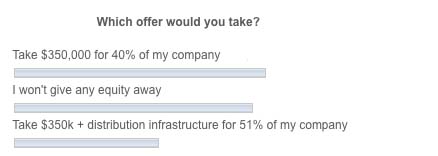
The reader poll shows that people are reasonably split between not giving any equity away at all, or giving away a minority … fewer still wanted to give away a controlling interest.

So, who is right? More importantly, what did the girls decide?

I once told you that most business decisions are made emotionally and justified rationally later, and I believe that this is a classic case of that, but more on that later … for now, let’s simplify this seemingly complex decision (competing offers of $350k then $500k then back to $350k again, against equity of 40% to 65% then back to 51%) into two sets of binary decisions:

Decision Point # 1: To give away equity or not to give away equity, that is the question?!

Rick Francis makes the ‘no equity’ argument quite well:

I wouldn’t have given the equity away- it sounded as if they didn’t really NEED the 350K to keep their business going. They have some big customers and are getting repeat orders. They want the $ for marketing, $350K will NOT make them a household word, and I doubt it would dramatically increase their sales. Their product is in major hotel chains THAT can be their main marketing. They could use the internet to make very targeted ads for a small fraction of $350K which they should be able to do as an operating expense.

And, in a strange twist, Scott actually helps to illustrate the reverse argument:

I wouldn’t give an ounce of equity away on this. You could read the sharks from the first 30 seconds that they were salivating over this. Even if it took me 5-6 more years to reinvest every penny I could into marketing and if I had to do everything I could to tell the world about that idea, including trying to land a spot on Oprah

You see, I think the equity / no equity decision boils down to time … without the Sharks’ help, can you get your business to the point where it will deliver your Number by your Date? If not, then with the Sharks’ help, can you reach your Number/Date?

That extra 5 to 6 years that Scott is talking about could be a killer … not to mention, the longer you wait the more chance there is of stronger competition raining on your parade.

That would be the driving force for the equity / no equity decision for me; while I would prefer to keep 100% of the equity (and control), do I need to compromise in order to win the main game, which is being able to finally live my Life’s Purpose within a reasonable period of time?

At least, that’s how I would look at it …

Decision Point # 2: How much of my soul do I sell?!

Once you’ve decided to sell (part of) your soul to the devil … or, in this case part of your company to the Sharks, it becomes a matter of how much to sell, and here, the trend is clear: our readers want to give away a minority stake. WJ was clear and succinct on this:

I would give away equity only to the point of still being in control.

Whereas, Trainee Investor sees both sides:

Either I would only give away minority equity on terms that left me with control and relatively limited fetters on my ability to run the company OR the investor would have to provide something more than just a monetary investment (such as the ability to significantly expand distribution in a manner which would otherwise have been beyond me).

Here’s how I look at it: the girls – in this case – reached decision point # 1 by deciding that they did wish to give away some equity in return for some benefit (cash and expertise/guidance from the Sharks), otherwise they would not be on the show.

So, now they need to decide what to give away and how much … and, this boils down to simple mathematics.

But, “wait” you say “surely you can’t give away control?”

And, I say: “you already have”

You see, as soon as you sign the shareholder’s agreement, you will find that your control over the company is no longer entirely yours, no matter what equity you still hold: 1% or 99%.

The shareholder’s agreement will be full of “by unanimous decision of the board”, and you can be sure that the Shark sits on that board!

I know, because I have been a 51% joint venture partner and a 40% joint venture partner and it made not an iota of difference … I still had a similar lack of effective control in both cases …

… I have even been a 100% owner and my clients and bankers still held the real control over my company. But, does it really matter all that much? Aren’t we all interested in making the company a success?!

‘Control’ is not all its cracked up to be 😉

So, if you are giving away control – and you will, trust me – just by entering into an agreement with an outside investor, then its time to start looking at what you get. In this case:

– $350k for 40% equity + Barbara’s guidance, OR

– $350k for 40% equity + finance/distribution/administration support for 11% equity + the guidance of 3 mega-millionaires.

To me the decision isn’t even close: once you’ve decided that 40% of your company is worth $350k then tell me where you can buy a complete operational and administrative infrastructure for your business (not to mention close a guaranteed line of funding) for less than 11% / 40% x $350k = $100k?

Folks, it’s the bargain of the century, but you have to be a Shark to see it 😉

BTW: remember that ’emotional v rational’ thing that I mentioned towards the beginning of this post? Instead of the simple math that I would have used to make the correct choice, Luis summed up exactly how they made their emotional choice:

Unbelievable! They made their decision on “I really like Barbara, like I really like her”. Barbara read them right “You got spunk” and at the end “…you are going to be happy”.

Unbelievable, indeed!

Take the money and run!

Which offer would you take?

View Results

Loading ... Loading ...

Watch this video – remember, these are real investors, preparing to invest their OWN MONEY if the right idea(s) comes along – then answer the poll (and, please make a comment if you can … it would be great to be able to share WHY you feel that way):

How to become an expert in your chosen field!

expert_1

Last week I suggested that a great way to compete against your larger, more established competition (particularly if you are a small business trying to sell products or services to larger businesses) is to become an expert in your chosen field.

Problem: Your LITTLE COMPANY cannot hope to be able to compete on even footing with the BIG CORPORATIONS you will most likely be facing off against.

Solution: You change the game: you make it about PEOPLE … better yet, you make each person at each corporation compete with YOU, rather than your company competing with theirs!

Implementation: You make being small/unique an advantage … YOU become the expert that your clients will want to come to for advice [read: products and services]. Forget the advertising, forget the telemarketing, forget the doors slammed in your face.

Becoming an expert is something that I am quite ‘expert’ in having done it 2.5 [twice and a bit] times already 🙂

So, let me tell you how I did it:

1. The first time that I became an expert was when I was working my first Big Corporate Job, straight out of college …

I was asked to work with a guy who was doing an assignment with one of the national banks to help them do some forecasting; at first I balked because the technique that he was using seemed rather technical, and I hate anything detailed/technical. As it turns out, this character flaw became one of my greatest assets.

You see, I came across a little-known-even-less-used Canadian technique that used simple rules-of-thumb to replace the laborious detailed calculations of the more commonly used method that I was busy – under quiet sufferance – learning.

What I found, though, were three things that really excited the clients:

i. The Canadian method could be explained easily to the business people who were making the decisions based on the forecasts, and

ii. The forecast results lent themselves to pretty graphs and pictures, again favored by the ‘business leaders’ over the detailed tables produced by the more common method,

iii. It had a fancy name (not dissimilar to the type of name in the graphic at the top of this page) with a cute acronym.

… oh, and two fantastic advantages for me:

a) Only I had the keys to this ‘new car’, and

b) it was quick and easy for me to both understand and implement.

Bingo!

Instant expert … not bad for a guy with a little over two years’ industry knowledge competing with guys who had been doing this stuff for 20 years.

Who do you think got the ‘big bucks’? 😉

2. The second time that I became an ‘expert’ – this time in a totally different field – was when I got the idea to start my second business (the one that I eventually sold: employing well over 100 people, with operations in Australia, New Zealand, the USA and with consulting contracts all over the world) …

The first thing that I realized was that if I came up with the idea in Australia, it must exist in other parts of the world, since I’m really not that bright 🙂

And, if it exists in other parts of the world, then where more likely than the USA?

So, I scheduled a reconnaissance mission to the States and happened on the head office of the oldest – and, most respected – such company in Philadelphia … and, the owner welcomed me with open arms!

So, not only did I walk away with a business plan and operational model, but I had some key statistics for the USA market that would help me examine the business need in Australia, when I got back.

The first thing that I did – now, this is the real advantage of a college education [AJC: which, you now don’t need, because you just need to hire a smart college intern and tell her to do everything for you that I write in the next paragraph] – was to:

a) Reproduce the Market Intelligence report for the Australian market: even though I didn’t know anything about the business that I was getting into, neither did anybody else in Australia because I was the first. But, I didn’t need to know anything, because I just found somebody who did and copied them [AJC: of course, in your market, you may need to hire such a person, or go overseas and model an existing business as I did, or … any ideas from our readers?]

b) So, all I had to do was find some key industry stats and ‘guesstimates’ (hey, if I didn’t have an exact answer … nobody else did either!) and crunch the report with Australian numbers and dollars. This turned out to be easier than I thought.

c) Then I wrote a neat little Press Release – this was before they became known as Media Releases – [AJC: want to know how to write a press release? Try google, again!], and

d) Sent it out – along with a copy of my 6-page report – to some media guys whom I thought might be interested … this was easy: I just bought a few ‘trade’ magazines in the subject areas that I was interested in and found the right guys in the table of contents page … you could, of course, buy a media guide that lists all of that stuff, if you like [hint: google].

Then I waited, hoping for a tiny mention that I could refer to in business correspondence e.g. “Adrian’s Little Corporation – as featured in You Gotta be Joking Monthly – invites you to ….” to give me that hint of credibility.

Now, a little luck comes in handy, because I received a phone call from the first guy that I sent it to – who wrote for Australia’s equivalent of Forbe’s magazine – who told me that he was interested in my report, asked me a few questions, then asked when I’d be available for photographs.

Photos!?

Now I’m thinking a little thumbnail, and a quote!

Well, I was blown over when a few weeks later the magazine hit the newsstands and I saw that I had received a full page write-up – plus big photo – full of “Cartwood, Australia’s leading expert says ….”

Instant expert … again!

Now, I’m not suggesting that my phones rang off the hook; in fact, they didn’t ring at all …. but, this was not a sales/marketing exercise, it was a credibility -building exercise.

As a result of this simple process, two great things happened:

i) I asked for (and the magazine was kind enough to send me) a box of overruns: extra copies of the magazine that they may normally pulp – and, if they didn’t want to give them to me, well, what was a couple of hundred bucks to buy as many as I could lay my hands on? I used these as ‘business cards’ to give potential prospects, either to get – or, to kick-off the first meeting; these were highly effective ‘credibility builders’! I also ordered a whole stack of reprints of the article, which I used as my main ‘marketing brochure’ for years. Double the credibility, half the cost of a slick brochure 😉

ii) This is where luck steps in (everything prior to this positions you to make your own luck): a lady who runs a college-certified ‘for profit’ course recognized (from the photo in the magazine) me at a trade show and asked me to develop a one day course on the subject area of that article. I was paid $1,000 a day (plus travel expenses) to put myself in front of a captive audience of my best possible sales prospects … and, from this very course came my first 5 clients.

[AJC: Imagine being paid to sell your own product to clients who pay to hear your ‘pitch’!? Now, this is probably a subject for another post, but people ask: “why did you teach your secrets to clients?”. The answer is simple” you can teach people all you like, but the real secret is in the implementation … people would much rather BUY than DO. I have found that the more you give away, the more that comes back to you]

BTW: Now, do you see how important it is to try and polish your ‘public speaking’ skills as much as you are able?

3. Finally, it was a pleasure to be able to embark on the process of reinventing myself as an expert in a third field, this time one in which I actually had put in the ‘hard yards’ to learn as much about through personal experience before becoming ‘the expert’ rather than after 🙂

Of course, I’m talking about what I’m doing now: personal finance … specifically, how to get rich(er) quick(er), a subject in which I (humbly!) think I am expert in and one of very few, if not the only speaker of any genuine credibility, having achieved what I teach about before writing the books and getting the fat speaking contract.

Since this one is a work in progress, and more of a vague directional feeling than a solid strategy, I will outline for you roughly the steps as I think they may unfold:

Step 1: Write a blog (a) to get my ideas into the market, give them some ‘air’, and see what works from a literary sense, and (b) get some sort of audience/exposure,

Step 2: If I am lucky, get noticed by some producer, publisher, news or magazine editor and be given the type of opportunity that gets my message out to a large national/global audience,

Step 3: Write a book and (a) find an agent/publisher or (b) self-publish

Step 4: See Step 2!

Step 5: Write another book

Step 6: See Step 4!

Step 7: See Step 5!

If I needed the money, I might organize my own speaking engagements and spend more time wooing the ‘traditional media’, instead of relying on Step 2. But, I don’t so I won’t 🙂

And, if I am ‘unlucky’, I’ll keep going with Steps 1., 3., 5., and 7. for as long as you and I keep enjoying it!

Can you ‘small ball’ your way to wealth?

JA-101Mitch suggests that while you are waiting for the “landmark victory … i.e. a four-bagger, a game changer … one that propels your business to a new level” you should play a little ‘small-ball’ with your business:

Small ball for me is the ability to deliver small but meaningful enhancements to your business in succession and continually.

A 2% improvement here, a 1% improvement there and a 4% pick up in efficiency here – those small bits can really add up.  If you stopped to think about how you can deliver a 10% or a 20% improvement in your business it could be a struggle.  Or you might have a few good ideas, but the resources to get there may be out of reach.

Instead, if you thought about how you could improve your business by 1% or 2% you’d likely come up with a bunch of practical, implementable ideas.  And the good news is if you string those wins together you get your 10-20%!  Even better, if you keep doing it you’ll go way beyond.

Thinking back, I can’t really recall if I was a ‘small-ball’ type of business person … perhaps I was, but  just called it ‘business as usual’, which is what I guess it should be … in fact, it’s the small stuff that you should empower your staff to go after (with encouragement, culture, recognition, and incentives) while you, perhaps, focus on the strategic picture (assuming that you have staff … otherwise I guess you’re going to have to do all the small-and-big-ball stuff yourself!).

If I suggested that you needed to find a way to produce a compound growth rate of 33% in your business to help you reach your Number, you might balk …

… but, if I suggested that you look to increase a few key areas by a mere 10%, would you be quite so wary? Probably not.

Jay Abraham, perhaps the greatest (and, most practical!) marketing mind of the modern era, illustrates this perfectly … in this case, by demonstrating the power of cumulative changes in, say, your marketing and sales strategy:

If you had [say] 1,000 active clients, and if you had an average order of $100 for each time they were coming in, if they bought two times a year, that works out to an annual revenue of $200,000.

# of Clients        Transaction Value per Client       Transactions per Year      Total Income
1,000            x                      $100                       x                 2                    =      $200,000

But if all you did was increase those three categories by a mere 10% each…

# of Clients        Transaction Value per Client       Transactions per Year      Total Income
1,100             x                     $110                       x                2.2                  =      $266,200

It would increase your annual revenue to $266,200—a 33% increase!

Now, if you have a ‘normal’ business … one operating profitably, and with a reasonable gross margin (which means, that you have more fixed than variable costs), then I don’t need to tell you that the effect on your bottom line could be much larger than 33% … do I?!

You can now see why this is one of the most powerful business lessons that I ever learned … and, Jay told me via a written document, exactly the same way that I am now telling it to you.

So, If you have a business, don’t waste time; meet with your key staff [AJC: or, yourself 🙂 ] today to look at how you can increase each of:

– The number of clients that you have [sales and prospecting],

– The average order size [upselling and cross-selling],

– The number of times that they buy [repeat-selling and back-end sales].

Simple … effective!

Become an expert in your chosen field …

expert

Recently, I wrote about how important it is to improve your ‘public speaking’ skills, as that skill alone can give you an incredible edge in your business and/or investing life; Jacob asks:

How do you get in front of the large companies in the first place?

Before I answer that question, let me backtrack a little:

This isn’t a blog about how to earn more money in a job or consulting … because those, alone, are unlikely [AJC: for most] to get you to your Number by your Date.

But, as Luis gently reminded me, this is a blog about “how you can make $7 million in 7 years … no scams, no schemes … just good old financial advice!” so I had better be talking to those with large Numbers and soon Dates!

So, why did I choose today’s topic?

Because, you probably want to start a business to really ramp up those  required annual compound growth rates

… the problem is how do you transition from a small fish in a huge sea of competing businesses? Especially, if your business services other businesses (i.e. B2B) … and, particularly if the Fortune 1,000 is your stomping ground …

1. With better sales?

Possible, but unlikely, because Friendly McConglomerate – that multi-billion-dollar-multinational around the corner – already has a sales rep in each state, lunching your best prospects right now!

How do you, on your lonesome – even with the help of your out-of-work brother-in-law (who is ‘busy’ mooching off your limited capital and patience) expect to get to, let alone win over, all of those guys when you simply don’t have the gold Amex cards to splash around like your competitor’s reps?

2. With better marketing?

Hmmm …. you mean those leaflets that you stuck on all of those lampposts around the neighborhoods that you service? I’m sure they will really zing compared to that multi-barreled discount-coupon-backed television, radio, magazine, and letterbox drop campaign that your competitor’s ‘top of the town’ advertising agency cooked up!

3. With a better product?

Whoever it was who said: “build a better mousetrap and they will beat a path to your door” was wrong! A ‘better product’ ONLY works on the back of excellent sales and marketing, so you had better refer back to 1. and 2. above 😉

But, don’t sweat it, even with all their money, your major competitors are not really collaring the market either …

… and, while they’re out there spending money, there is still one way that your B2B business can compete – nay, totally smash – your ham-fisted-big-budgeted corporate competitors; it’s to:

Be seen by your clients – and competitors – as the expert in your chosen field.

You see, your competitors are actually wasting their mega-millions trying to get to – then ineffectively schmooze with – the middle managers who don’t even have the capacity to actually make buying decisions without referring their proposals to the Big Guys Upstairs …

… but, if you are the expert, you are side-stepping this whole time-and-money-wasting ‘sales process’ simply by using your Industry Expert status to:

1. Gain free publicity in the general media and/or trade press that the decision-makers actually see and read, and

2. Virtually demand – and, get – interviews with those same ‘top management’ guys for the clients who actually need and want your product or service, and

3. Present your ‘proposal’ to all the decision makers so that you set the ground rules that your competitors will need to follow.

So, Jacob, the answer to your question about how do you get in front of the large companies is simple: become the expert in your field and all doors will magically open.

Just remember that being ‘the expert’ gets you to the table … it’s then up to you to close the deal.

In an upcoming post, Jacob, I’ll tell you HOW to become an expert in your chosen field, something that I’ve done 2.5 times already!

It’s easier … and, much quicker … than you think 😉

Speech Night!

They say that the most important skill that you can have in your [business] life is to be able to SELL.

And, why shouldn’t it?

– You want to buy a house? You need to shmooze the bank manager … SELL him on why he should give you the loan.

– You want to get married? You’d better woo the spouse-to-be and their parents … SELL them on letting you join their family.

– You want to get a job? You should brush up on your interview skills … SELL them on why you should get the job over all the others applying.

– You want a pay-rise? You had better impress the boss … SELL her on why you – above all others – deserve the promotion.

– You want your start-up to break-even, the maybe make a few bucks profit … who else is going to do the SELLING for you??!!

Unfortunately, I’m actually a terrible salesman, and am very uncomfortable in a one-on-one ‘convince the other guy to give me what I want’ situation.

Luckily, I actually think that the ability to sell is only the second most important [business] skill …

… the first – most important – one came back to me when I attended my daughter’s Speech Night tonight.

In case you’ve never been to one of those, it’s when a bunch of kids each select a random topic and write – then present to their classmates and parents – a 3 minute speech.

Now, I remember the first time that I spoke in public: it was while I was still at college and I was asked to be Best Man at my friend’s wedding; well, all I remember was:

a) I was so nervous that my knees were literally wobbling as I spoke, and

b) I had no idea what to say … I only remember that it was ridiculously schmaltzy like some cheap, drug-store gift card.

I also remember my first ‘real’ work-related speech: it was at a training course for selling, sponsored by the company that hired me straight out of college. I remember that my speech, my delivery, and my materials (overhead transparencies, hand-drawn/colored like some some 5th grader!) were terrible, and my instructors were more than happy to let me know 🙂

The turning point came when – at a later course, after I learned at least SOME presentation skills – I was video-taped giving a practice talk, and (naturally) felt very uncomfortable and unconfident … but, I soldiered on as best I could, resigned to be as embarrassed as usual when I saw the tape.

However, when I was finally shown the tape, the person I saw on the screen was somebody else entirely: he looked relaxed and confident … I couldn’t even see his leg shaking 😛

From that moment on, my career as a ‘public speaker’ was launched!

Realizing that it didn’t matter how I felt that counted, but how my audience perceived me, I rapidly went from strength to strength, actively seeking opportunities to stand up in front of a whiteboard, write-on-wipe-off felt-tip marker in hand.

This, more than any other single skill, accounts for my success in business, investing and Life:

– If I wanted to fund my businesses and investments, I presented my financial plans to my bank manager and his team, careful to fully explain the opportunity and address all of their potential concerns; the presentation format allowed me to be proactive, yet still leave room for additional questions. This allowed me to secure millions of dollars in funding, even when I had absolutely NO assets behind me!

– When I wanted to get married, my real job began at the first family dinner as I carefully presented myself in the best possible light with (sparingly applied!) carefully chosen anecdotes.

– When I wanted a promotion or pay-rise, I made sure that I had a an opportunity to have my boss see me doing something that most people (including him!) are afraid to do: being relaxed, confident, informative, and entertaining in front of an audience. This made me one of the most successful ‘experts’ in my field, within only a couple of years of taking up that particular specialty.

– When I wanted large companies to buy what my company had to sell (and, later, to buy my company), I always came up with a crackerjack presentation that addressed all of their buying considerations (which I had been careful to assess in prior “ask polite questions and listen to what they have to say” meetings); being the only person standing up really allowed me to control the flow of the meeting and helped me to sign multi-million dollar contracts all over the world.

In other words, I let the presentation do the selling, which really took the pressure off me having to perform as a Salesman …

… and, it became clear to me: everybody respects the person standing on the stage.

As for my daughter: she did an awesome, confident speech … as did many of her classmates.

In my opinion, if they keep it up, they will have a flying start in their later business life … and, so will you, if you take the time to learn – and, practice – speaking to an audience.