The definition of insanity …

“Insanity: doing the same thing over and over again and expecting different results.”  Albert Einstein

Thankfully, this blog isn’t for everybody … only those who want to get rich(er) quick(er) … I’ve proved that it can be done successfully, and I am conducting a ‘grand experiment’ at one of my other sites to prove that it’s not just luck and that others can do it, too.

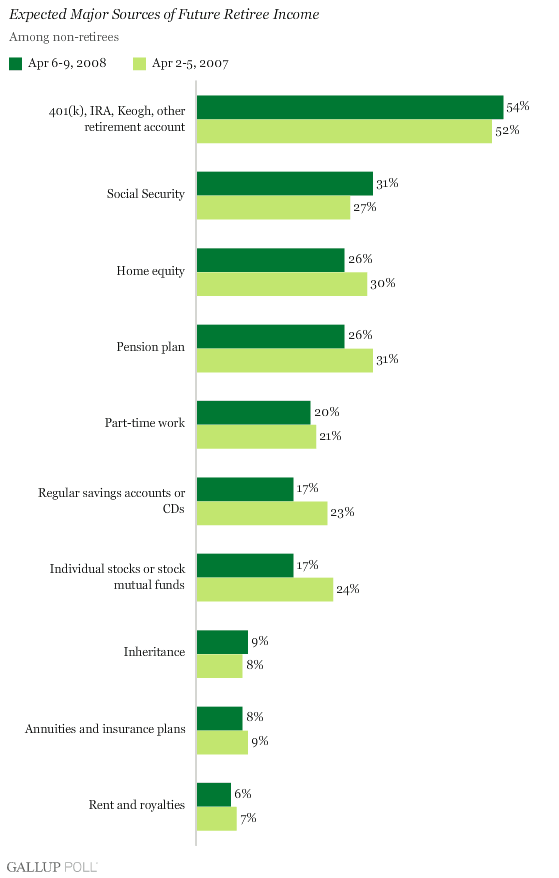
But, the vast majority are still in the ‘work for 40 years and hope to have saved enough’ mindset … and they have worries of their own, as this recent Gallup Poll showed:

Of course, recent economic woes are probably ‘skewing’ this a little … but, think about it – most aren’t retiring tomorrow, or even in the next 10 years, so markets will have plenty of time to boom and bust again for them.

No, the problem is more endemic: most people simply don’t think that they will be able to retire happy or comfortably – and certainly not wealthy – despite the ‘formidable’ array of ‘retirement weapons’ at their disposal:

So, if the majority of people are using these tools and the majority of people believe that they won’t work for them …

Whatup?!

Surely, at some level, these people know that these tools – as I have been hammering home in this blog for some months now – simply won’t do the job?!

Let’s take a look:

1. 401k’s – High fees; low returns; lousy investment products on offer:

STRIKE 1 – I have never had a 401k and I have no idea what is even in any of my tax-advantaged / retirement accounts.

2. Social Security – An unfunded program; USA in the highest level of debt in history’ what’s the chances of Social Security being around in the same form when YOU retire?:

STRIKE 2 – When my social security statement arrives I chuck it in the trash without reading it, it’s irrelevant, it won’t be around when I retire, and I had this same line of thinking BEFORE I became rich.

3. Home Equity – Please! Where do you intend to live when you retire? By the time you buy and pay changeover costs etc. if you see any spare cash, it may be just about enough to pay off your remaining credit card debt:

STRIKE 3 – I live in my home equity, don’t you?

4. Pension Plan – Do you work for Ford/GM/Chrylser? Any airline? Just about any bank?:

STRIKE 4 [AJC: 4 strikes???!!! I’m an Aussie, what do I know from baseball?] Ditto to the above, in fact, I have never subscribed to an employer-sponsored pension plan, even where I have had the choice.

… need I go on?

The point is, if you know these tools aren’t going to work for you – as the majority of Americans surveyed by Gallup seem to – yet you keep using them – as the majority of Americans do – isn’t that the very definition of ‘insanity’?

Now, that’s a question that I would love to see the Gallup Survey for!?

Merry Chrismas?!

Why am I posting a really nice Christmas video on January 25th?!!

Well, it’s simply to make a point …

… it doesn’t matter how late you start, but how well you execute that counts.

Just ask Ray Kroc (McDonalds), ‘Colonel’ Sanders (KFC), my father (who started a business at the age of 60), and (hopefully, soon) our very own Lee Martin …. old is the new young 🙂

Advice for a small investor …

Glossary asks:

With limited funds at ones disposal, say in the 10K to 40K range, what are the arguments for and against buying outright low price stocks to accumulate more shares than would be possible with higher priced stocks. Or, alternately, of using call or put options to purchase stocks of any share price?

To which the ‘common wisdom’ response was:

Whether you are a “big investor” or a “small investor” doesn’t matter as much as you think, IMHO. Nobody likes to lose their money. Everybody needs the same general principles when it comes to investing.

Figure out your risk tolerance. The market is volatile. If your investment drops 10% will you be up nights puking your guts out into the porcelin throne?

Never put all your eggs in one basket. This means only 2%-4% in any one investment AND make your individual investments in different types of investments such as large cap value and medium cap growth.

But, you know my take on this by now: if you diversify your investments, then expect to get ‘market returns’ or less …

LESS to the extent of fees and the losses that you can expect from mis-timing the market … which the Dalbar Study shows will be often and the cost of these mistakes will be very, very, expensive:

Fees: Of these, the fees are the reason why even the most disciplined investors (even 75% of Mutual Funds) perform worse than the market.

Market Timing: But, it is the second – the market timing risks – that mostly affect smaller/individual investors: it’s the reason why the Dalbar Study found that during a long period where the S&P 500 grew at an average rate of 11.9% ‘smaller investors’ only managed a paltry 3.9% return … they would have been better off in CD’s!

So, here is my suggestion:

A. If you want ‘passive investments’ and are satisfied with market returns (circa 9% AFTER inflation … current market aside) then plonk your money in a low-cost S&P 500 Index Fund and let it sit until you retire … add to this investment as much and as often as you can.

OR

B. If you want (need?) ‘above average’ market returns – and, are prepared to ‘gamble while you learn’ (the price of an investment education) – then pick an investment that you can study up on and DO NOT diversify into that asset class; instead, put all of your eggs into no more than 4 or 5 baskets (i.e. stocks and/or real-estate holdings) … but, recognize that you ARE gambling-while-learning, so that you can get the higher returns that you crave.

OR

C. If B. is not for you – or it simply doesn’t work out for you when you are still only ‘gambling’ with small amounts, then it’s not for you at all! Quit while you are not too far behind and then refer to A.

That’s it! 🙂

Money Makes the World Go Around …

It’s sad, but true … it seems that money does make the world go around.

It’s what seems to drive people to make – lose then make – lose … and, so on … their money. It becomes an end rather than merely a means.

But, I have a slightly different view:

1. FIRST decide WHY you need the money … I call this Understanding Your Life’s Purpose

2. THEN decide HOW MUCH money you need in order to do whatever it is that you need the money for (and, by WHEN) … I call this Calculating Your Number

3. FINALLY, when you DO get to your Number, STOP and LIVE YOUR LIFE.

… the fallacy of dividend paying stocks!

billboard2

When I’m not writing posts here, I’m hanging around the Share Your Number Community Site, talking to the other members.We launched this site in 2008, and in 2009 we are planning a major expansion so please join now … it’s FREE and easy!

Remember, helping others get to their Number is the best way to get to yours

________________________

I have been itching to write this post for some time now, and yesterday’s post about investing in income-producing real-estate v speculating in (hopefully) appreciating RE should have provided the necessary comments/questions …

… but, it didn’t 🙁

However, Steve chose this particular day to finally complete his comment on a post that goes back 6 months … a comment that is right ‘on topic’ for me … and, is a question that all of us should be asking … so, thanks Steve!

Here’s what Steve had to say:

I don’t purport that he is write [sic] in his article but would really love to hear your views on [this] story…

http://seekingalpha.com/article/84850-investing-in-dividend-paying-companies?source=d_email

what i liked about it is the dividend paying stock situation. certainly i wouldn’t consider as an only avenue to wealth, but do you feel dividend paying stocks are a better choice than non dividend paying stocks?

The article promotes a method of investing that the author claims returns “a little over 8.68% annually … while not earth shattering by any means, compare[s] very favorably with the market’s performance over the same period. From July 1988 to now, the S&P 500 has advanced … around 7.86% annually.”

The ‘now’ is actually July 2008, so only reflects some of the recent stock market losses, but the principle is clear, at least according to the author: invest in dividend-paying stocks …

… and, this is certainly ONE (of many) Making Money 301 tactics that I recommend when you have made your Number and are trying to preserve your wealth. However, it is just that – a tactic – and, certainly not the best one there is.

Given this, and my strong recommendation that you invest in RE for income, you might be a little surprised to hear me say:

As a Making Money 101 or 201 strategy, seeking out dividend-paying stocks is almost irrelevent!

Why?

Well, let’s take a look:

Stocks return in TWO main ways, just like real-estate:

1. Capital Appreciation

2. Dividends

Capital Appreciation

Just like real-estate, the price of a stock tends to go up according to the profits of the company. When I say “just like real-estate”, I mean just like commercial real-estate … residential real-estate has other, less tangible drivers of future value. So commercial real-estate tends to rise in value as rents rise, and stocks tend to rise in value as the company’s profits rise.

Naturally, inflation is a key driver (forcing rents/profits up, hence the price of the real-estate/stock) but there are plenty of other ‘micro’ and ‘macro’ factors as well e.g. for real-estate it could be job growth, for companies it could be competitive pressures, etc.

This is what I would call the Investment Factor that tends to drive up the value of such investments, and you can generally be confident that prices will increase according to this factor – over the long-haul.

An equally important factor is ‘market demand’ for that type of investment, which is reflected in ‘capitalization rates’ for real-estate and ‘Price-Earning (PE) Ratios’ for stocks … this is essentially a measure of how long somebody who buys that investment is willing to wait to get their money back via future rents/profits.

This is what I would call the Speculation Factor that tends to drive up or down the value of such investments, and you can never be sure which way this will drive prices – over the short-haul.

Unfortunately, as recent market events in both real-estate and then stocks have very clearly shown – the Speculation Factor has a much greater effect on pricing than the Investment Factor … unless your time horizon is very long, indeed.

This is why it is much better to look for the underlying investment returns, unfortunately often mistakenly confused with …

Dividends

Because Real-estate produces rents – and, hopefully positive cashflow after mortgage and holding costs are taken into account (which, should be your main criteria for investing ), people often confuse dividends paid on stocks with returns on real-estate investments.

This is not the case:

Whereas real-estate returns are simply the rents that you receive less the costs (e.g. mortgage, repairs and maintenance, etc.), stock dividends do NOT directly reflect the profits of the underlying business.

Commercial real-estate usually provides an investment return set by a ‘free market’ (for things like competitive rents, competitive interest rates, etc.) …

… but, the dividends on most stocks are simply set by a board of directors according to whatever criteria makes sense to them at the time.

People who invest in dividend-paying stocks are confusing dividends with company profits … but they are NOT directly aligned: a company may make super profits and not pay a dividend at all (for example, Warren Buffett’s own Berkshire Hathaway has NEVER paid a dividend).

A company that makes NO profit may still choose to pay a dividend (perhaps from cash or even borrowings) … just to keep their shareholders happy (for example, in 2004 Regal Cinemas paid a $5 per share dividend; “to make the $718 million payout, Regal first had to borrow from its banks”).

Is it a sound financial strategy TO invest in Regal Cinemas because they DO pay a dividend, or NOT TO invest in Berkshire Hathaway because they DON’T?

I’d love to hear your views …

___________________

You can also find us at the latest Money Hacks Carnival, hosted this week by Money Beagle

Investing is a business …

There was a craze that hit Australia in the 90’s and America in the 2000’s … we know the result, but what was the cause?

It was the ‘negative gearing’ craze …

… people were promoting real-estate purchases on the basis that you take a loss now and make a (hopefully, huge) capital gain in the future.

The benefits that used to be promoted by the real-estate gurus are stated very nicely in this comment on Andee Sellman’s blog:

You have forgotten tax benefits which can be substantial. Also, the actual equity needed to purchase his investment could have been minimal compared to the purchase price. Most importantly, over time the tenant and the tax man pay for the majority of his investment.

Now, I would understand this comment if it were from 2005 or even 2006, but it is from only a couple of months ago

if we don’t learn from our mistakes, we are doomed to repeat them!

When real-estate is going up in price, it is easy to get caught in the trap of buying on the basis of future capital appreciation, and use tax deductions on the mortgage and depreciation benefits on the building and improvements to help ‘soften the blow’ as running costs were typically higher than the income (in some places, severely so … yet we still bought!).

Given the current market we all KNOW the problems this causes, but real-estate – and sentiments – cycle every 7 to 10 years, so WHEN you forget what happened in 2007 and 2008 during the next boom, pull up this blog and remember:

Treat your real-estate investment as a BUSINESS.

A real business is bought (or started) because it does (or soon will) produce profits and free cash-flow year in and year out, and then MAY be sold at a future date for a speculative gain. At least, that’s what happened to me …

… I can’t understand why we shouldn’t look at any other investment, including property, exactly the same way?

Can you?!

The perfect way to allocate your spending?

I saw this on Get Rich Slowly and wonder what you think of it?

Since I didn’t allocate my own spending this way ‘on the way up’, I can’t comment either way … but, maybe some of you can?

Here’s how it works:

You take your After Tax income and divide it into three categories:

1. Needs – These are you ‘must haves’ i.e. things that you can’t go without: rent/mortgage; car; electricity; basic food (the book provides a ‘rule of thumb’ for this); and, so on.

You allocate 50% of your after tax income to these needs; given that we already have the 25% Income Rule (spend no more than 25% of your after tax income on rent/mortgage) that leaves 25% on all the other ‘needs’.

2. Wants – According to the book, you should have fun – and, budget 30% of your after-tax income for it. I happen to be of the same mindset … what is money, if not for spending (except that you must do it in a way that allows you to live your Life’s Purpose by your desired Date). 

According to the book, ‘wants’ include additional food (i.e. lamb chops instead of dog food?), your cable TV and internet (these are definite needs for me, especially on my 100″ home theater screen … but, I can afford it!); trips and vacations; and, so on.

3. Savings – that leaves (or should leave) 20% of your after-tax income for your 401k investments and other savings/investment … since this is 5% to 10% more than most authors suggest, I commend it. Just remember, that even with 20% you’re not going to be able to save your way to wealth.

All in all, it seems like a pretty good savings plan to me … what improvements would you make?

Instant Net Worth Fix?

personalfinance-main_full

What is the relationship between your income and your Net Worth? Does paying down a mortgage increase your Net Worth … these are the comments made by Diane to a reader who said that they had income that was going into CD’s, but still had a mortgage:

[If] you are paying down your mortgage some – rather than just interest …  then your net worth may be going up [?]

I told Diane that it doesn’t work that way ( Where Diane is right that putting money into CD’s while you hold a mortgage is probably a sub-optimal financial decision, it’s NOT because your Net Worth would change … paying down your mortgage does NOT change your Net Worth – it just reduces both your CASH (on hand) and MORTGAGE balance columns in your NWiQ profile …

… your total of Assets – Liabilities (hence, your Net Worth) remains the same!

Diane took me to task:

I assume [that you would be] applying income to [your] net worth and that is NOT reflected in the assets/debt columns of the networth calculations – it’s future cash for the most part (those who have incomes ;)) — or did I miss how else the income is reflected other than as a header above (along with our education)???

These are very good ‘technical’ questions, that I can explain (for those who are business/finance minded) as follows:

Income/expenses is/are a bit like a business’ P&L (Profit and Loss Statement), and your Net Worth is like a Balance Sheet … the former is a ‘work in progress’ and the latter is a ‘snapshot’ at a specific point in time.

Both cash and loans sit on the Balance Sheet … or, in our case, on our statement of Net Worth. Simply moving amounts around does not change either. Your Balance Sheet only changes if you make or lose money, grow or reduce assets (as long as you are not turning them into cash or some other balance sheet item).

Similarly for your Net Worth: decreasing a positive bank balance (on one side of your Net Worth statement) in order to similarly decrease a negative house balance (a.k.a. a mortgage) on the other side hasn’t changed anything – except where you keep various components of your Net Worth.

On the other hand, earning more profits (reflected in a businesses P&L) is similar to earning a salary or other income for a person (income) provided that you don’t spend it all (expenses) …

… they all help to increase your Net Worth (or improve the value of the business, as reflected in an improved Balance Sheet).

BUT, it doesn’t matter if you ‘store’ that extra income in a bank account (i.e. the CASH column of your NWiQ profile) or in your mortgage (effectively reducing it) … your Net Worth goes up by the amount of income that you saved since you last calculated your Net Worth.

As Scott says:

As long as you are living in your home, it is a liability and costing you money if anything.

That is, unless you are prepared to tap into that home’s equity and use that money to invest.

Yes, it’s what you ’save’ from your income (i.e. after expenses) that goes into improving your Net Worth regardless of whether you use it to build up your bank balace, pay down debt, or – as Scott suggests – buy a new asset.

Anatomy of a Commercial RE Investment – Part 3

Hopefully, my last post gave you the numbers, and today’s will explain the ‘deal’:

Summary

So, here is the crux of the deal:

1. I have a property with one good tenant (they are cashed up … because I just gave them the cash!) and an easily rentable smaller area for a second tenant.

2. If I borrow 75% at 6.5% fixed for 7 years, I get $63,000 cash (i.e. TOTAL INCOME – TOTAL EXPENSES) in Year 1 to spend (well, keep some in reserve against future repairs, vacancies, etc.).

3. My deposit is $700,000 so that $63,000 is a 9% return on my own money (subject to those unforeseen costs that I mentioned in 2.) … not a bad return on cash AND I get all the upside on the property.

4. If the second tenancy is vacant for any reason, I still almost break-even.

5. If the second tenancy rents at only $6 / sq. foot I still net $43k per year; if I get $10 / sq. foot I net $83k.

6. Properties in this area sold for $80k – $120k per sq. foot; even though the market has softened somewhat (commercial generally works on a slower up/down cycle than residential) I am buying it for $60 / sq. foot … clearly, if a condo. developer knocks on my door in 7 years and offers me $120 / sq. foot, I’ve doubled the whole $2.6 Mill. (not incl. Realtor’s commissions) purchase price!

Note: Think about that – when people say that RE only increases with inflation, therefore stocks are a better option: I make $63k a year less costs (est. 25% as a contingency), say, 6.75% net. The property then increases to $3.4 Mill. over the next 7 years (that’s only inflation):

I earn: $362k in rents (after the 25% contingency against, repairs, and with a 3% rent increase each year)

plus: I net $700k on the sale of the property (I’m expecting to make close to double that, but let’s just accept inflation for now).

I return: That’s a total of $1.362 against the $700,000 that I put in (the bank put up the rest, and they’ve already been paid interest and their money back in these numbers) or 11.5% on my money

I expect: But, that’s only if the building appreciates by inflation; I expect to net at least $1.5 Mill. on the sale of the property (if not $2.5 Mill.!) which brings the return up to 20% … secured by real-estate, no less!

7. If no purchaser does come along, I am earning a neat 9%+ on my $700k until somebody does buy it!

So, by all measures, this is a great deal … some common sense and some simple number-crunching tells me that, no ‘cap rates’, ‘proforma’s, or any other complex financial manipulations necessary.

BTW: I did a quick ‘drive by’ but haven’t even been inside, yet. It doesn’t matter … I won’t be ‘living there’ 🙂

Next step: tell the broker to make the offer!

Anatomy of a Commercial RE Investment – Part 2

OK – close your eyes (actually, keep them open so you can keep reading!) and imagine the complexity of analyzing cashflows and proformas for a real-estate deal north of $2.5 million

Daunting, huh?

Well, that may be how OTHERS analyze a deal, but not me … all of my deals are done on the backs of envelopes … well one clean sheet of paper. I have this one right in front of me, in my own scrawly handwriting.

On the strength of it, I have authorized my Realtor to make a written offer, with a $200k ‘earnest money’ deposit on the $2.7 Mill. office/warehouse. Sure, the proformas will come later, but I’ll get him to prepare those for the bank … while I’m at the beach or off skiing someplace!

Here’s what the piece of paper says:

Purchase Costs

$2.7 Million (incl. $100k broker commission)

$5k Building / Environmental inspections

$15k Closing Costs (legals, bank fees, appraisals, etc.)

Of these, the $5k for the inspections is my only financial risk, as I need to undertake these during ‘due diligence’ (we’ll talk about this in a future post if the deal gets that far).

Finance

$2.7 Million Purchase Price (incl. broker’s commission)

$ 2 Million to be financed

Note: this is approx. 75% of purchase price to be financed; this is high for commercial which can be as low as 60% being the maximum that the bank will fund.

$700k – so this leaves me 25% of the purchase price, or $700k, to find as a deposit.

Note: I’m sure that the owner’s won’t ‘carry back’ a note on this one, as the whole purpose of the sale is to raise cash to keep their business afloat or growing.

So, that’s the purchase / financing side of the equation, now let’s see if it can make me any money …

Income

$175k – Rent for Tenant 1 @ $8 / sq. foot

Note: the current owners will lease 2/3 of the property for the above fee (probably 5 years, with a 3% yearly increase)

$80k – Rent for Tenant 2 @ $8 / sq. foot (we need to find this smaller tenant)

Note: the property is street front with car park, so we feel is should be easy to find a second tenant in the $6 – $10 / sq. foot price range

$255k TOTAL INCOME

Expenses

Note: the GREAT thing about commercial properties is that most expenses (and in a ‘triple net property, all expenses – unfortunately, this is NOT one of those) are handled by the tenant, leaving me just …

$45k Taxes

$7k Building Insurance

$10k Management Fees

Note: Rental management fees can vary from 4% – 6% of the rent if you don’t want to deal with the tenants yourself; keep in mind that commercial property is very different to residential and you won’t have as many issues dealing directly with commercial tenants – they are responsible for all repairs & maintenance … but, if the roof springs a leak, you’ll be expected to act quick! I will use an agent ( my friend).

$130k – Bank Interest @ 6.5%

Note: this is the ‘biggie’ and I haven’t spoken to any banks, yet; obviously, that’s my next port of call but my Realtor friend tells me that I shouldn’t have any problem getting funding fixed for 7 years (or a 25 year P&I loan with a 7 year balloon) around these rates. Variable can be as low as 4%, but I prefer to ‘fix my costs’.

$192k TOTAL EXPENSES

In the final part [AJC: when I return from my ‘winter break’ on Jan 5], I’ll summarize this all for you and explain why I like the deal so much …