7million7years in the 'news' again!

picture-11Kimberly Palmer wrote an excellent piece for US News (and, reprinted by Yahoo News!) called 10 Secrets of Millionaires’ Money Management and the first cab off the rank is 7million7years!

I’ll let you click on the link to read the article in its entirety.

In the meantime, I thought that I should share with you my response to Kimberly’s contribution request which said:

I’m writing a story on “secrets of millionaires” and would love to include some of your thoughts — could you please share two to three of the strategies that worked for you, perhaps things you’ve written about on your blog before?

Hmmm …

Two or three strategies that could be counted as a ‘secret’ to becoming a millionaire?

The strategies are easy (Kimberly included one of mine in her finished piece), but there’s nothing ‘secret’ about making money and/or amassing serious wealth, as my eventual response to Kimberly showed:

Here we go:

1. The Number One secret of being a millionaire is not an obvious one, but it’s the absolute key: you need to know your Number i.e. how much is enough FOR YOU.

For most Gen-X and Gen-Y’ers, retiring with a couple of million when they are 65 won’t be anywhere near enough to maintain even an average lifestyle because that little pup called inflation is constantly nipping at your heels as you try to run towards building your own retirement nest-egg. You need to be aiming for a MINIMUM of $3 million+ in 5 to 10 years to even be considered a ‘bare bones millionaire’ these days.

2. The second secret is also counter-intuitive but equally powerful: when you get to your Number STOP and live your Life, you deserve it.

For example, if you have a business and somebody offers you enough money to meet your needs for the rest of your life, then – as long as the offer values the business reasonably – TAKE IT. Don’t get greedier πŸ˜‰ by rejecting the offer looking for more. And, don’t be tempted to start again – lighting doesn’t often strike twice and who knows when the next recession (or other disaster affecting your business e.g. fire, departure of a number of key employees, etc.) will hit?

3. The final secret is to learn the lessons of money early and stick to them.

For example, know how much capital to have invested in your own home, in your cars and in your other possessions, learn how much you can safely borrow, learn how to live within your means, and learn how to delay gratification; these are the habits that you need to maintain on the way up, so that you can keep your millions when you get there. If lotto winners can spend their winnings in just 5 years and end up broke and athletes and celebrities such as MC Hammer, Elton John, and Evander Holyfield can spend their huge fortunes, your paltry few millions can easily disappear much faster than it arrived.

See? This is pretty much it … the rest is just “filler” πŸ˜‰

Can't think of a side-business to start?

cute-cuddly-toy1Everybody wants to be an entrepreneur, or so it seems; but, where to start?

If you can’t think of a side business to start, Trent at The Simple Dollar gives you a ‘kick-start’ with this list of 50 Side Businesses You Can Start On Your Own

… you can click the link and browse through all of his ideas, but here is a sampling:

What follows is a list of 50 of those ideas that I’ve collected over the last year or so. Each of these ideas is very simple to start, and most can be done as a sole proprietorship at first (meaning you don’t have to file any legal documents to get started, though you will want to do that if it starts to take off). Most of these can be done at home in your spare time in your spare space, too.

Ready? See if there are any ideas below that fit you well. If you find an idea, seek out a guide on how to get started in that area.

Blogging If you enjoy writing, find a topic you’re passionate about and start a blog on the topic. All you need is a computer, some time, and some energy to consistently write.

Candle making Candle making is a great little craft to learn. You can often easily sell the candles at local shops and also through websites like Etsy.com.

Event coordinator Events like family reunions and large parties are often full of busywork that many people simply don’t want to tackle. That can be the perfect place for you to step in and take charge of the planning and coordination.

Jewelry making If you have a good eye for detail work and a lot of patience, homemade jewelry can be quite profitable. As with other items on this list, there are many opportunities to sell such items through local gift shops or at sites like etsy.

Pet walking Many busy people leave their pets home all day, but realize that those pets really could use a vigorous walk (and an opportunity to relieve themselves) during the day. Pet walking is a great opportunity for exercise, fresh air, and some pocket money if you have free time during each day.

Scrapbook making Many people dream of having beautiful scrapbooks. They collect all the materials they want in the scrapbooks but never follow through on the actual creation. You can step in here – take their ideas and materials and assemble a scrapbook for them.

Virtual assistant Many ultra-busy professionals appreciate having someone who can check and answer their email, organize task lists for them, update their calendars, and so on, with minimal interaction. The best part is that you can provide this service from home with a good internet connection.

I’m betting the readers have many, many more ideas along these same lines.

I’m also betting that my readers have many, many more ideas along these lines … and, each is a potentially GREAT Making Money 201 idea that can:

– Produce a little extra income

– Boost your savings rate (remember, you WILL save at least 50% of this extra money, right?)

– Help you build up some capital for future businesses investments (putting the 50%+ savings to its highest/best use)

BUT … did you spot the problem?

Almost all of these business ideas (and, I mean Trent’s full list, not just the random few that I have sampled above) seem to have one – I feel – major flaw:

They (almost) all rely on the fruits of your personal labor.

And, it’s easy to understand why: you have a skill – perhaps learned on your job or via a hobby – and you naturally apply that to a business: you start making some cute little cuddly toys for your kids, then friends, then the school fete, and before you know it … you’re in the Cute Cuddly Toy Business!

Even though you are in the business of making PRODUCTS (i.e. Cute Cuddly Toys), you are really in the SERVICE business, because it is all tied to YOUR ability to keep making Cute Cuddly Toys.

The problem is that these businesses are hard to expand past … well … YOU. And, any business based on Y O U is actually just another J O B.

Sure, you can expand by hiring people to do what you do, but then:

– Will you be able to find / train sufficient people to manage growth?

– Will you be happy with their quality?

– Will you be able to manage people (they get sick; ‘forget’ to turn up; have temper-tantrums; etc.; etc.)?

– Will YOU be around (will you get sick; have family conflicts; etc.; etc.)?

There is a simple solution:

Turn these service-based businesses into product-based businesses; here’s how:

1. Start with your service-based business, but keep it small as you will probably shut it down pretty soon

2. Video yourself doing what it is that you do (including how you buy/sell/make) … every step, sequentially … and, explain what you are doing as you go along

=> you are creating a series of short instructional videos πŸ™‚

3. Write down the same steps that you followed in the videos … every step, sequentially … and, explain what you are doing as you go along

=> you are creating a series of short instructional manuals πŸ™‚

4. Write down a list of materials required and places to get them

=> you are creating a Buyer’s Directory πŸ™‚

5. Package the lot up!

=> you are creating a course in [insert part-time business of choice] πŸ™‚

6. Buy a web-site-building package such as Bebiz and/or Site Build It! and sell your course (and/or materials required to make Cute Cuddly Toys) online!

=> you are creating an internet-based business πŸ™‚

Can you see what you have done?

You have turned your ongoing personal labor (i.e. making the Cute Cuddly Toys) into once-off personal labor (i.e. developing a course on how to make/sell Cute Cuddly Toys), and then selling those toys online … once the course is complete and the web-site is set up, you can outsource most of the manual work of the business (fulfilling/shipping orders) to someone else when you get too big (or too sick) to fulfill them yourself.

Not to mention, you can make a lot more money; for example this guy who turned his hobby of wire-sculpture jewellery-making into a $600k per year online business.

The even greater Power of 10-1-1-1-1

Yesterday’s post was about Suzy Welch’s “life transforming idea” (her words, not mine) about the Power of 10-10-10, which I believe can be applied to financial decisions as well.

Now, here’s an even better idea:

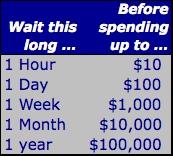
How do you know WHEN something is a ‘major financial decision’ worthy of asking Suzy’s Three Big Questions?

Simple, use this table:

If you’re on a low-to-average income, or still well-entrenched in Making Money 101, then you may want to replace each ‘$1..’ with a ‘$3..’ but, if you’re super well-off, then you just start adding zero’s to the dollar amounts to suit!

But, the ‘default table’, as presented above, is a pretty good place to start …

So, next time you’re walking past a store and see that little $99 ‘number’ on sale that you simply “HAVE to have … and, look … it’s ONLY $99! [squeal]” pull out this little table – that you’ve laminated [ AJC: don’t worry, you’ll wait at least 10 minutes in line at Kinko’s to give yourself plenty of time to decide if the cost of laminating is worth it :)) ] – from your pocket and check to see that you really need to come back in 24 hours to complete the transaction …

… chances are you won’t.

Think about even the small expenses that you may be tracking, if you keep a budget; take a glance down the list for even one or two random days and see how many you would have not bought (or bought less of, or fewer of, or the cheaper one of, etc.) had you taken even 10 minutes ‘time out’?

Is this being frugal [AJC: shock/horror … 7million7years on a frugality drive?] – perhaps, overly so? I don’t think so, because you can still make the purchases that you want to make … it’s just that you may change your mind IF you:

(a) allow a little time out, and

(b) ask yourself Suzy’s 10-10-10 questions.

Instead, you may just end up suffering a little less buyer’s remorse

Does this work?

imagesWell, when the ML Mercedes first came out, I simply HAD to have one of those [squeal] little SUV’s that drives like a car … after some self-imposed ‘time out’, I decided that I really didn’t need the car right now.

Sure enough, the burning desire to buy the car – right then and there – dissipated to the point that I forgot about it; sure enough, a year later the opportunity fell in my lap to buy a factory executive-driven vehicle (genuine … I bought it directly from Mercedes Benz head office), virtually no miles on it, for $11k off the best dealer price that I could get.

Oh, and last week I was hungry … but, after 10 minutes of waiting decided I was even more hungry, so I bought more πŸ˜›

Give it a try and let me know how 10-1-1-1-1 works for you … use the Contact Me form on the About page or just drop me a line at AJC at 7million7years.com, I love hearing from readers (but, not spammers) …

The Power of 10-10-10

10-10-10Suzy Welch, in her new book of the same name, calls 10-10-10 “a life-transforming idea” …

… I don’t know about ‘life-transforming’ but, it’s definitely a simple-yet-powerful decision-making process.

Suzy says:

I call it 10-10-10.

Here’s how it works. Every time I find myself in a situation where there appears to be no solution that will make everyone happy, I ask myself three questions:

What are the consequences of my decision in 10 minutes?

In 10 months?

And in 10 years?

The answers usually tell me what I need to know not only to make the most reasoned move but to explain my choice to the family members, friends, or coworkers who will feel its impact.

I can definitely see how these questions could apply to personal finance: before you make your next major financial decision, take some time out to ask yourself how that decision to [insert financial decision of choice: buy, sell, finance, change, etc.] could affect your life in 10 minutes / 10 months / 10 years.

Chances are that you will change your mind πŸ™‚

Tomorrow, I’ll show you an even more powerful idea that will go hand-in-hand with 10-10-10 to “totally transform” your personal spending habits …

Cash Cascade your car?

community7I often get comments from new readers asking where to start: so, I start from the premise that living frugally and working for 20 to 40 more years to retire on the equivalent of $15,000 today isn’t what you had in mind? If it is, then this blog isn’t for you πŸ™‚

OK, so you’re still reading … great! In that case, the place to start is to work out what you want from your life and how much it will cost you to get it; here is a site that shows you how to work all of that out: http://www.shareyournumber.com/ Visit it (and, join the Community) … not only is this site totally free, I promise that it will be truly Life Changing.

Once you confirm that you do need to make $7 million in 7 years or $3 million in 10 years (or anywhere in between) then you’ll probably want some ‘quick start tips’; well, let’s start with your greatest expense: your house. This post – if you follow all the backlinks – will tell you all you need to know to make sure that your house actually HELPS you get rich(er) quick(er) instead of poorer: http://7million7years.com/2009/01/12/how-much-house-can-you-afford/.

And, if you’re struggling with questions around debt, then this post will totally change the way that you think about ‘good debt and bad debt’: http://7million7years.com/2009/03/25/debt-snowball-debt-shmowball-as-long-as-youre-rich/.

If you’re still with us after that, then sign up for e-mail updates and trawl through the site to see what you can find, just like this guy did …

_______________________

waterfall_over_carI’m glad that some people still rummage through my older posts, as the principles of money don’t age (reference the Richest Man In Babylon, for example) …

… so, I was pleased to have this opportunity to renew this discussion when John commented on this post about cars:

I know it has been over a year since you published this but I was wondering if you could comment on a few calculations I did after reading this post. My disagreement is mostly with the Finance Vs Cash option. The buying a used car part I totally get.

Let’s say I wanted to buy a car with an MSRP of 30,000. If I put 10% money down and get a loan of 27000 for 5 years at let’s say 5% APR. At the end of 5 years I will end up paying 33,571 for the car. If I had paid in cash I would have paid 30,000 for he car. The depreciation on the car would be the same in both cases. So I ended up paying 3,571 more for the car by choosing to finance it instead of paying cash.

But here’s the thing, by financing the car, I also ended up with 27,000 of cash which I can invest elsewhere. To recover the extra 3,571 that I’ll have to pay on interest for the loan, all I need to do is to put this 27,000 in an investment that can give me an APY of 2.52% only, which is not very difficult to find at all.

This suggests that buying with cash, even for a depreciating asset, does not make all that sense. Am I missing something here?

John is basically putting forward the idea of applying Cash Cascade principles to your car … and, given the parameters that he has set, John is absolutely right: it would be better to finance your car and invest the cash elsewhere …

… at least, in principle.

However, in practice, I’m not so sure that the Cash Cascade actually would suggest that you DO finance the car.

Here’s why:

Reason # 1 : It’s unlikely that you will see 5% APR on a auto loan

5% APR car loans are not unheard of, but they are relatively rare; MSN Money cites the current national averages for auto loans as:

National Averages: Low – 3.99% Average – 6.18% High – 10.49%

So, while auto loans as low as roughly 4% (an internet only ‘special’) are available, most are in the 6% – 10% range; and, don’t forget to factor in any added fees!

Of course, you MAY be able to take a 5% HELOC on your house to raise the cash for the car, but I wouldn’t recommend a short-term loan (i.e. a HELOC) for a long-term use (i.e. financing your car over 2 to 5 years) because the bank can change the terms – or even cancel your HELOC – whenever they feel like it. Then you might be stuck with getting a more conventional loan at a higher rate (there goes your 5% loan!).

On the other hand, a refi may do the trick … but, you need to watch both the 25% Income Rule and the closing/refi costs, which are likely to push you well over the 5% if amortized over the expected life of the car loan (you’d be crazy not to have a 2 to 5 year loan payback expectation).

Reason # 2 : It’s likely that you can beat a 5% APR auto loan

This seems to contradict Reason # 1, but doesn’t …

… you see, if you do find a 5% APR loan, it will most likely be offered by an auto dealer. However, the chances are that it comes with a catch: the car isn’t discounted as much as it could be!

A low (or even zero) APR loan is a very common manufacturer / importer / dealer incentive … but, they do a deal with their finance company (often manufacturer-owned, like GMAC) whereby they pay the differential interest rate for you and up front. Back to the catch: they load the price of the car to offset the pre-paid interest component. Sneaky, huh?

Reason # 3 : Even if you can’t beat the 5% APR auto loan you’d better have the cash ready

But, let’s assume that you go to the Pentagon Federal Credit Union for the only 4% APR rate that I could find that wasn’t loaded with fees, and they do give you the loan …

… you had better have the cash ready to buy an investment reasonably quickly.

If you don’t have already have the cash saved up then you should be prepared to save up until you have the lump-sum cash then decide if you want the car only or both the car and the investment. No point borrowing money for the car and trying to save up for an investment … unless, you really, really, really need the car right now! πŸ™‚

… oh, and if you’ve read all the way to here, then you might want see what my 7 Millionaires … In Training! are up to; kind of like American Idol Meets The Apprentice …except it’s online πŸ™‚

Are you carrying expensive debt?

picture-2Sometime ago, I uploaded a video that explains my unique debt repayment strategy – after all, EVERY self-respecting ‘finance guru’ has one these days πŸ˜› –Β  and, I wrote a follow-up post explaining the concept of ‘expensive debt v cheap debt.

Money Funk – and, I thank her for (a) taking the time to run the numbers, and (b) for taking the trouble to write about what she found (in not just one post, but two on her own blog) – says:

Now, read the post and reread the post. It took me a couple times to completely follow. But, I will tell you that I am really glad I did. Why? Well, because it could end up saving me $35,328!

I recommend that you read Money Funk’s post – “and reread the post” – to see how she thought through the numbers …

… but, for those of you – like me – whose eyes glaze over as soon as you see a bunch of numbers with IF’s and THEN’s liberally interspersed, simply think about the whole subject this way:

Take a look at the interest rate on the debt that you are thinking of paying (e.g. 2.5% on a student loan; 5.5% on a mortgage / housing loan; 19% on a credit card debt) and decide whether you would be better off leaving that loan in place and investing the payments that you would have made instead.

– If you could earn 8.5% on that money in the stock market, why wouldn’t you do that?? 8.5% is better than either 2.5% or 5.5%

– Alternatively, if you are thinking of borrowing to buy an investment property, why would you pay off a 2.5% loan just to then take out a 6.5% ‘investment loan’?

Oh, and if you are not thinking of buying an investment property instead of paying down any reasonable, low-cost (eg mortgage or student loan) debt … think again!

– However, if you are carrying a 19% credit card debt, what are you thinking of: pay that sucker off ASAP!

BTW: you may be wondering what the Debt-to-Income-Ratio pie chart on the top of the page has to do with anything?

I ‘lifted’ it off MoneyFunk’s site before she changed the pie chart to this one:

picture-3

Now, I can’t comment on the first version, but I can on this one: even though Motley Fool suggests that it’s OK to carry 15% of your income in servicing ‘bad debt’, the ‘correct’ ratio of bad debt to income is 0% … you should carry NO bad debt.

On the other hand, if you DO currently have ‘bad debt’ (eg consumer loans, car loans, mortgage – this one is in the ‘grey area’ between good/bad debt – or credit cards) then the correct comparison is how much expensive debt you should carry v cheap debt … the answer again, of course, is none.

So, the real comparison is how much cheap debt you should then carry, but that’s a whole other enchilada that I have some of my best people working on for you …

… stay tuned πŸ˜‰

——————————-

This is like the closing credits: the reward for people who don’t leave the movie until the VERY end … or, in this case, actually for people who read the WHOLE post:

I got top billing on a site called “hahagood” … I sincerely hope it’s a foreign-language version of this site and not a Chinese porno site πŸ™‚

DIY Property Management?

tenants-from-hell1Money Monk asks:

“A question about your commercial property: How do you collect rent? Do you use paypal or another source? Do you have a Post Office Box that they send checks to or do you have a property management team do it for you? I only plan to have one properly so a mgmt team may not be necessary.”

I currently have a smaller portfolio of investment property than previously [AJC: unfortunately, I also have a larger portfolio of for-my-own-use residential property than planned or ideal], having sold the ‘jewel in my investing crown’ due to market conditions (then, favorable) upon careful deliberation and finally deciding NOT to be my own developer (the existing property was not the ‘highest and best use of the land’ so somebody needed to develop the land) …

… however, I still use a variety of Property Management teams (paid by ~6% commission on rents collected) for all of my remaining properties; they pay directly into my account (monthly) and send me statements electronically (also monthly).

I recommend that you use property managers once your portfolio gets to a certain size … unfortunately, I have no rules of thumb on this other than that I took this route from the very beginning NEVER managing even my first apartment myself.

However, if – like Money Monk – you only plan to have one or two properties – and, they will be conveniently located (and, you don’t mind calls from the tenant/s) – then managing them yourself can:

(a) save 6% – 10% in Mgt Fees, which may make the difference between a cashflow positive property or one that loses you money, and

(b) provide needed experience to help you oversee the property managers better, if and when your portfolio grows.

Just remember, if you do decide to manage the properties yourself, to STILL build in the property manager’s fee (say 6% to 10%) when doing your acquisition budget, as you are really paying yourself to manage the property.

Also, be aware of burnout … it only takes a few late night phone calls to unclog a blocked toilet before you decide that this “property thing” really isn’t for you, and put your property/s up on the market at a lossΒ  … when what you really mean is that this PROPERTY MANAGEMENT thing isn’t for you, so you should just outsource it …

… lucky you built that extra 6% to 10% into your budget ‘just in case’. huh? πŸ˜‰

The Dean of Wall Street

picture-21

Five Cent Nickel (after inflation, it’s only worth a penny) uses these wise words of Warren Buffett’s teacher/mentor – and the ‘father’ of Value Investing (the art of buying a stock for less than its ‘real’ or ‘intrinsic’ value) to teach us about the value of index funds:

The recommendation to track an index rather than pick stocks may sound somewhat surprising coming from the man who wrote one of the most well-respected books ever written about picking stocks. However, as more and more investors are learning every year, index funds make a lot of sense compared to the alternatives.

5c’s heart is in the right place, but it’s not what Benjamin Graham was suggesting at all; he simply suggested that analysts and untrained investors should invest via Index Funds

… then dedicated his life to teaching others (and, practising what he preached) how to select common stocks that will give better than average results.

The trick is that you need to become a trained investor to do so … it’s a business and like any other business, it requires training, dedication and a certain degree of risk-taking (although, I fail to see how suffering a 15% loss – as I did – while the indexes all lost 50+% is more risky?!).

Phil Town reportedly turned $1,000 into $1,000,000 using Grahamesque ‘value investing/trading’ techniques, and Warren Buffett created a $40+ Billion monolith using similar techniques … and Graham himself made millions. And, studies have shown that this is due to skill, not luck (as is the case for most successful ‘businesses’).

By all means, realize that you don’t have the skills and stick to Index Funds … because, if you DO want to invest in stocks, these experts are telling you that you MUST first acquire the skills.

Three … well, four questions to ask when picking a financial adviser …

picture-23I love those articles that the mainstream financial press likes to trot out from time to time, such as this Wall Street Journal piece that offers Seven Questions to Ask When Picking a Financial Adviser; you will have to read the article for the full story (literally!) but here is their list:

1. What’s in the adviser’s background?
2. What do the adviser’s clients say?
3. How does the adviser get paid?
4. Where are the adviser’s checks and balances?
5. What’s the adviser’s track record?
6. Can the adviser put it in writing?
7. What do other pros think?

Personally I could care less how an adviser gets paid (as long as I know up front) and whether they can write or not … and, I certainly don’t care what the their clients or peers think, because I am always looking for above-the-herd results. And, track records and supposed checks and balances mean nothing when there is a long line of Madoff-wannabes in this world (so, I ain’t handing over the keys to my check account to anybody!) …

… I only want to know three (actually, four) things:

1. How much is the ‘adviser’ worth today?

I only want to take advice [AJC: commercial, money-making advice … not ‘technical’ advice such as tax codes, appropriate legal entities, contract wording, etc.] from people who are already well ahead of me. When I start to catch up to my adviser’s net worth, it’s time to find a new adviser!

2. What does the adviser invest in?

I only want to take advice [AJC: yadda yadda, yadda … as above] from somebody who has made the bulk of their current net worth in exactly what they are advising me to invest in.

3. Will her advice get me to my Number?

Can the adviser then show me – in a way that I can understand (no smokes and mirrors) – exactly how what she invested in to get to her current net worth will get me to my Number by my Date [AJC: apply this reasonableness test to the investment mix that she is recommending]?

Then there’s a fourth question, but it’s for me to answer, not her:

4. Is it something that I love, understand, and feel comfortable doing?

Because, once the adviser has finished dispensing her advice, and you have handed over your money for her fees/commissions, despite what anybody may tell you to the contrary, it’s all up to you!